Florida property owners usually start thinking about battery storage after a familiar one-two punch. The first is a utility bill that feels harder to predict. The second is a storm warning, followed by the question nobody likes asking at the last minute: what happens if the grid goes down for longer than expected?
That's why battery storage for solar has become a practical planning topic in Florida, not a niche upgrade for early adopters. For homeowners, it can mean keeping essential circuits running when the utility is offline. For commercial buildings, it can mean better control over when solar power gets used, when it gets stored, and when it offsets expensive consumption from the grid.
The important part is this. A battery isn't automatically a smart investment just because it sounds modern. In Florida, the right answer depends on your outage risk, your load profile, your building type, and how your utility bill is structured. Good planning matters more than marketing.
Why Now Is The Time For Battery Storage In Florida
A lot of Florida owners already understand solar panels. The missing piece is what happens after the sun goes down, or when a hurricane leaves the neighborhood without utility power. Solar alone can lower daytime grid use. Solar with battery storage can give you more control over when that solar energy is used.

Florida Owners Want More Than Bill Savings
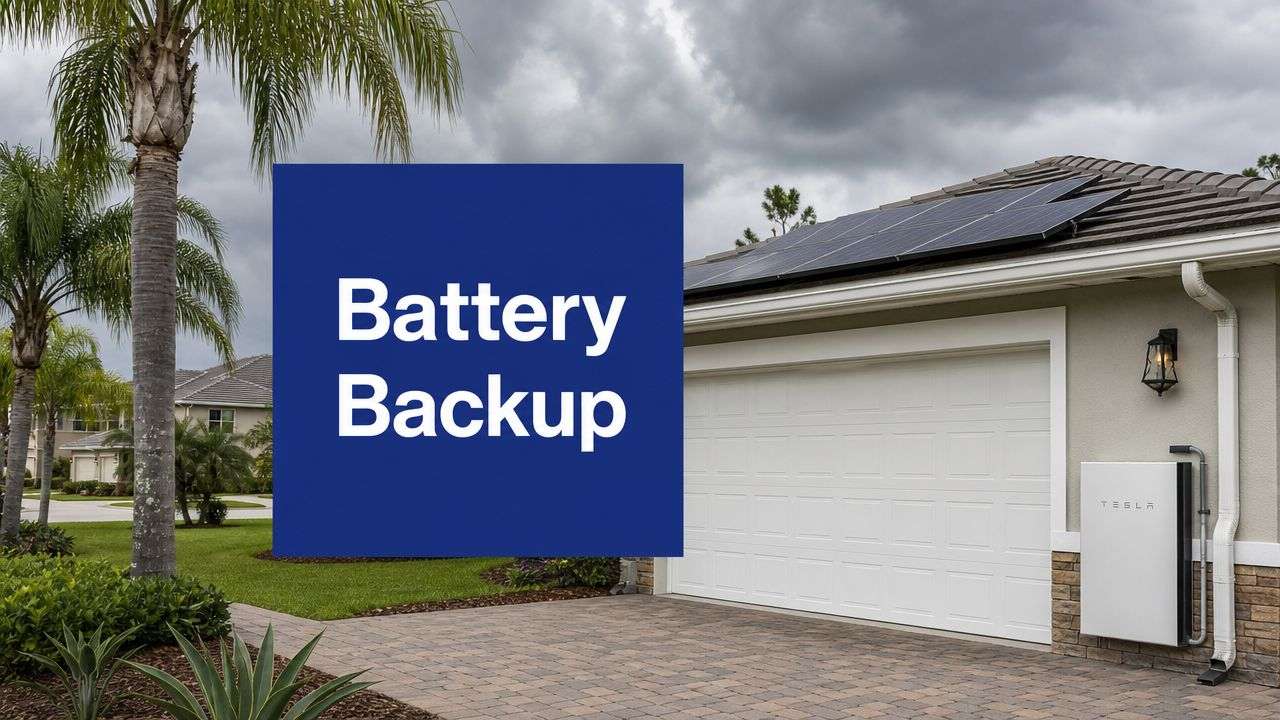
In Florida, resilience changes the conversation. A battery can support refrigeration, communications, lighting, security systems, internet equipment, gate access, and selected HVAC loads during outages. For some properties, that's a convenience issue. For others, it's business continuity or health protection.
Batteries also help solve a timing problem. Solar production is strongest during the day. Many homes and buildings need more power later, when occupants return, cooling loads remain high, and the sun is fading. Battery storage lets you hold some of that daytime production for later use instead of treating all solar as immediate-use power only.
Practical rule: If your main concern is “How do I keep key equipment running when the grid is out?” you're already asking a battery question, not just a solar question.
Storage Has Moved Into The Mainstream
This isn't a fringe market anymore. The global solar energy storage market was estimated at USD 86.8 billion in 2025 and is projected to reach USD 423.2 billion by 2035, with the residential segment holding 81.5% in 2025 according to Global Market Insights solar energy storage market data. That tells you homeowners are no longer treating batteries as an exotic add-on. They're increasingly planning for them from the beginning.
For Florida owners, that shift matters because it changes how systems get designed and financed. A battery can influence panel layout, inverter selection, critical-load strategy, and how you evaluate backup expectations during storm season. If you're comparing options for solar battery backup for power outages, you're looking at a category that has become part of standard solar planning rather than an afterthought.
Why Timing Matters In Florida
Waiting until after a major outage usually leads to rushed decisions. Better results come from planning before you need the system. That gives you time to answer questions:
- What must stay on: Refrigerator, medical equipment, well pump, server rack, security system, or selected air conditioning.
- What can wait: Pool equipment, EV charging, decorative lighting, or nonessential receptacles.
- What are you buying: Lower bills, outage protection, operational continuity, or a combination.
Florida's weather makes those distinctions more than theoretical. When the grid is stable, storage can improve energy management. When the grid is unstable, it can protect how your property functions.
Beyond The Panels How Solar Battery Storage Works
The easiest way to understand battery storage for solar is by considering it an energy savings account. Your solar panels generate electricity during the day. If your property doesn't need all of it at that moment, a battery can store some of the extra energy so you can use it later.
That's the big idea. The rest is just how the equipment moves electricity safely and intelligently.

The Four Parts Most Owners Need To Understand
A typical solar-plus-storage system has a few core pieces:
- Solar panels: These are the generators. They produce electricity when sunlight hits them.
- Inverter: This is the translator and traffic manager. It converts power into a form your home or building can use and directs where that power should go.
- Battery: This is the storage bank. It holds energy for later.
- Electrical panel: It supplies power to your building for lights, appliances, equipment, and circuits.
If you like financial analogies, the panels are your income, the battery is your savings account, the inverter is the banker moving funds around, and the electrical panel is where spending happens.
What Happens During A Normal Florida Day
On a sunny day, your panels produce electricity first. Your building uses what it needs in real time. If solar production is higher than the immediate demand, the system can charge the battery.
Later in the evening, when solar production drops, the battery can discharge and power selected loads. That means you may rely less on the grid during those hours. For a business, this can support smoother energy use across the day. For a home, it often means using your own stored solar energy after sunset rather than immediately switching back to utility power.
A well-designed system doesn't just make electricity. It decides when to use it, when to store it, and which loads matter most.
What Changes During An Outage
A standard grid-tied solar system usually won't keep running during an outage unless it was specifically designed to do so with battery support and the right controls, a point that often confuses many Florida owners. That shutdown is a safety feature.
With storage and backup capability, the system can isolate from the grid and continue serving selected circuits. The key phrase is selected circuits. Most systems are not designed to run every load in a building indefinitely. They're designed around priorities.
Common backup priorities in Florida include:
- Food and medicine protection: Refrigerators, freezers, and medical refrigeration.
- Basic livability: Lighting, outlets for phones, internet gear, and ceiling fans.
- Property protection: Security systems, sump or lift equipment where relevant, gates, and alarms.
- Targeted comfort: A bedroom mini-split, part of a central HVAC system, or another limited cooling strategy.
Smart Controls Matter More Than Most People Realize
Modern storage systems don't charge and discharge blindly. They can be programmed around your goals. Some owners want the battery kept full for outage readiness during storm season. Others want daily cycling to reduce grid purchases in the evening. Commercial properties may prioritize demand management or critical operations first.
That control layer is why two systems with similar hardware can perform very differently. The battery isn't just a box on the wall. It's part of a decision-making system about energy flow.
The Heart Of The System Comparing Battery Chemistries
When owners compare batteries, they often focus on brand first. A better starting point is chemistry. The chemistry affects safety profile, temperature behavior, energy density, and how the battery fits a Florida property.
For most residential and light commercial conversations, the two chemistries you'll hear most often are Lithium Iron Phosphate (LFP) and Nickel Manganese Cobalt (NMC). Both are used in modern energy storage. They are not interchangeable in practice.

Why Florida Heat Changes The Discussion
Florida isn't a mild-climate market. Heat, humidity, enclosed equipment rooms, garage installations, and storm-related operating stress all shape what makes sense. In that context, many owners and consultants pay close attention to thermal behavior and safety characteristics.
LFP is often favored where safety and thermal stability carry extra weight. NMC is often discussed where compact size and higher energy density are attractive. Neither label tells you whether a product is right for your building. It just tells you what tradeoffs to examine more carefully.
LFP Versus NMC In Plain Language
Here's the practical distinction many owners care about:
- LFP often appeals to cautious buyers: It's commonly chosen when long-term durability and thermal stability are high priorities.
- NMC often appeals where space is tight: It can offer higher energy density, which means more energy in a smaller physical footprint.
- Real-world suitability depends on the full system: Enclosure design, ventilation, controls, certifications, and installation quality matter alongside chemistry.
If your battery will sit in a Florida garage, mechanical room, or exposed service area, you should ask detailed questions about temperature management and operating conditions. Chemistry is one part of that answer, not the whole answer.
Decision lens: Don't ask which chemistry is “best.” Ask which chemistry fits your risk tolerance, space constraints, and backup goals.
Questions Worth Asking Before You Choose
A useful chemistry comparison usually sounds like this:
Safety And Thermal Stability
How does the product behave under heat stress? What certifications does the full system carry? What protections are built into the battery management system?
Space And Layout
Do you need a compact wall-mounted unit, a floor-mounted cabinet, or a larger commercial enclosure? On some Florida properties, available installation space narrows your options quickly.
Intended Use Pattern
Will the battery sit mostly reserved for outages, or will it cycle frequently as part of daily energy management? The answer influences how you think about long-term wear and operating strategy.
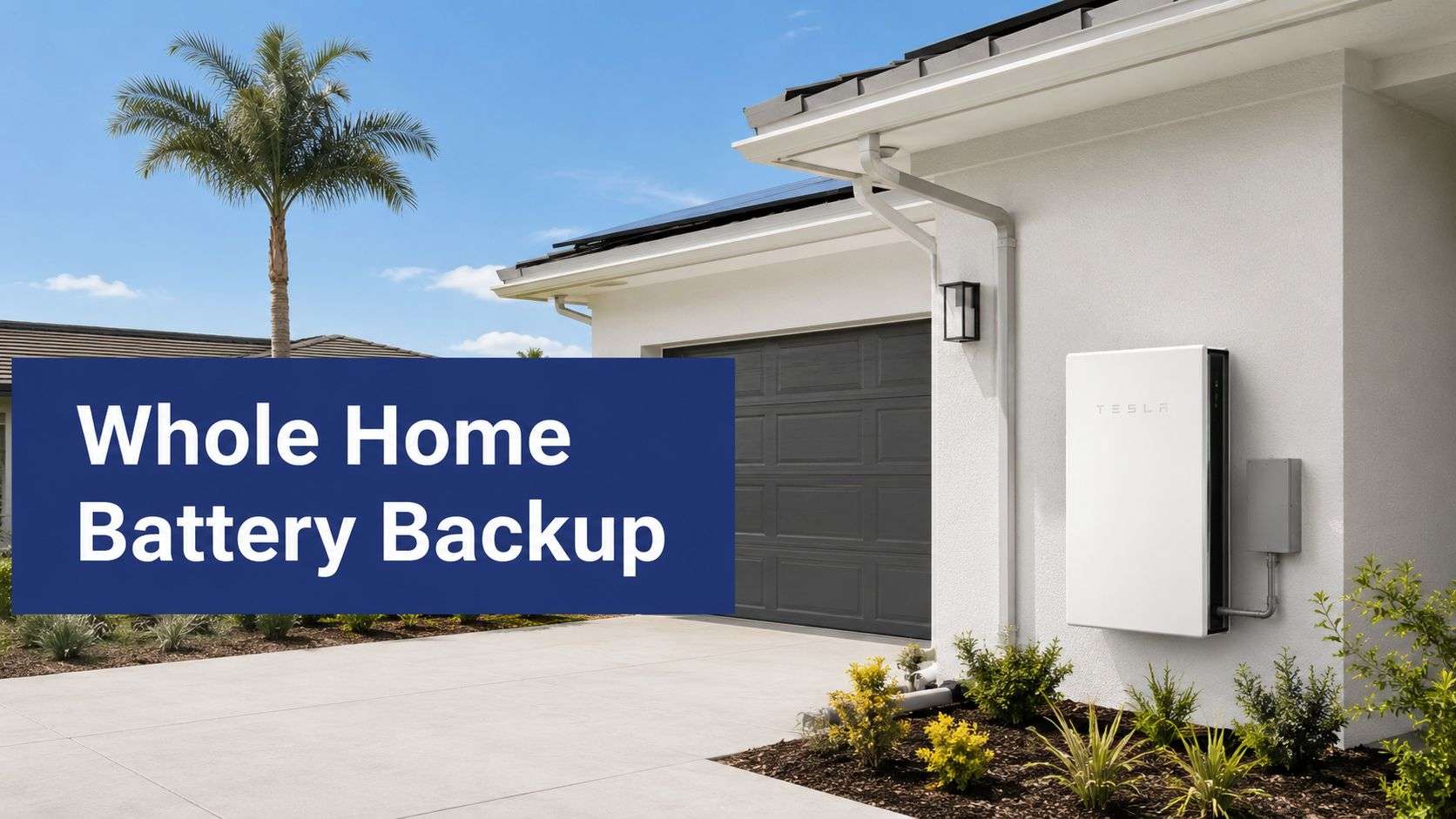
For owners reviewing branded options such as Tesla battery storage systems, it helps to compare not just the name on the product but the chemistry, operating limits, integration approach, and service model behind it.
Don't Reduce The Decision To A Spec Sheet
Spec sheets matter, but they don't tell the whole story. A battery that looks great on paper can be a poor fit if the enclosure location runs hot, the backup panel design is sloppy, or the owner expects whole-home performance from a selective-load system.
The best chemistry decision usually comes from matching the battery to the property. In Florida, that means looking hard at installation environment, resilience expectations, and how much complexity you want to manage over the life of the system.
Designing Your Energy Future Sizing And System Planning
Often, the wrong question is asked: “How much battery do I need?” The better question is, “What do I want the battery to do?”
That distinction changes everything. A battery designed for overnight self-consumption is not the same as a battery designed to ride through storm outages. A commercial battery used to manage building loads follows a different logic than a residential backup battery protecting a refrigerator and a few rooms.

Start With Function Not Capacity
A consultant-led sizing process usually begins with priorities, not equipment. Florida owners tend to fall into one or more of these buckets:
- Backup-focused owners: They care most about what stays on during an outage.
- Bill-management owners: They want to shift solar energy into higher-value hours.
- Mixed-goal owners: They want both resilience and better energy control.
- Operational users: Businesses may need storage to support continuity, refrigeration, data systems, or tenant-facing operations.
Those goals shape the battery size, inverter configuration, and whether you build a critical-load subpanel or support a broader portion of the building.
The Critical Load Audit
For Florida homes, this is often the most revealing exercise. Instead of listing every appliance, list what you can't lose during a grid outage.
A practical audit might include:
- Life and safety loads: Medical devices, oxygen equipment, critical refrigeration, security systems.
- Food and sanitation loads: Kitchen refrigeration, water treatment, well pump, garage access.
- Communications and work loads: Internet, modem, router, a few device chargers, office circuit.
- Selective cooling: Not “the whole house,” but one area where people can safely sleep and recover.
This process often resets expectations in a good way. Some owners realize they don't need to back up the entire property. Others discover one hidden load, such as a pump or server closet, drives the design.
A battery plan gets better when you stop thinking in terms of square footage and start thinking in terms of circuits.
Residential Planning Versus Commercial Planning
Commercial and industrial projects require a different level of analysis. For those properties, battery sizing is determined through a 15-minute interval review of PV generation and facility demand to identify average daily solar surplus. The battery's usable capacity is then typically sized to capture about 80 to 100 percent of that surplus, with depth-of-discharge limits taken into account, as described in this commercial and industrial battery sizing guidance.
That same guidance explains an important point many buyers miss. Usable capacity and nameplate capacity aren't the same thing. Because batteries are usually operated within depth-of-discharge limits, the portion you can routinely use is often only 80 to 90 percent of the stated nameplate capacity. In practical terms, a facility targeting about 1,200 kWh of average daily surplus may need roughly 1,000 kWh of usable storage rather than 1,200 kWh of nameplate capacity.
Three Planning Mistakes Florida Owners Make
Oversizing For Rare Events
Some owners design around the absolute worst outage scenario and end up buying more battery than they'll regularly use. Resilience matters, but the system still needs to make operational and financial sense the rest of the year.
Ignoring Air Conditioning Reality
Cooling is one of the biggest Florida planning issues. Running all air conditioning loads on battery backup can require a very different system than backing up essential circuits plus one comfort zone. Good design means deciding what comfort level is necessary, not assuming the battery should do everything.
Skipping Load Data
Residential owners sometimes rely on rough guesses. Commercial owners sometimes rely on monthly bills alone. Neither approach is enough. If you want a useful storage design, start with actual consumption patterns. If you're working through how to size a solar system, load data should drive the answer, not showroom assumptions.
Investing In Resilience Costs ROI And Florida Incentives
Battery decisions get distorted when owners look only at purchase price. The right question is broader: what value does the system create over time, and in what form?
For a Florida property, that value may come from avoided utility purchases during certain hours, better use of on-site solar production, reduced business interruption risk, and protection of essentials during outages. Those benefits don't all show up on one monthly bill line item, which is why storage ROI needs a wider lens than a simple payback conversation.
What You're Actually Buying
A storage project usually includes more than the battery itself. The full investment can involve the inverter strategy, controls, backup panel work, electrical upgrades, mounting location, permitting coordination, and commissioning. If a proposal looks cheap, check what has been left out.
For homeowners, one common mistake is comparing battery quotes as if they were appliance prices. They aren't. The comparison should be system-to-system. A lower-cost proposal with weak backup planning may produce less practical value than a more carefully engineered design.
ROI In Florida Usually Has Multiple Layers
Owners often expect a battery to justify itself through one obvious savings number. That's not how many Florida projects work. Storage value often comes from a combination of outcomes:
- Backup value: You avoid the cost and disruption of losing refrigeration, internet, security, gate access, or critical operations.
- Energy timing value: You use more of your own solar energy later in the day instead of depending entirely on the grid after sunset.
- Operational value: Businesses may protect tenant experience, maintain equipment uptime, or keep selected services running during outages.
- Planning value: A battery can support a more resilient long-term energy strategy rather than functioning as an isolated hardware purchase.
Some properties see storage mainly as resilience insurance. Others use it as an active part of energy management. Both can be valid. The mistake is assuming every battery should pencil out the same way.
If you only measure battery value by monthly bill reduction, you can miss the reason the system matters most during a Florida storm.
Incentives And Policy Need Careful Review
Federal incentives can materially affect project economics, but owners should confirm current eligibility and structure before making assumptions. Florida utility policy also matters because battery value depends partly on how solar production is credited, when your building uses power, and how much of your solar energy you want to keep on site versus send outward.
That's one reason policy should be part of the analysis, not a footnote. A storage decision made without reviewing incentive treatment, utility billing structure, and operational goals is incomplete. If you're evaluating current Florida solar incentives, treat that review as part of system design, not just tax-season cleanup.
A Better Way To Think About Payback
Simple payback has its place, but it can be too narrow for storage. A stronger decision framework asks:
- What outage losses are you trying to prevent?
- Which loads must remain powered, and for how long?
- How much solar energy do you want to shift into later hours?
- Will the battery mostly sit in reserve, or cycle regularly?
- Does this improve tenant confidence, livability, or building function?
For Florida owners, battery storage for solar often makes the most sense when you value both economics and resilience together. If you insist that it behave like a basic commodity purchase, you'll likely misread its purpose.
Navigating The Process Permitting Safety And Maintenance
A good battery project feels orderly. A bad one feels rushed, vague, and full of assumptions. Florida owners should expect a defined path from design review to commissioning, with clear safety decisions at each step.
That matters because storage equipment isn't just another electrical accessory. It becomes part of your building's power architecture. The planning, placement, protection, and inspection process all affect long-term performance.
What The Process Usually Looks Like
The sequence often follows a predictable pattern:
- Feasibility review: Load profile, outage priorities, site conditions, and equipment options are evaluated.
- System design: The team determines battery placement, inverter approach, backed-up circuits, and integration details.
- Permitting and approvals: Local jurisdiction review, utility coordination where required, and code compliance documentation are prepared.
- Installation and commissioning: Equipment is installed, tested, configured, and verified under operating conditions.
In Florida, local permitting details can vary by municipality and utility territory. That's normal. What shouldn't vary is the discipline of the process.
Safety Is A Design Issue Not A Sales Brochure
Owners should ask direct questions about listing, certification, enclosure suitability, disconnects, ventilation, and shutdown behavior. Terms like UL 9540 matter because they point to system-level safety evaluation, not just isolated components.
Fire protection planning also deserves attention. In larger facilities or equipment areas where suppression strategy is part of a broader risk review, it can help to understand specialized suppression approaches such as Knight Tek Suppressit, especially when discussing how battery-adjacent hazards are managed within a building safety plan.
A battery system should be easy to live with because it was hard to design properly.
Maintenance Is Usually Light But Not Zero
Modern battery systems are often marketed as low maintenance, and that's generally fair. Still, “low maintenance” doesn't mean “ignore it for years.” Owners should expect periodic checks of monitoring data, physical condition, firmware status, and any warning alerts.
For commercial properties, maintenance discipline is even more important because multiple stakeholders may depend on the system. A battery that supports tenant operations or critical equipment should be treated as an operational asset, not a decorative upgrade.
What Good Ownership Looks Like
Strong ownership usually includes:
- Monitoring access: Someone should know how to read the platform and recognize abnormal behavior.
- Clear backup expectations: Occupants should understand which loads are backed up and which are not.
- Document retention: Keep permits, one-lines, product documentation, and commissioning records accessible.
- Service pathway: Know who handles troubleshooting, software issues, and equipment coordination if problems appear.
Battery systems can be straightforward to own when the design is thoughtful and the documentation is clean. Most headaches come from confusion created at the beginning.
Making A Data-Driven Decision The Role Of A Solar Consultant
Battery storage has crossed into the mainstream. In 2025, battery energy stationary storage installations in the U.S. surpassed 57 GWh / 28 GW, and California, Texas, and Arizona represented 74% of installed capacity, according to the SEIA Energy Storage Market Outlook Q1 2026 summary. That level of deployment matters because it means the industry now has established hardware categories, procurement patterns, and design practices. It also means buyers face more complexity, not less.
For a Florida owner, the challenge isn't whether storage is real. It's how to choose the right configuration before you're locked into a proposal. Installers sell equipment and installation services. A consultant works from the owner's side of the table and tests whether the system matches the objective.
Why Independent Review Matters
A battery proposal can look polished and still miss the mark. It may oversell whole-home backup, underspecify cooling loads, ignore utility bill structure, or recommend a product that doesn't fit the site conditions. An independent consultant can model loads, compare options, and pressure-test assumptions before procurement moves forward.
That role is similar to the role of a general contractor in a broader building project. Someone has to coordinate competing priorities, evaluate scope, and make sure the finished result aligns with the owner's goals rather than just the supplier's product list.
What A Consultant Actually Does
A consultant typically helps with:
- Feasibility studies: Can storage support your goals on this property?
- Financial modeling: Does the investment make sense under realistic operating assumptions?
- Load and backup planning: Which circuits matter most, and how should they be prioritized?
- Procurement support: Are the proposed products, warranties, and designs consistent with the intended use case?
If you want owner-side guidance before choosing equipment, independent solar consultant services are designed for that step. Solar Energy Management LLC provides feasibility, ROI modeling, battery storage planning, and design guidance for Florida projects before clients commit to an installer.
The Better Question At The End
The final decision usually isn't “Should I buy a battery?” It's “What kind of energy control and resilience strategy makes sense for this property in Florida?”
That's a better question because it reflects reality. Batteries aren't magic. They're tools. Used well, they can make a home or building more resilient, more predictable, and more strategic in how it uses solar power. Used poorly, they can become an expensive mismatch between expectation and performance.
If you're weighing battery storage for solar in Florida and want a decision based on load data, outage priorities, and financial modeling, Solar Energy Management LLC can help you evaluate the options before you commit to a system.