Your electric bill keeps climbing, summer demand is punishing, and every proposal on your desk promises savings. One vendor says upgrade controls. Another says add batteries. A third jumps straight to rooftop solar. If you're managing a Florida commercial property, that mix of advice usually creates more noise than clarity.
A commercial energy audit cuts through that noise. Done properly, it tells you how the building behaves, which loads matter most, what can be fixed first, and whether solar plus storage will perform the way a spreadsheet says it should. In Florida, that's more than an efficiency exercise. It's the first serious step toward lower operating costs, outage planning, and energy independence.
What a Commercial Energy Audit Reveals About Your Building
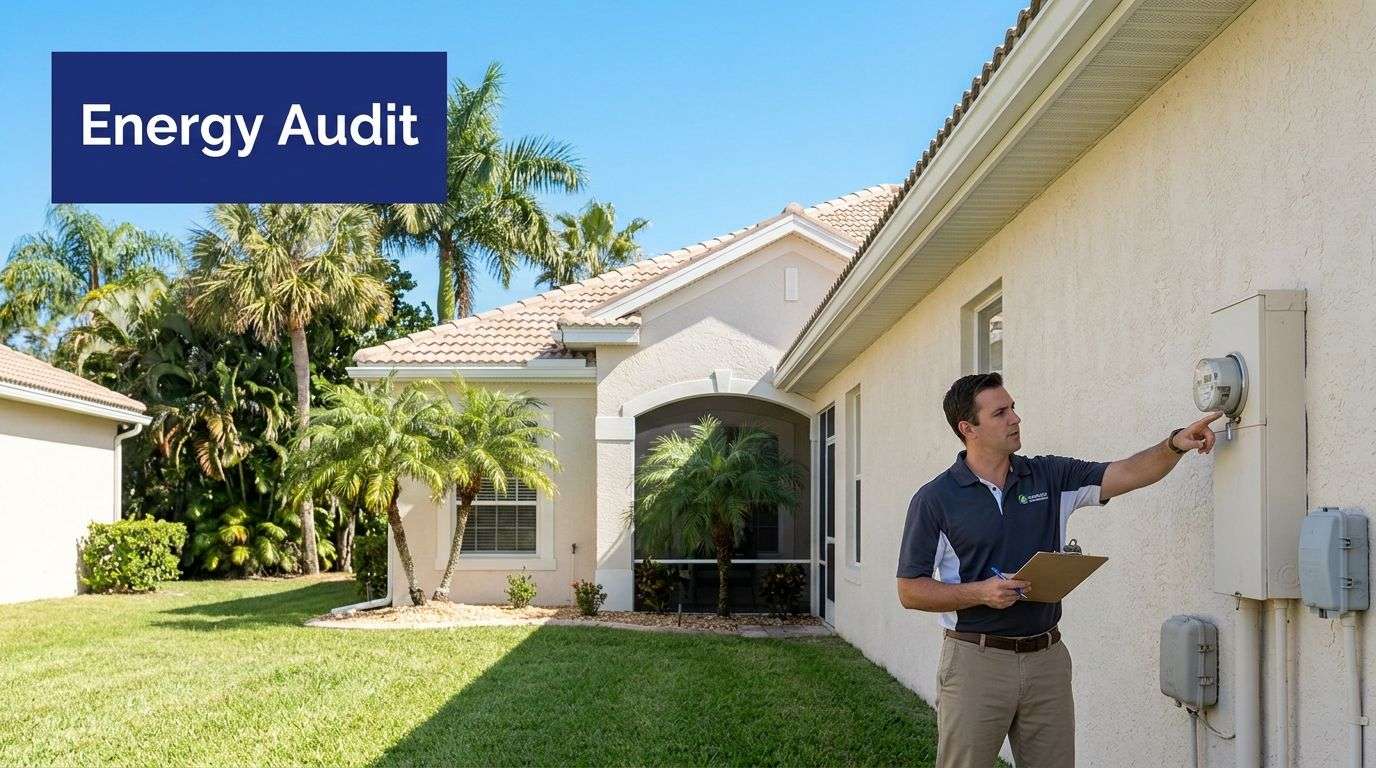
Think of a commercial energy audit as a building physical. A routine inspection might tell you something looks off. A real audit diagnoses why it's happening, how different systems interact, and which corrections will produce useful financial results.

In practice, the audit starts with the obvious symptoms. High utility bills, hot and cold complaints, lights left on, equipment running after hours, and spaces that never seem comfortable. But those symptoms rarely point to a single cause. An auditor looks at HVAC schedules, lighting controls, envelope conditions, operating hours, and how people use the space.
What The Audit Looks For
A useful audit maps where your energy dollars are going. That usually includes:
- Base building loads: HVAC, ventilation, pumps, lighting, and domestic hot water.
- Operational loads: Refrigeration, kitchen equipment, process equipment, server rooms, or tenant-specific demands.
- Schedule mismatches: Systems running when the building is lightly occupied or empty.
- Control failures: Sensors, thermostats, timers, and building automation sequences that no longer match current operations.
- Hidden interactions: One change in ventilation, cooling, or lighting that affects another part of the building.
For Florida businesses, load timing matters as much as load size. Cooling demand often drives the story, especially in long warm seasons and shoulder months when buildings still carry air conditioning loads even when staff assume demand should be lower.
Practical rule: If a building owner can't explain when the highest loads occur and which systems cause them, they're not ready to size solar or battery storage accurately.
Why This Matters Before Solar
A generic solar proposal usually starts with annual utility consumption. That isn't enough. A smart solar plan needs building-level context. If the audit finds waste that can be corrected first, then the solar system can be sized around the improved load, not the inefficient one.
That difference affects panel count, battery strategy, and financial modeling. It also affects whether your project offsets the right parts of your bill. For businesses looking for practical ways to reduce costs before or alongside generation, this guide on lowering an electric bill in Florida is a useful companion.
Operators in high-throughput environments already understand this. In sectors like food service, process discipline and energy discipline often overlap. That's one reason examples of sustainable fast food operations are worth studying. They show how equipment schedules, peak demand habits, and operational consistency shape energy performance long before solar enters the picture.
Choosing Your Depth The ASHRAE Audit Levels
Not every building needs the same level of analysis. Some owners need a fast reality check. Others need engineering detail strong enough to support a capital request, financing discussion, or solar-storage design. That's where the ASHRAE audit framework helps.

The Quick Screen
Before the formal levels, many projects start with a simple walk-through. This isn't the final answer. It's a scoping move. The consultant tours the facility, reviews basic utility history, identifies obvious operational issues, and flags whether the site needs a lighter or deeper study.
That early pass is useful when the building has never been assessed, when ownership inherited operating problems, or when the facility team suspects waste but can't yet isolate it.
Level I For Baselines And Obvious Opportunities
A Level I audit works well when you need a clear baseline. It combines a site review with utility analysis and identifies practical improvements without deep engineering. For many offices, retail sites, mixed-use properties, and straightforward commercial facilities, that's enough to expose low-friction actions.
A Level I usually answers questions like these:
- Where is the building wasting energy most visibly
- Which low-cost corrections should happen first
- Are schedules, controls, and maintenance driving avoidable costs
- Does the property need a deeper study before major spending
This level is often the right starting point when management wants direction, not a full investment package.
Level II For Serious Decision-Making
A Level II audit is where the work becomes decision-grade. The consultant gathers more detailed operating data, reviews how individual systems perform, and builds a stronger case for specific measures. This is the level I usually recommend when a Florida business is considering solar, battery storage, major HVAC changes, or a staged efficiency plan.
Level II is the bridge between "we think there's waste" and "here's how to allocate capital."
It typically helps answer:
- What is the building's load profile over time
- Which measures should be implemented before solar
- How do HVAC, controls, lighting, and occupancy patterns interact
- What critical loads should be protected during outages
- What project sequence creates the strongest operational result
If you're evaluating solar generation as part of a broader strategy, a solar power feasibility study becomes much stronger when it's built on Level II audit data instead of rough utility averages.
The more complex the building, the more expensive guesswork becomes.
Level III For Capital Projects That Must Perform
A Level III audit is an investment-grade study. This is for large portfolios, industrial properties, critical facilities, or projects where financing, resilience, and engineering precision all need to align. It supports major capital planning and leaves less room for assumptions.
Use it when you're dealing with any of the following:
- Critical continuity requirements: Data rooms, refrigeration, healthcare functions, or other loads that can't ride through an outage.
- Complex tariff exposure: Demand-sensitive bills, multiple meters, or layered usage patterns.
- Large equipment replacement decisions: Chillers, plant upgrades, major reroofing tied to solar, or campus-level resilience planning.
The trade-off is simple. Lower audit levels cost less and move faster, but they leave more uncertainty. Higher levels require more time and more building access, but they give owners better inputs for procurement, phasing, and financial planning.
From Audit Data to a Bulletproof Solar and Storage Plan
Many commercial projects falter when the business obtains a solar proposal based on past bills, broad assumptions about operating hours, and a generic battery concept. The design might look clean on paper, but it hasn't been tested against how the building uses power.

Why Utility Bills Alone Aren't Enough
Utility bills tell you the total. They don't tell you the full shape of the problem. They won't show whether a property has avoidable morning spikes, late-night HVAC drift, weekend waste, or a handful of critical circuits that deserve battery support while everything else can remain grid-dependent.
For solar in Florida, those details matter. Cooling-heavy buildings can look attractive for solar because daytime loads often align with solar production. But if the audit shows that the largest financial pain comes from short demand spikes, poor controls, or after-hours operation, then panels alone may not solve what ownership cares about.
A strong plan uses audit data to sort three separate questions:
- What should be reduced first
- What should be offset with solar
- What should be protected with storage
The Inputs That Improve Solar Modeling
The best solar and storage models use more than annual consumption. They use operating schedules, load shape, equipment inventory, roof constraints, outage priorities, and expected future changes in occupancy or production.
That changes the design conversation from "How many panels fit?" to "What system supports the business?"
Here are the inputs that make the difference:
- Load timing: When the building uses power, not just how much.
- Critical load identification: Which circuits must stay up during a grid outage.
- Efficiency-first adjustments: Loads that can be reduced before generation is sized.
- Seasonal operating behavior: Florida businesses often run very differently across cooling seasons, tourist cycles, or school calendars.
- Site limitations: Roof condition, shading, electrical interconnection realities, and space for battery equipment.
A battery that backs up the wrong loads is expensive insurance. A battery designed around audited critical loads becomes an operating asset.
What Works And What Usually Doesn't
What works is an audit-first process where efficiency and generation are designed together. What doesn't work is sizing a system around waste, then hoping future operational improvements won't distort the return.
A resilient solar project in Florida also needs outage logic. If the goal is continuity during storms, the design has to define what remains powered, for how long, and under what operating conditions. That's much more precise than saying the building has "backup power."
For businesses exploring a combined strategy, commercial solar battery storage is where the audit findings become site-specific design criteria. In that context, firms like Solar Energy Management LLC can be part of the process by providing feasibility analysis, financial modeling, storage planning, and design guidance before equipment procurement begins.
The Real Value Of The Audit-First Approach
The audit doesn't compete with solar. It protects the solar investment. It helps owners avoid oversized systems, weak battery strategies, and disappointing economics caused by bad assumptions.
When the audit is done well, the solar model becomes more credible because it reflects the building's improved and intended operating state, not its current mess.
Understanding Audit Costs Payback Periods and Deliverables
Owners usually ask two fair questions. What will the audit cost, and what do we receive for that spend?
Because project scope, building complexity, metering access, and analysis depth vary widely, audit pricing is best discussed as a scoped professional service rather than a commodity. A small, simple property may only need a baseline assessment. A multi-tenant or operationally complex facility may need a much deeper engagement. The mistake is trying to buy the cheapest report instead of the right decision tool.
What You're Paying For
An audit fee isn't just paying for a walk-through. It pays for diagnostic work, review of utility history, system analysis, operating interviews, measure development, and the judgment required to separate meaningful fixes from cosmetic ones.
A solid deliverable package usually includes:
- Executive summary: The main findings, priority issues, and recommended next steps.
- Building and system observations: Notes on HVAC, lighting, controls, envelope, and operational practices.
- Energy conservation measures: A list of recommended actions with implementation logic.
- Project sequencing guidance: Which items should happen immediately, which require capital planning, and which should wait until after other changes.
- Solar and storage implications: Whether current load conditions support a generation project as-is or whether efficiency corrections should come first.
A Practical Payback Example
Take a mid-sized Florida commercial building with aging cooling equipment, uneven scheduling, and a management team considering rooftop solar plus battery backup. If the audit identifies poor scheduling, simultaneous heating and cooling in some zones, or ventilation settings that no longer match occupancy, those corrections can reduce waste before the solar model is built.
The payback for the audit then comes from two places. First, implemented operational fixes can lower avoidable energy costs. Second, the audit can improve project sizing and reduce the risk of buying the wrong solar-storage package. In real-world decision-making, that second benefit is often underestimated.
A weak audit report gives you a list. A strong one helps finance, operations, and ownership agree on what to do next.
Field note: The report should be specific enough that another qualified party could use it to price and implement the recommended work without guessing what the consultant meant.
If the building will likely move into a funded solar project, the audit should also support conversations around commercial solar financing. Lenders and internal decision-makers both respond better when the load assumptions behind the project are transparent.
Leveraging Florida Incentives and Building for Resilience
Florida businesses have two reasons to treat a commercial energy audit as strategic. The first is financial. The second is resilience. If you only focus on utility savings, you miss half the value.

Incentives Start With Good Project Definition
Florida solar projects often involve a mix of tax treatment, depreciation considerations, and program-specific opportunities that depend on the property type and ownership structure. An audit helps define the project cleanly enough for those discussions to be productive.
That matters because incentives don't rescue a poorly scoped project. They improve a well-scoped one.
A practical audit will document the conditions that shape incentive use:
- Eligible improvement categories: Whether the project includes efficiency work, solar generation, storage, or a combined scope.
- Ownership structure: Tax appetite, lease considerations, and who can claim available benefits.
- Site readiness: Electrical, roof, and operational factors that affect whether the project can move on schedule.
- Critical load strategy: Especially relevant when resilience is part of the justification.
For a current overview of programs and planning considerations, Florida businesses should review Florida solar incentive guidance.
Resilience Is A Design Question, Not A Marketing Phrase
Storm season changes the conversation. For many Florida businesses, the issue isn't only how to reduce the bill. It's how to keep operating when the grid is unstable or unavailable.
An audit helps owners identify critical loads before they buy storage. That means separating essential functions from convenience loads. Refrigeration, point-of-sale equipment, communications, security systems, limited cooling, pumps, or server equipment may all matter. Lobby lighting and every nonessential receptacle usually don't need to ride through an outage.
That distinction affects battery size, panel configuration, transfer strategy, and operational expectations.
The Florida-Specific Advantage
In Florida, solar production and daytime cooling demand often align in useful ways. That can support strong on-site consumption during normal operations. But resilience planning adds another layer. During an outage, the building needs a controlled load plan, not just generation.
Use the audit to answer these resilience questions:
- What absolutely must stay on
- Which loads can be shed immediately
- How will staff operate the building under outage conditions
- What is the sequence for normal operation versus emergency mode
When owners define those answers early, the solar plus storage design becomes tighter, more defensible, and easier to operate under stress.
Finding Your Consultant and Preparing for the Audit
The quality of the audit depends heavily on who performs it. If the person evaluating the building is mainly trying to sell a predefined equipment package, the analysis can get pulled toward the product instead of the facility's real needs. That's why many owners prefer an independent consultant who can evaluate efficiency, solar, and storage options without tying the outcome to a single installation path.
What To Look For In A Consultant
Choose a consultant who understands commercial building systems and can translate technical findings into business decisions. You want someone who can discuss HVAC, controls, load profiles, resilience planning, and project sequencing in the same conversation.
Look for these signs:
- Commercial experience: They should know how offices, retail sites, multifamily common areas, industrial spaces, and mixed-use buildings operate.
- Solar and storage literacy: If energy independence is one of your goals, the consultant needs to connect audit findings to solar feasibility.
- Clear deliverables: Ask what the final report includes and how recommendations will be prioritized.
- Operational realism: Good consultants ask how your staff uses the building, not just what the drawings say.
How To Prepare So The Audit Is Worthwhile
You can make the audit better before the consultant even arrives.
Bring together:
- Utility records: Gather recent electric bills and any interval data you already have.
- Building documents: Floor plans, equipment schedules, past upgrade records, and roof information if solar is under consideration.
- Key people: Facility managers, maintenance staff, and anyone who understands recurring comfort or equipment issues.
- Operating realities: Occupancy schedules, tenant concerns, after-hours use, and known outage vulnerabilities.
If storm recovery or continuity planning is part of your concern, practical restoration guidance for Florida businesses can help frame the broader risk picture around outages, water intrusion, and recovery logistics.
The best audits happen when ownership, operations, and energy strategy are aligned before the site visit starts.
If you're evaluating a commercial energy audit with solar and storage in mind, Solar Energy Management LLC helps Florida businesses assess building loads, model project economics, and plan resilient solar power systems before moving into procurement or installation.