Your electric bill shows up. It's higher than you expected. Then you remember the next problem. You're also thinking about backup power, a future EV, maybe rising insurance costs, and whether adding batteries helps or just complicates the math.
This defines the Florida conversation now. Electric and solar no longer means putting panels on a roof and calling it a day. It means planning an energy system that includes how you produce power, when you store it, how you use it, and what happens when the grid fails or your building load changes.
If you own a home, manage a commercial property, or oversee a facility in Florida, the mistake is treating solar as a commodity purchase. It isn't. It's a long-term operational and financial asset. Good planning can lower utility dependence, improve resilience, and support EV charging. Bad planning can leave you with weak production estimates, overstated battery value, and ROI numbers that ignore heat and insurance.
The New Energy Reality For Florida Property Owners
Florida property owners are dealing with a tougher energy environment than most sales pitches admit. You're not just buying electricity anymore. You're managing exposure to grid dependence, outage risk, equipment performance in extreme heat, and the cost structure of your property over time.
That's why I advise clients to stop thinking in terms of “panels” and start thinking in terms of an energy architecture. The right question isn't “Should I go solar?” The right question is “How should my property produce, store, and use electricity in a way that makes financial sense in Florida?”
Solar has already moved far beyond early adoption. In the U.S., deployments have grown at an average annual rate of 28% over the last decade, and installed capacity is now sufficient to power 45 million homes, according to SEIA's solar and storage industry data. That matters because mainstream adoption changes the planning standard. This is no longer experimental. It's infrastructure.
What Electric And Solar Means Now
For a Florida property owner, electric and solar usually includes several moving parts:
- Solar generation through a rooftop or ground-mounted PV system
- Grid interaction so the property can import and export power
- Battery storage for backup and load management
- EV charging that adds a major electrical load
- Financial modeling that reflects incentives, insurance, and long-term operating costs
Those pieces have to work together. If they don't, your project may still operate, but it won't perform strategically.
Practical rule: If your solar plan doesn't account for future battery storage, EV charging, and Florida-specific operating conditions, it's incomplete.
A lot of homeowners start with the simple goal of lowering utility bills. That's reasonable. If that's where you are, this guide on how to lower your electric bill in Florida is a useful starting point. But bill reduction is only one layer of the decision.
The bigger opportunity is building a system that supports the way your property will use electricity over the next several years, not just the way it used electricity last month.
How Solar Power Interacts With The Electric Grid
Most Florida solar systems are grid-tied. That means your building and the utility are in a two-way relationship. Your solar array produces electricity during the day, your property uses that electricity first, and any excess can move back to the grid.
The easiest way to understand the grid is to think of it as a shared community battery. It isn't a literal battery, but functionally it serves that role for many property owners. When your system produces more than you need, you share that energy outward. When your panels aren't producing enough, your building pulls electricity back in.

What Happens During A Typical Day
A normal solar day usually looks like this:
- Morning ramp-up. Your system starts generating as sunlight increases.
- Midday self-consumption. Your building uses solar power for active loads like air conditioning, lighting, refrigeration, equipment, or office operations.
- Excess export. If production exceeds demand, the surplus goes to the utility grid.
- Evening import. After solar production falls, the property draws electricity from the grid again.
That basic flow is why grid-tied solar is often the most practical starting point. You don't need to oversize a battery on day one just to keep the lights on at night. The grid covers the gap.
Why Net Metering Matters
Florida property owners also need to understand net metering, because it affects how exported energy gets credited. The exact mechanics depend on your utility and tariff structure, so you should review your utility-specific details before making assumptions. A simple savings calculator that ignores billing rules is not serious analysis.
If you're served by Duke Energy, this overview of Duke Energy net metering gives a practical explanation of how the arrangement works.
Treat exported energy as part of a billing relationship, not a magic savings bucket. The value depends on your utility rules, system sizing, and when your building actually uses power.
There's another reason this matters. In 2024, the U.S. generated 756,621 gigawatt-hours from solar and wind combined, with 303,167 gigawatt-hours coming from solar, and solar plus wind accounted for 17% of total U.S. electricity generation. Climate Central also reports that California, Texas, and Florida led among states for solar generation that year, which you can review in Climate Central's 2024 solar and wind analysis. Florida isn't on the sidelines. It's already one of the states where solar plays a serious grid role.
Adding Resilience With Battery Storage And Microgrids
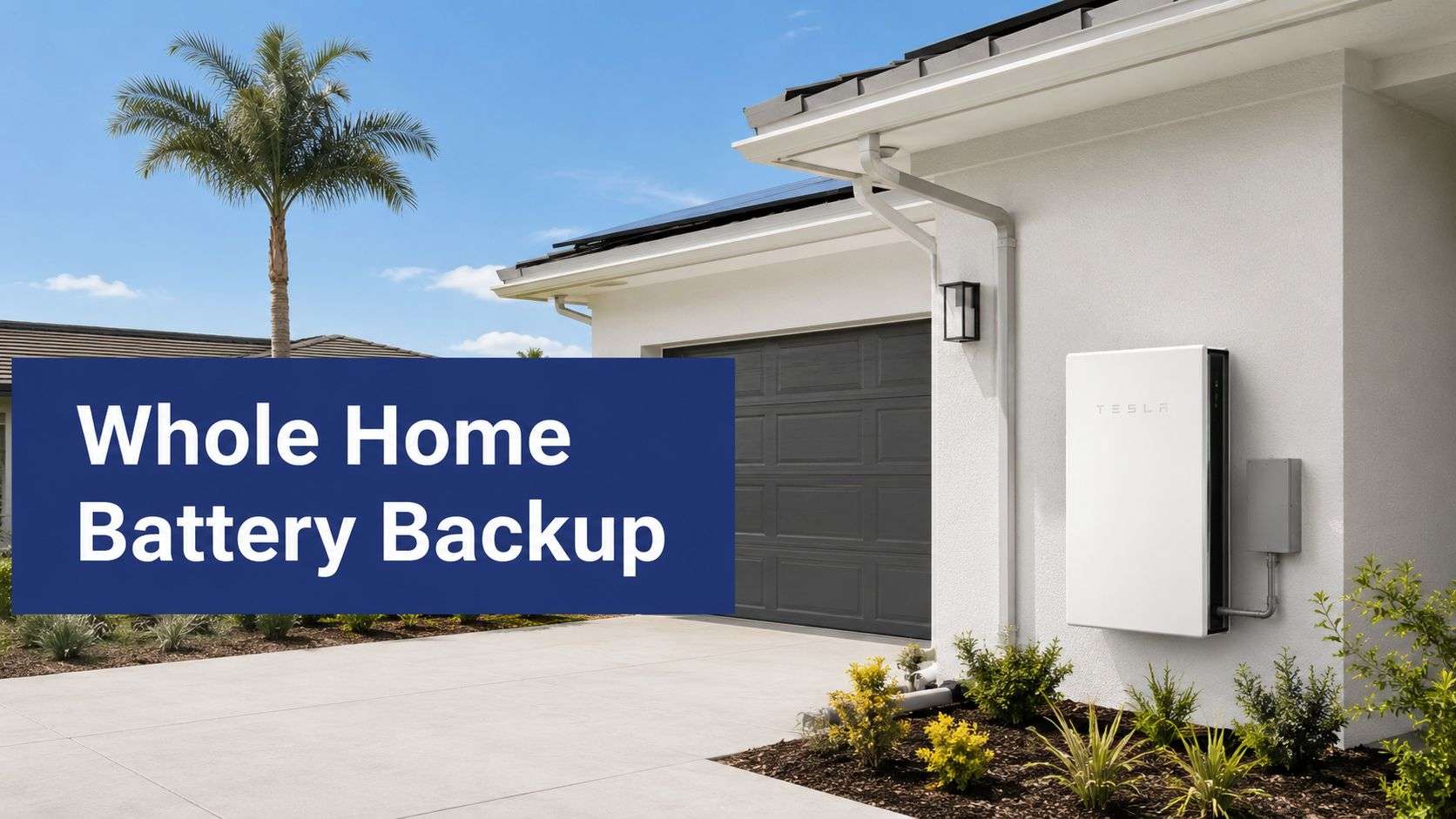
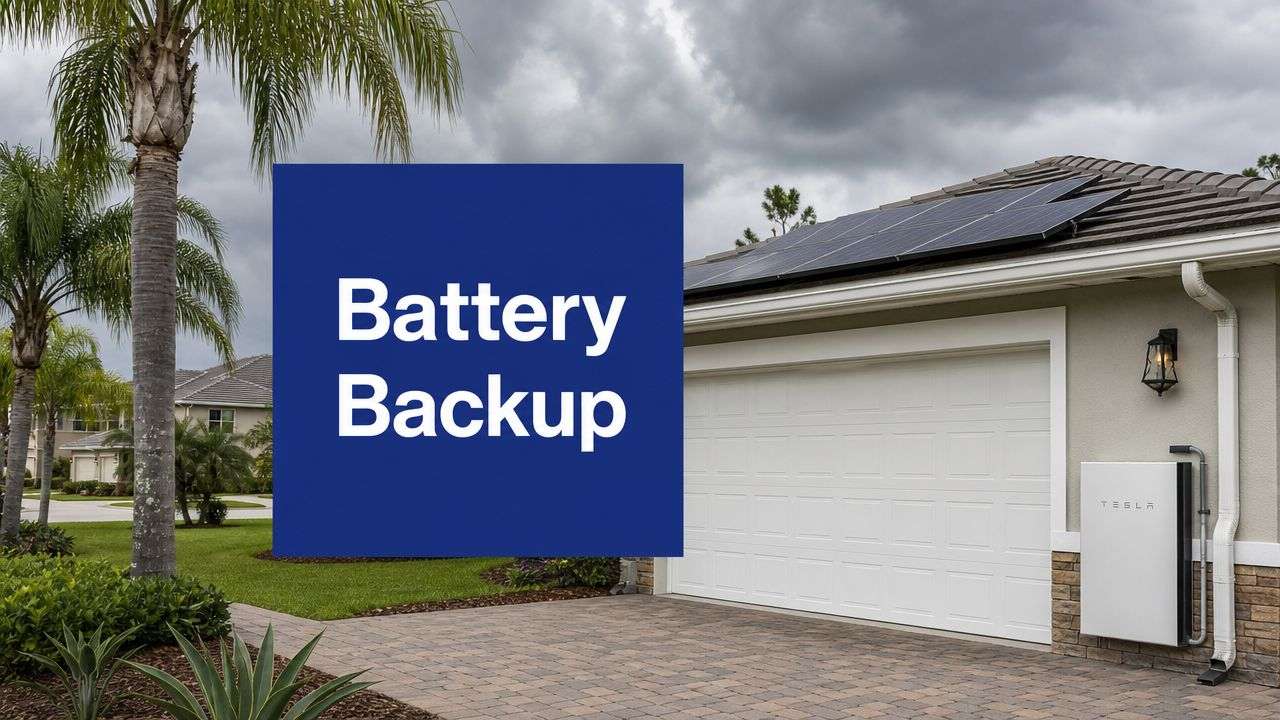
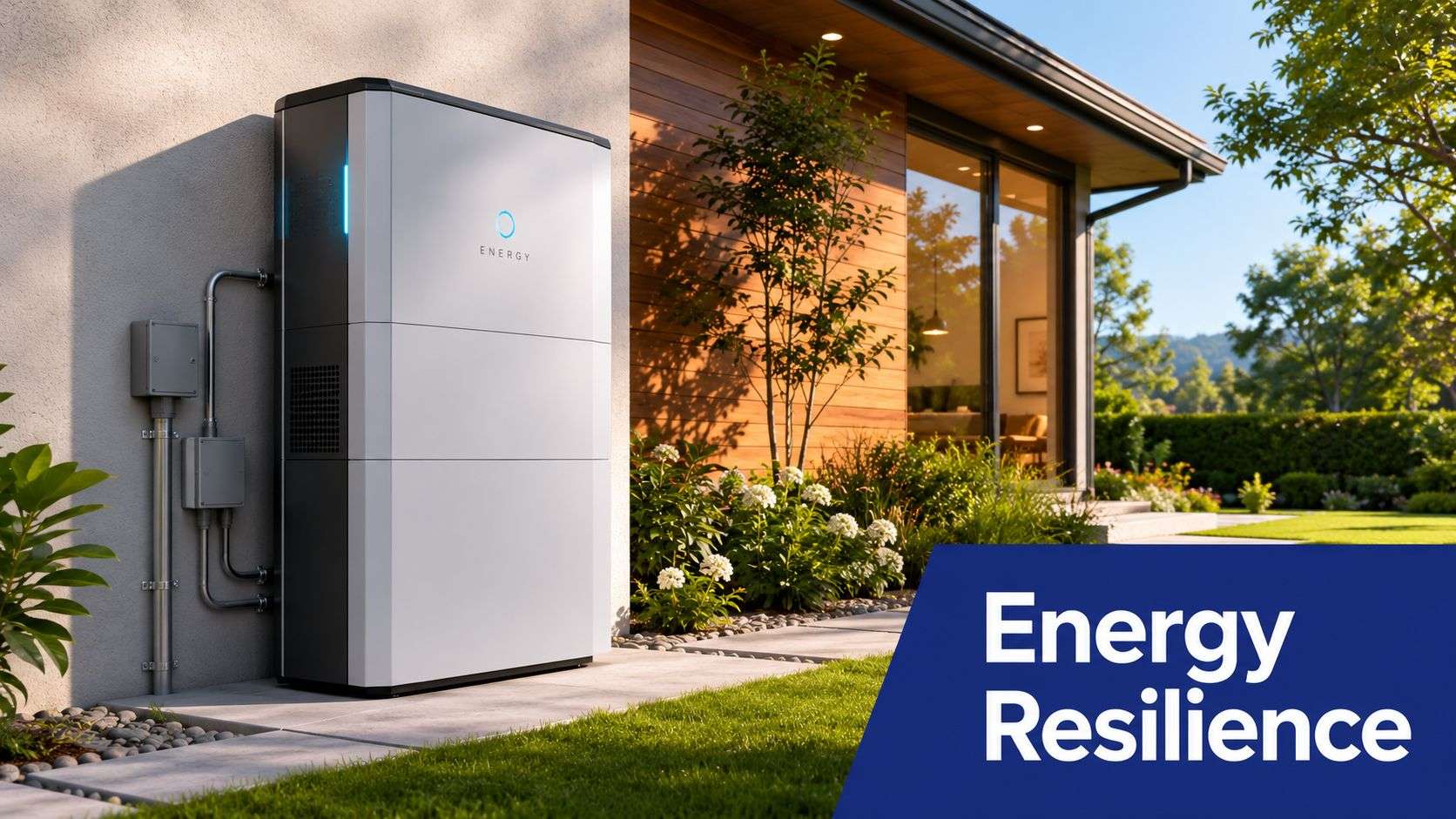
Battery storage changes the job of a solar system. Instead of sending all excess daytime production back to the grid, you can keep some of that energy onsite for later use. In Florida, that usually means one thing first. Backup power.
Storm exposure makes resilience a business issue and a household issue. A battery can keep selected circuits or critical loads running during an outage. For a home, that may mean refrigeration, communications, lighting, and limited cooling. For a business, it may mean network equipment, security, controls, refrigeration, or process continuity.
What Storage Really Adds
Battery storage can create value in several ways:
- Outage resilience by supporting critical loads when the grid is down
- Load shifting by saving solar energy for evening use
- Operational control for commercial properties that need more predictable power continuity
- Microgrid capability when solar, storage, and controls are designed to operate as a coordinated onsite system
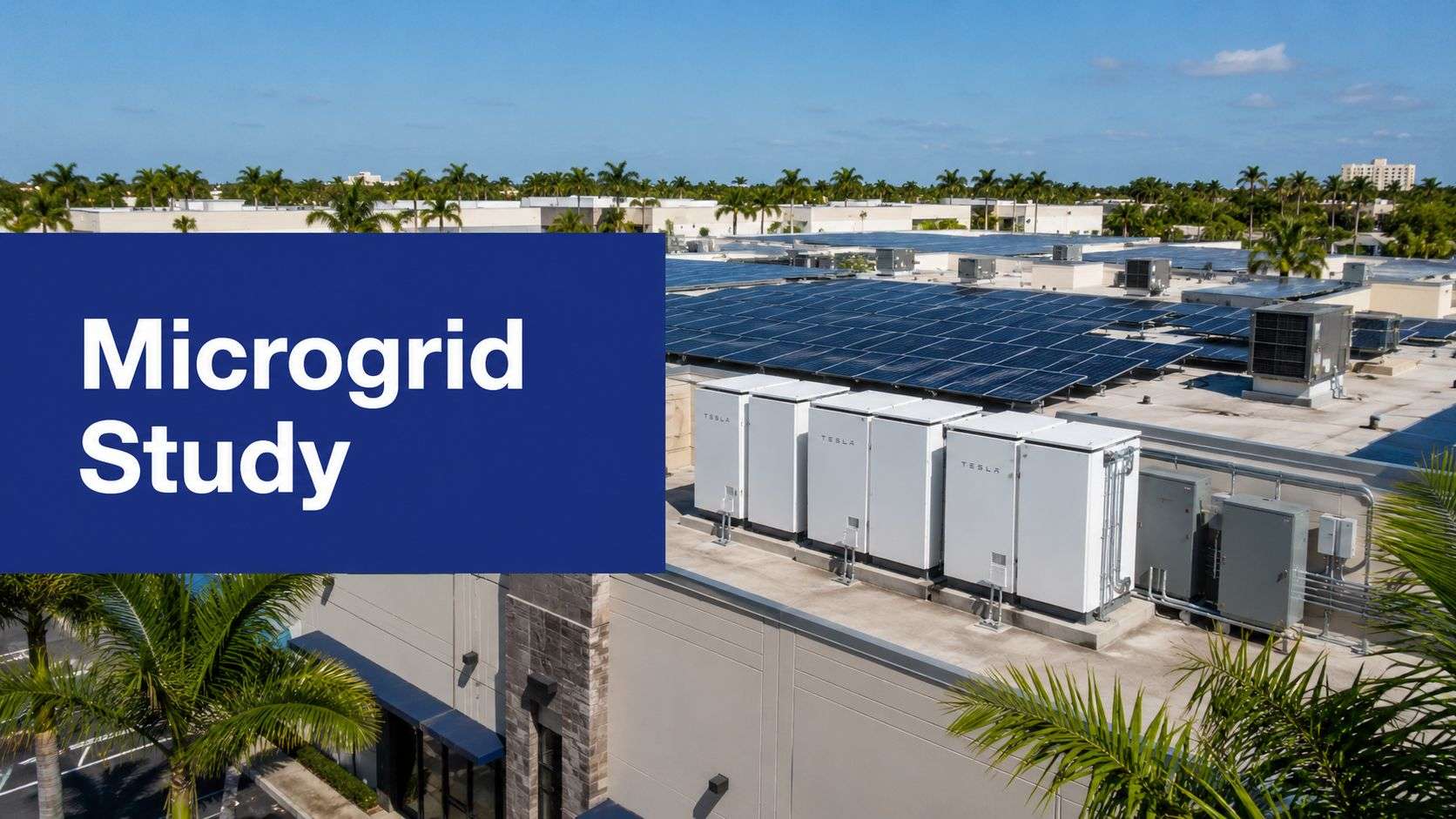
For larger facilities, the conversation often moves from “battery backup” to microgrid strategy. That's a different level of planning. A microgrid isn't just a battery attached to solar panels. It's a coordinated system that manages generation, storage, controls, and critical load priorities.
Battery and inverter expertise matters here. Larger PV systems increasingly depend on strong inverter diagnostics, SCADA monitoring, fault isolation, warranty management, and spare-part planning because those practices directly affect uptime and energy recovery, as reflected in the operational requirements described in this ENGIE expert PV role summary.
Florida Heat Changes The Battery Math
Many proposals fail because they model the battery in ideal conditions instead of Florida conditions.
Recent 2025 studies from NREL indicate that ambient temperatures above 35°C (95°F) can reduce lithium-ion battery cycle life by 20% to 30% annually. In Florida, that isn't a rare edge case. It's a normal planning condition. If your ROI model uses lab-style assumptions and ignores outdoor heat stress, the model is wrong.
That has direct implications for:
- Battery placement
- Thermal management
- Warranty interpretation
- Replacement timing
- Long-term cost of ownership
A homeowner in Tampa asking how long a battery will last through Florida summers deserves a real answer, not a brochure assumption built around mild temperatures.
For clients comparing options, a focused review of battery storage for solar can help frame the decision. But the main recommendation is simple. Don't buy storage until someone models its operating reality in Florida heat.
Integrating Electric Vehicles Into Your Solar System
An EV changes your load profile immediately. It adds a major electricity demand that can either work beautifully with solar or distort the economics if nobody sized the system correctly.
If you already have solar and you're adding an EV, revisit the design. If you're planning both at once, model them together from the start. That's the smart move.
Why EVs Improve The Solar Case
Charging an EV with onsite solar is one of the clearest ways to expand the value of a system. You're not just offsetting building electricity anymore. You're shifting part of your transportation energy onto your own roof or property.
That changes the way many clients think about electric and solar. It turns solar from a utility-bill tool into a full energy strategy. The same system can support the home or building during the day and help cover vehicle charging when the sun is available.
The catch is sizing. EV charging can justify more solar capacity, but it can also trigger additional design decisions:
- Panel capacity may need to increase so the array can support both building load and vehicle charging.
- Battery sizing may change if you want to store daytime solar for evening charging.
- Electrical infrastructure may need upgrades, especially if the property already has a constrained panel or multiple high-demand loads.
Don't Treat EV Charging As An Afterthought
A lot of flawed solar proposals ignore the EV because the owner hasn't bought it yet. That's shortsighted. If you expect to add one, design for it now. Leave room in the electrical plan, interconnection strategy, and inverter architecture.
For readers exploring more advanced vehicle-to-home or vehicle-to-building concepts, this explanation of bidirectional charging by EVChargers.eu is worth reviewing. It helps clarify where EVs may play a larger role in energy resilience, even though practical use depends on vehicle compatibility and system design.
If an EV is likely within your planning horizon, include it in the original solar model. Retrofitting assumptions later usually costs more and performs worse.
If you want a focused look at design considerations for this setup, review solar-powered EV charging station planning. The bigger point is this. Your vehicle is now part of your building's energy equation. Plan accordingly.
Modeling The Financial Returns Of A Florida Solar Project
Most solar ROI discussions are too shallow. They focus on a monthly bill offset and stop there. That's not enough for Florida, especially if you're comparing solar-only against solar-plus-storage, evaluating a coastal property, or managing a commercial asset with tax and depreciation considerations.
A serious model needs to account for production, equipment behavior, utility interaction, ownership structure, and risk costs. If it doesn't, the return analysis is little more than a sales estimate.

What A Real ROI Model Should Include
For Florida projects, I expect a financial model to address at least these variables:
- Production assumptions tied to site-specific design, not generic output estimates
- Utility bill interaction based on the property's actual usage pattern
- Tax credit treatment for the owner type involved
- Depreciation analysis where commercial ownership allows it
- Battery replacement risk if storage is included
- Insurance cost impact, especially in exposed coastal markets
Many buyers often get misled. They assume battery storage automatically improves ROI. Sometimes it does. Sometimes it improves resilience while weakening pure financial payback. Those are not the same objective, and you need to decide which one matters more.
Florida-Specific Costs Change The Outcome
Recent data from the Florida Public Service Commission shows that solar-equipped homes can face 15% to 20% higher insurance premiums in some coastal counties. That cost has to be modeled against tax credits and energy savings to determine the true ROI of a solar-plus-storage system. If your proposal ignores insurance, it's not finished.
The same goes for ownership structure. Nonprofits, tax-exempt entities, multi-tenant properties, and commercial facilities all have different financial pathways. The value of a project can shift depending on how incentives, depreciation, and financing align with cash flow.
Here's my opinion. A simple payback figure is not enough. You need a decision model that separates three questions:
- Does the project reduce long-term operating cost?
- Does it improve resilience enough to justify storage?
- Does the ownership and insurance context support the investment?
If you're trying to pressure-test the economics, a tool like this solar panel return on investment calculator can help frame the inputs. But don't confuse a calculator with due diligence.
For owners who want a consulting-first process, Solar Energy Management LLC provides feasibility studies, ROI modeling, and system design guidance in Florida. That's useful when you need an independent view before procurement, not another product pitch.
Key Design And Planning Considerations
The fastest way to ruin a solar investment is to skip design discipline. In Florida, system performance depends on site conditions, structural realities, and equipment layout. Generic estimates are not good enough.
A reliable solar design requires site-specific analysis. Professional engineers must account for local climate, structural loads, tilt, azimuth, and shading to predict annual energy yield accurately, as outlined in this solar engineering occupation summary from O*NET. That's why two properties with similar roofs can produce very different outcomes.

The Site Assessment Issues That Matter
Before anyone talks about equipment brands or financing, these planning questions need answers:
- Roof condition. If the roof is near the end of its useful life, solar timing becomes a reroofing decision too.
- Structural capacity. The building has to support the planned system and attachment method.
- Electrical panel constraints. Existing service equipment may limit what can be added without upgrades.
- Shading exposure. Trees, parapets, nearby structures, and rooftop equipment can reduce output and complicate string design.
- Equipment location. Inverters and batteries need thoughtful placement for serviceability and thermal conditions.
Why One Size Fails In Florida
Florida projects often get treated as simple because the state has strong solar resources. That's lazy thinking. Strong sun doesn't erase poor layout, roof complexity, shading, or bad assumptions about battery environment.
Small design errors become long-term financial errors. A weak shading analysis or a careless equipment location decision can undercut production for years.
For commercial and industrial properties, planning gets even more specific. Roof zones, operational access, future tenant needs, and critical load priorities all shape the design. The consultant's job is to test feasibility before money gets committed, not after.
If someone gives you a proposal without a serious site review, treat it as marketing material, not engineering.
Your Next Step A Professional Feasibility Study
At this point, the pattern should be obvious. Florida solar decisions aren't simple product purchases. They're planning exercises with long financial tails.
That's why the smartest next step is a professional feasibility study. Not a quick quote. Not a savings screenshot. A real study.
A proper feasibility study should evaluate the property from several angles at once:
- Technical feasibility through site review, preliminary design logic, and equipment compatibility
- Production realism based on the actual property, not a template
- Financial modeling that reflects incentives, insurance, and long-term operating assumptions
- Storage strategy if backup power or microgrid resilience is part of the goal
- Load planning for future changes like EV charging or building expansion
This process protects you from two common mistakes. The first is underbuilding a system that won't support your long-term goals. The second is overbuilding one based on assumptions that don't survive real-world Florida conditions.
For homeowners, that means knowing whether solar-only or solar-plus-storage fits the property. For businesses and facility managers, it means understanding whether resilience value, operational continuity, and capital structure justify the investment.
You don't need more solar marketing. You need a decision framework. Once the feasibility work is done, procurement becomes easier, financing becomes clearer, and equipment choices can be evaluated on facts instead of pressure.
If you want an independent, Florida-focused feasibility study before committing to a solar or storage project, Solar Energy Management LLC helps homeowners, commercial property owners, and organizations model production, evaluate battery strategy, and make grounded financial decisions.