The Florida homeowner looking at energy storage usually arrives here for one of two reasons. The first is frustration. Another outage, another night moving extension cords around the kitchen, another worry about refrigerated food, internet access, or medical devices. The second is financial. A power bill lands in the inbox and raises the same question again: is there a smarter way to use solar power in Florida so the house works for you instead of against you?
That's where home energy storage solutions stop being a gadget conversation and start becoming a planning conversation. A battery isn't just a box on the wall. It's a way to decide when your home uses the solar power your roof produces, which loads stay on during an outage, and how much financial control you want over the next decade and beyond.
In Florida, that matters more than most places. Storm risk is real. Heat drives heavy evening demand. Many homeowners and business owners don't need a flashy system. They need one that pencils out, stays code-compliant, and covers the critical loads.
Why Florida Homeowners Are Turning to Energy Storage
A common Florida scenario goes like this. The sun was out all day, your solar panels did their job, and then the grid drops in the evening just as the house needs power most. Or the lights stay on, but the utility bill still feels too high because your biggest usage happens after solar production slows down.
That gap is why more households are looking seriously at batteries. Storage lets you keep solar power for later, not just use it when it's produced. It also gives you a controlled backup plan during outages, which feels very different from hoping the grid comes back soon.
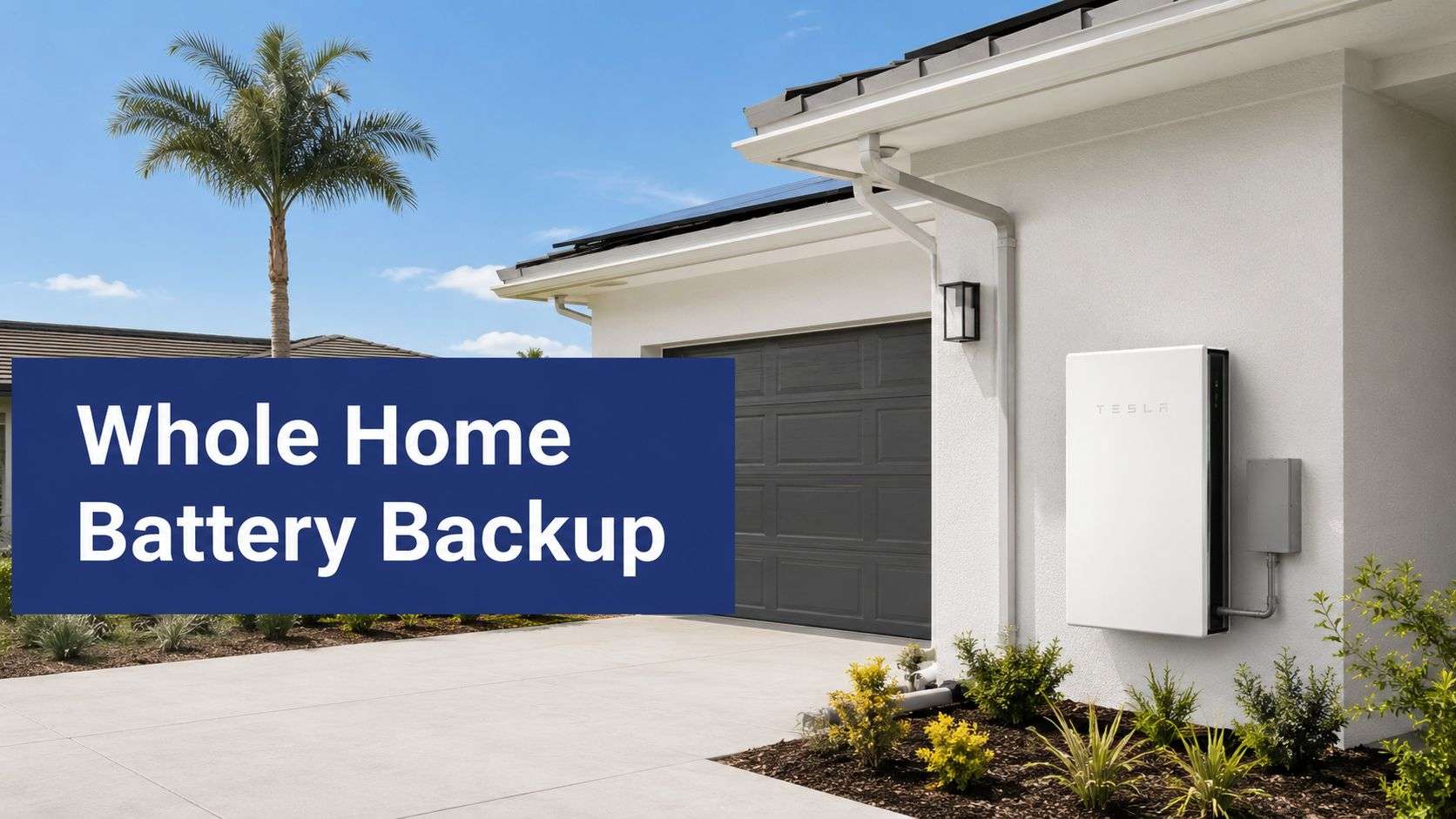
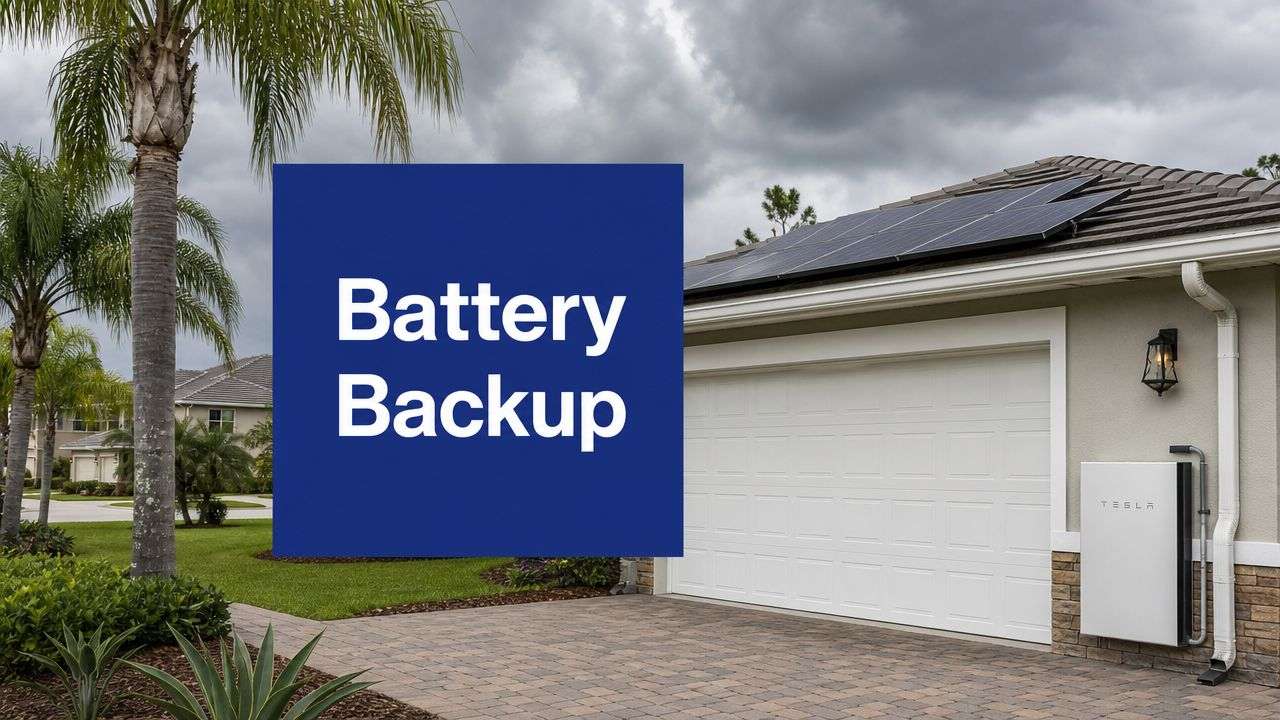
Right near the start of your research, it helps to see what that looks like in a real residential setting.

Resilience Is Now Part of the Solar Conversation
For many Florida families, the first decision isn't “Which battery brand should I buy?” It's “What do I need to keep running?” Refrigeration. A few lights. Internet. Garage access. Phone charging. Sometimes a medical load. Sometimes a home office.
That's why a battery plan should start with resilience goals, not hardware brochures. If your main concern is storm-related outages, a focused backup design often makes more sense than trying to power every circuit in the house. If you want a deeper look at outage planning, this guide to solar battery backup for power outages is a practical next read.
Home energy storage works best when it's tied to a clear household goal. Lower bills, outage backup, or both.
The broader market shows this isn't a fringe upgrade anymore. The residential solar energy storage market reached a valuation of USD 70.5 billion in 2025, with projections indicating a Compound Annual Growth Rate of 20.3% between 2026 and 2035, which points to a mainstream shift in how households think about power, according to Global Market Insights on residential solar energy storage.
Why It Feels More Mainstream Now
Three things changed. Solar power in Florida became more familiar. Battery technology became easier to understand. Homeowners started treating resilience like a home improvement category, not a prepper hobby.
You can hear that shift in the questions people ask now:
- Can I cover my evening usage better? This is about using more of your own solar power instead of leaning on the grid at night.
- Can I keep key circuits on during storms? This is about comfort, food safety, communications, and continuity.
- Can I make the investment make sense on paper? This is the consultant's question, and it's the right one.
When those three questions come together, batteries stop looking optional. They start looking like part of a smarter Florida energy plan.
Understanding Your Energy Storage Options
The simplest way to understand a battery is to think of it as an energy savings account. During the day, your solar system makes deposits. At night, or during an outage, you make withdrawals. The value isn't in owning the account. The value is in controlling when you use what you already produced.
That's the part many homeowners miss at first. Solar panels make electricity. A battery changes the timing.

The Two Main Jobs a Battery Can Do
Most home energy storage solutions in Florida serve one or both of these roles.
- Evening self-consumption: Your system stores excess daytime solar production and uses it later, especially after sunset when the house is still active.
- Backup power: The battery keeps selected loads running when the grid goes down.
Those are related, but they aren't the same. A homeowner focused on bill management may size and configure a system differently than a homeowner focused on hurricane backup. Business owners often care about continuity first, especially for refrigeration, security, network equipment, and critical tenant services.
How the Pieces Work Together
A typical setup includes solar panels, an inverter, a battery, and an electrical panel strategy that decides where power goes. Think of the inverter as the traffic officer. It routes solar power to the home, to the battery, or to the grid based on conditions and system design.
If you already have solar, a battery may be added to that existing setup. If you're planning a new project, the battery can be designed into the system from the start. Either way, the best results come from planning the full energy flow before any equipment gets selected. That's one reason people benefit from reviewing both household electrical use and the larger electric and solar relationship in Florida homes.
Practical rule: Don't ask “How big a battery can I buy?” Ask “Which loads do I want the battery to control, and when?”
Where People Get Confused
The biggest misunderstanding is assuming every battery powers the whole home automatically. It doesn't. Some systems are designed around critical loads only. Others aim for broader whole-home coverage. The answer depends on your electrical habits, outage concerns, and budget.
Another common confusion is mixing up capacity and power. Capacity tells you how much energy the battery can store. Power tells you how many appliances it can run at the same time. A large “tank” doesn't help much if the “spigot” is too narrow for the loads you care about.
That's why battery planning should feel less like shopping and more like matching a system to a living pattern.
Choosing the Right Battery and System Design
Florida buyers usually compare battery systems on brand first. That's understandable, but it's not the most useful starting point. The better first question is chemistry. In practice, that often means comparing LFP and NMC.
For Florida conditions, heat tolerance and long-term behavior matter a lot. You're not buying a battery for a showroom. You're buying it for a garage, utility area, or outdoor-adjacent environment that may spend much of the year under thermal stress.

LFP Versus NMC in Plain English
LFP stands for Lithium Iron Phosphate. NMC stands for Nickel Manganese Cobalt. Both are used in storage, but they behave differently.
Here's the practical comparison a Florida homeowner usually cares about:
- LFP and lifespan: High-quality LFP batteries are engineered to sustain over 6,000 full cycles while retaining 70 to 80 percent capacity, often corresponding to 10 to 15 year warranties, based on technical BESS specifications from Flex Power.
- Heat matters in Florida: The same source notes that operating above 30°C can accelerate degradation and reduce cycle life by 20 to 30 percent without proper thermal management.
- NMC tradeoffs: NMC batteries are often discussed in terms of energy density, but for many fixed residential applications, the deciding factors are usually safety profile, climate fit, and expected long-term service behavior.
For most stationary Florida applications, LFP often fits the conversation well because durability and thermal tolerance matter more than squeezing maximum energy into the smallest possible package.
A battery in Florida should be judged partly by where it will live, not just by what it can do on a spec sheet.
Why Thermal Management Isn't a Side Detail
Heat is one of the quietest ROI killers in battery storage. Homeowners often compare total capacity, inverter size, and warranty length, but overlook installation environment. That's a mistake.
If a battery spends years in a hot location without thoughtful design, the expected savings model can miss the mark. Good planning means asking where the system will sit, how ventilation will work, and whether the product's operating range matches real Florida conditions.
AC-Coupled and DC-Coupled Design
This is another area where people get overwhelmed by jargon. The practical version is simpler.
DC-coupled systems are often a strong fit when you're designing solar and storage together from the start. Solar energy reaches the battery through a more direct path.
AC-coupled systems are commonly considered when adding storage to an existing solar setup. They can be useful for retrofit scenarios because they adapt to what's already installed.
Neither architecture is “the winner” in every case. The right answer depends on whether you're starting fresh or layering storage onto an existing Florida solar system. During planning, many property owners use outside design help to compare those paths before procurement. One example is solar power system design guidance, which focuses on matching layout, loads, and long-term operating goals before equipment decisions get locked in.
Sizing Your System for Florida Homes and Businesses
Sizing is where a lot of battery projects either become sensible or become expensive wish lists. The goal isn't to buy the biggest unit you can afford. The goal is to buy enough storage and enough output to cover the way the property functions.
That starts with one clear split. Are you planning for critical load backup or whole-home backup?

Critical Loads First
Critical load backup is the more common starting point. It usually includes the things that protect comfort, safety, and continuity.
A Florida homeowner might put these on the essential list:
- Food and medicine protection: refrigerator, freezer, and any medically necessary cooling or storage
- Basic livability: lights, fans, internet equipment, and phone charging
- Access and safety: garage door opener, security system, select outlets
- Business continuity: router, workstations, point-of-sale equipment, or network gear for a small office
This is often the most cost-conscious way to use home energy storage solutions. Instead of trying to run every circuit, you preserve what matters most.
Capacity and Power Are Different
Here's the easiest analogy. Capacity is your fuel tank. Power is the engine output. You need enough tank to last through the outage period you care about, and enough output to start and run the loads you care about at the same time.
That distinction matters because a battery with 13.5 kWh of total capacity may provide about 12 kWh of usable energy, and for backup planning, systems are often sized for 4 to 8 hours of essential loads in the 5 to 10 kWh range, while 5 to 10 kW of power output is recommended to run high-draw appliances, according to this residential energy storage guide for homeowners.
If your battery has enough stored energy but not enough output, it's like owning a large water tank with a small pipe.
A Simple Sizing Thought Process
Instead of jumping into complex calculations, use this decision path:
- List what must stay on. Separate “must-have” from “nice-to-have.”
- Flag anything with a big startup draw. Air conditioning, pumps, and certain appliances can change the system design.
- Decide how long you want coverage. A short outage strategy looks different from an overnight or multiday resilience plan.
- Review solar production timing. Daytime recharging can change the battery size you need.
- Check expansion options. Some owners start with essential loads and add capacity later.
If you want help turning that list into a realistic battery target, this guide on how much battery backup you need is a useful planning step.
For Florida businesses, the same logic applies, just with different priorities. A retail site may care about refrigeration and transaction systems. A multifamily property may prioritize common-area lighting, gate access, and communications. The right size is always tied to operational priorities, not generic package labels.
Maximizing Your ROI with Florida Incentives
The financial case for storage gets clearer when you stop treating the battery as a standalone object and start treating it as part of a solar power strategy in Florida. The value usually comes from a combination of bill control, outage resilience, and tax treatment.
For homeowners, the most important current lever is the federal tax credit. In Florida, the federal Investment Tax Credit allows system owners to deduct 30 percent of the total installation cost from their federal taxes, and that rate is fixed through 2032, according to EnergySage's overview of energy storage incentives.
What ROI Really Means Here
A good ROI review doesn't start with “How cheap can I get a battery?” It starts with questions like these:
- How much of my solar production goes unused today?
- How much do outages cost me in spoiled food, business disruption, or lost comfort?
- Which loads create the highest value if they stay powered?
- Am I designing for bill management, backup, or both?
For some properties, resilience is the deciding factor even if the pure payback math is only part of the story. For others, especially owners with strong solar production and predictable usage, a battery can support better energy timing and a stronger long-range financial model.
The Cost Stack People Overlook
Battery decisions often get distorted because buyers compare only battery nameplate pricing. A complete investment typically includes system controls, inverter compatibility, electrical integration, load management strategy, and planning work.
For that reason, it helps to model the entire project rather than price one component. Florida property owners often also look across related incentive categories when evaluating broader home upgrades. If HVAC changes are part of the same efficiency plan, this resource on understanding FWB Florida heat pump incentives can help frame how different energy improvements may interact in your budgeting process.
A Smarter Way to Compare Proposals
When two proposals look similar, compare the financial logic behind them.
Ask for:
- An explicit load strategy: Which circuits are backed up, and why?
- A usable-energy explanation: Not just total battery size
- A tax-credit assumption: Show how the 30 percent credit is being applied
- A degradation discussion: Especially important in Florida heat
- A planning basis: Utility bills, operating schedule, and solar production assumptions
For owners who want an independent review before talking to installers, Florida solar rebate and incentive planning is one part of a broader financial diligence process. Solar Energy Management LLC also provides feasibility studies, ROI modeling, and battery storage planning for Florida projects, which can help owners compare options before installation contracts are signed.
For commercial owners, depreciation may also affect the economics, but the exact tax treatment should be reviewed with a qualified tax professional. The bigger point is that storage should be analyzed like an asset decision, not an impulse purchase.
Navigating Florida Permitting and Safety Codes
Battery safety rules can feel like red tape until you understand what they're trying to prevent. In Florida, where many systems are placed in garages or near exterior walls, code decisions affect both daily safety and emergency response.
One of the most important standards is NFPA 855. For residential installations, NFPA 855 limits residential energy storage to 80 kWh in attached garages and requires physical barriers such as safety bollards if the system is subject to vehicle impact, according to NFPA's residential energy storage system regulations overview.
Why These Rules Matter in Real Homes
A battery in a garage isn't just an appliance. It's electrical equipment that must be protected from impact, installed in the right location, and coordinated with detection systems. That's why code rules also address placement and alarm integration.
For a homeowner, the practical takeaway is simple. Installation location is not just a convenience choice. It affects compliance, inspection outcomes, and long-term safety. A design that looks tidy on paper may not pass once clearance, impact risk, and room use are considered.
Safety code isn't there to slow the project down. It's there to keep a manageable problem from becoming a dangerous one.
Permitting Works Better When It Starts Early
Many delays happen because owners choose equipment before someone checks the placement and code fit. That reverses the right order. In Florida, the permitting path is easier when the load plan, equipment location, and battery capacity strategy are aligned early.
If you want a plain-language refresher on how home improvement permitting works more broadly, HomeProBadge permit advice is a useful companion read. It won't replace local project review, but it helps frame why permits, inspections, and documentation matter before work begins.
A knowledgeable consultant helps by spotting friction before the permit set is submitted. That includes whether the proposed location makes sense, whether the backed-up loads match the design, and whether the project stays inside residential thresholds.
Next Steps and Frequently Asked Questions
Most people don't need more battery marketing. They need a short list of practical next actions. If you're evaluating home energy storage solutions for a Florida property, start with the planning steps that remove guesswork.
Your Next Planning Checklist
- Pull recent electric bills: Look for seasonal patterns, evening usage, and demand spikes.
- Write down critical loads: Don't rely on memory during an outage.
- Decide your priority: Lower bills, outage backup, or a blend of both.
- Review your solar setup: Existing system or new installation changes the design path.
- Check likely installation areas: Garage, exterior wall, utility space, or another compliant location.
- Ask for modeling, not just pricing: A proposal should explain the logic behind the size and configuration.
Frequently Asked Questions
Does a battery save money if I don't have solar
Sometimes, but the answer depends on your utility rate structure and how the battery is operated. Without solar, storage is usually a timing tool rather than a production tool. It may still offer resilience value, but the economics should be modeled carefully instead of assumed.
Should I size for the whole house
Usually not at first. Many Florida owners get better value by covering the circuits that protect comfort, food, connectivity, and essential operations. Whole-home backup can make sense, but it needs a tighter review of large loads such as air conditioning and electric heating.
How do I compare consultant or installer proposals
Look for clarity, not just total price. A useful proposal explains backed-up loads, usable energy, power output, expected operating strategy, and any assumptions around incentives, temperature, and expansion.
Is one battery enough
It depends on the loads and your runtime expectations. For some homes, one unit covers essentials well. For others, especially with larger appliances or stronger backup expectations, the system may need more storage or a different load strategy.
What should a Florida business owner focus on first
Continuity. Identify the loads that protect revenue, safety, communications, and tenant or customer experience. Once those are clear, the system can be sized around business function rather than generic package names.
If you want an independent, data-driven review before committing to equipment, Solar Energy Management LLC helps Florida homeowners, businesses, and property managers evaluate solar and storage options through feasibility studies, ROI modeling, system design guidance, and battery planning. That gives you a clear basis for comparing proposals, understanding resilience tradeoffs, and moving into installation with a better plan.