Solar panels in Florida cost $2.18 per watt on average, and a typical 14.56 kW home system runs about $31,762 before incentives. After the 30% federal tax credit, that average out-of-pocket cost drops to about $22,233.
That number answers the basic question, but it doesn't answer the important one. Whether solar is a smart move in Florida depends on total cost of ownership, system sizing, battery strategy, financing, and whether the quote in front of you is built for your property instead of a sales script.
Most buyers focus too hard on panel price and not hard enough on financial design. That's backwards. In Florida, sunlight is not the hard part. The hard part is making sure the system you buy produces the savings, resilience, and payback you're expecting.
Understanding Solar Costs in the Sunshine State
Florida is one of the few places where solar pricing and solar production work in your favor at the same time. You get strong sun, a mature market, and enough installer competition that bad pricing is easier to spot if you know what to look for.
The mistake I see most often is simple. A homeowner asks, "how much do solar panels cost in florida," gets a rough online number, then starts comparing quotes as if the cheapest one automatically wins. It doesn't. A low quote can hide weak equipment choices, poor battery planning, or a system size that leaves too much utility spend on the table.
What You Should Care About First
Start with three questions:
- What is the gross installed price? You need the full pre-incentive number before anyone starts talking about monthly payments.
- What is the net cost after the federal tax credit? That's the number that matters for real ownership cost.
- What does the system offset on your property? A cheap system that doesn't match your load isn't a bargain.
If you're already thinking through larger home upgrades, the same budgeting logic applies across the house. A practical example is this Miami home water heater guide, which shows why equipment decisions should be tied to operating cost and fit, not just sticker price.
Practical rule: Don't evaluate solar as a product purchase. Evaluate it as a long-term energy asset.
Florida buyers also need to think beyond panels. Roof condition, exposure, backup power goals, and utility bill patterns all affect value. If you want a broader overview of system types and planning considerations, review these Florida solar power systems.
Why a Consultant's Lens Matters
Installers sell installations. Advisors should model outcomes.
That's an important distinction in Florida because two properties with similar roofs can produce very different financial results depending on daytime usage, critical loads, and whether battery storage is part of the plan. A homeowner trying to reduce bills has one set of priorities. A business trying to preserve operations during outages has another.
The right way to start is with economics first, equipment second.
The Average Cost of Solar Panels in Florida
The cleanest benchmark in Florida right now comes from marketplace pricing. As of May 2026, the average installed solar price in Florida is $2.18 per watt, and the average 14.56 kW system costs $31,762 before incentives, with a range from $26,998 to $36,526 according to EnergySage Florida solar cost data.

Those numbers give you a real market anchor. They also expose why broad national averages are less useful than Florida-specific pricing. This state has the sunlight and market density to keep pricing relatively competitive, so you should judge every quote against local reality, not generic U.S. talking points.
What Different System Sizes Cost
The same EnergySage Florida pricing page reports these common benchmarks:
- 5 kW system at about $10,908 before incentives
- 10 kW system at about $21,816 before incentives
- 14.56 kW system at about $31,762 before incentives
- Typical 14.56 kW net cost after the 30% federal tax credit at about $22,233
- Typical payback period of 7 to 10 years
That range matters because many Florida homes need more than a small system. Air conditioning loads are real. Pool pumps, electric water heating, and work-from-home usage push demand up fast. If your annual consumption is high, a small array may lower your bill but leave too much of your utility spend untouched.
What These Numbers Mean in Practice
Use the market average as a screening tool, not a final answer.
A quote near the low end may be fair if the roof is straightforward, the equipment package is simple, and there aren't unusual structural or electrical issues. A quote at the high end might also be justified if the site is difficult or storage is involved. Price alone doesn't tell you enough.
A better way to think about it is this:
| System Size | Typical Gross Cost |
|---|---|
| 5 kW | $10,908 |
| 10 kW | $21,816 |
| 14.56 kW | $31,762 |
That framework is useful in the same way square-foot pricing helps when evaluating a custom build. If you want an example of how cost ranges become meaningful only when tied to scope, finish level, and project conditions, this guide to luxury home construction prices is a good comparison point.
A solar quote isn't expensive or cheap in the abstract. It's only expensive or cheap relative to system size, site conditions, equipment quality, and financial outcome.
If a Florida homeowner gets a quote that sits far outside the normal range, that's the moment to slow down. Ask why. Get the assumptions. Don't let financing presentation hide the actual installed price.
Deconstructing Your Solar Quote Line by Line
A solar quote is never just about panels. You're buying a complete power system, plus design work, permitting, project coordination, and interconnection.
For a Florida benchmark, a typical 6 kW installation averages $2.58 per watt, or $15,480 before incentives, and that's 20% below the national average according to This Old House's Florida solar cost guide. That same source notes that monocrystalline panels dominate the market at 19% to 22% efficiency, with module costs of $0.45 to $0.60 per watt, typically paired with string inverters for grid-tied systems.

The Big Line Items You Should Expect
Here's what usually appears in a serious quote:
- Solar modules. In Florida, this usually means monocrystalline panels because they produce more power per square foot and fit better on many residential roofs.
- Inverter equipment. String inverters remain common for straightforward grid-tied systems. If your roof has multiple planes or shading, ask whether another inverter architecture would improve performance.
- Racking and mounting. This hardware matters in Florida because wind exposure and roof type can complicate the install.
- Electrical balance of system. Wiring, disconnects, breakers, and connection points all add cost.
- Labor and project management. Installation is physical work, but coordination often matters just as much.
- Permitting and utility interconnection. These are not glamorous costs, but they are real costs.
What Buyers Miss Most Often
The cheapest quote often strips value out of the invisible categories.
That can show up as weaker design work, vague assumptions about roof layout, undersized battery planning, or thin documentation on what happens after installation. A polished proposal isn't enough. You need to know what's included.
Review every proposal against a question list before you compare brands or payment options. This set of questions to ask a solar company is a strong place to start.
If the quote doesn't explain equipment choices, production assumptions, and interconnection scope in plain English, it isn't detailed enough.
How Florida Changes Quote Economics
Florida's high solar irradiance helps smaller systems generate meaningful output compared with lower-insolation states, as noted by This Old House's Florida solar cost guide. That's good news for buyers with limited roof space.
But don't confuse good sunlight with automatic savings. Roof geometry, storm-hardening requirements, and backup power expectations can all shift the value equation. A business owner who needs continuity during outages should not evaluate a system the same way as a homeowner who only wants bill reduction.
That's why line-item clarity matters. You're not buying "solar." You're buying a specific design with specific financial consequences.
Florida Solar Incentives That Reduce Your Net Cost
The biggest cost reducer for most Florida buyers is the 30% federal Investment Tax Credit. In practical terms, it takes the average 14.56 kW system from $31,762 down to about $22,233 out of pocket, based on the Florida pricing benchmark already cited from EnergySage.

That one incentive changes the conversation. A lot of sticker shock disappears when you stop looking at gross cost and start looking at net cost.
The Incentive That Deserves Your Attention
Most buyers don't need a long incentive scavenger hunt. They need a disciplined net-cost model.
Focus on this order:
- Gross installed price
- Federal tax credit treatment
- Any site-specific design choices that affect ownership cost
- Battery economics if resilience matters
- Cash-flow impact under your preferred financing method
You can review broader Florida program details through this Florida solar incentive resource.
Why Net Cost Beats Payment Talk
Monthly payment presentations can make bad economics look comfortable. A long term can flatten the payment while hiding a bloated project price.
That's why I prefer to strip everything back to two numbers first: what you're paying before incentives, and what you're paying after the federal credit. Once those are clear, then you can evaluate financing.
Use this simple check when reviewing any proposal:
- Ask for the gross system price in writing
- Confirm how the federal credit changes your effective cost
- Separate panel-only pricing from storage pricing
- Make sure the quote doesn't bury add-ons inside a monthly payment
Decision filter: If a salesperson leads with monthly payment before showing the installed price, you're being sold financing before you're being shown value.
Incentives Don't Fix a Bad Design
In this context, people get lazy. They hear "30% tax credit" and assume the project must be good.
It doesn't work that way. Incentives improve a well-designed project. They don't rescue an oversized system, a weak battery plan, or a quote inflated by sales pressure. A tax credit reduces cost, but it doesn't create discipline. You still need that yourself, or you need an advisor who will enforce it for you.
For businesses, the incentive picture can become much stronger when storage and tax treatment are modeled correctly. That belongs in the ROI discussion, not in a generic rebate pitch.
Calculating Your True ROI and Payback Period
Most solar buyers stop at savings estimates. Serious buyers build a return model.
For Florida residential projects, the benchmark numbers are strong enough to justify real analysis. The average system described earlier carries a 7 to 10 year payback period and about $52,828 in lifetime savings over 25 years according to the same EnergySage Florida pricing data. Those are useful reference points, but your actual return depends on usage pattern, financing, and whether storage changes the economics.

A Residential Florida Example
Take a homeowner in St. Petersburg. The goal isn't to buy the biggest system possible. The goal is to buy the system that offsets expensive grid consumption without creating waste.
The right model usually starts with recent utility bills, daytime versus evening use, roof production potential, and whether backup power is important. If the homeowner buys with cash, the economics are usually easier to read because there is no financing layer distorting the outcome. You can compare gross cost, federal tax credit effect, annual bill reduction, and simple payback without a lender muddying the picture.
A loan can still work, but only if the financing terms don't erase too much of the savings. That is where many residential deals get weak. The system may be viable. The financing may be the problem.
A Commercial Florida Example
Commercial solar needs a different lens. A business owner isn't just looking at utility savings. They're looking at tax treatment, operational continuity, tenant expectations, and capital allocation.
According to ConsumerAffairs' Florida solar cost coverage, emerging 2026 trends show battery-integrated microgrids slashing effective costs by 20% to 30% via resilience rebates and utility demand-response programs. The same source states that MACRS depreciation can yield 40% to 50% tax savings for commercial owners, which can accelerate payback and materially improve ROI.
That changes the math fast.
A business with refrigeration, tenant services, data needs, or downtime exposure should model battery storage as part of an operations strategy, not just a solar add-on. If outages hurt revenue, battery-backed solar may be more valuable than a simple utility-bill model suggests.
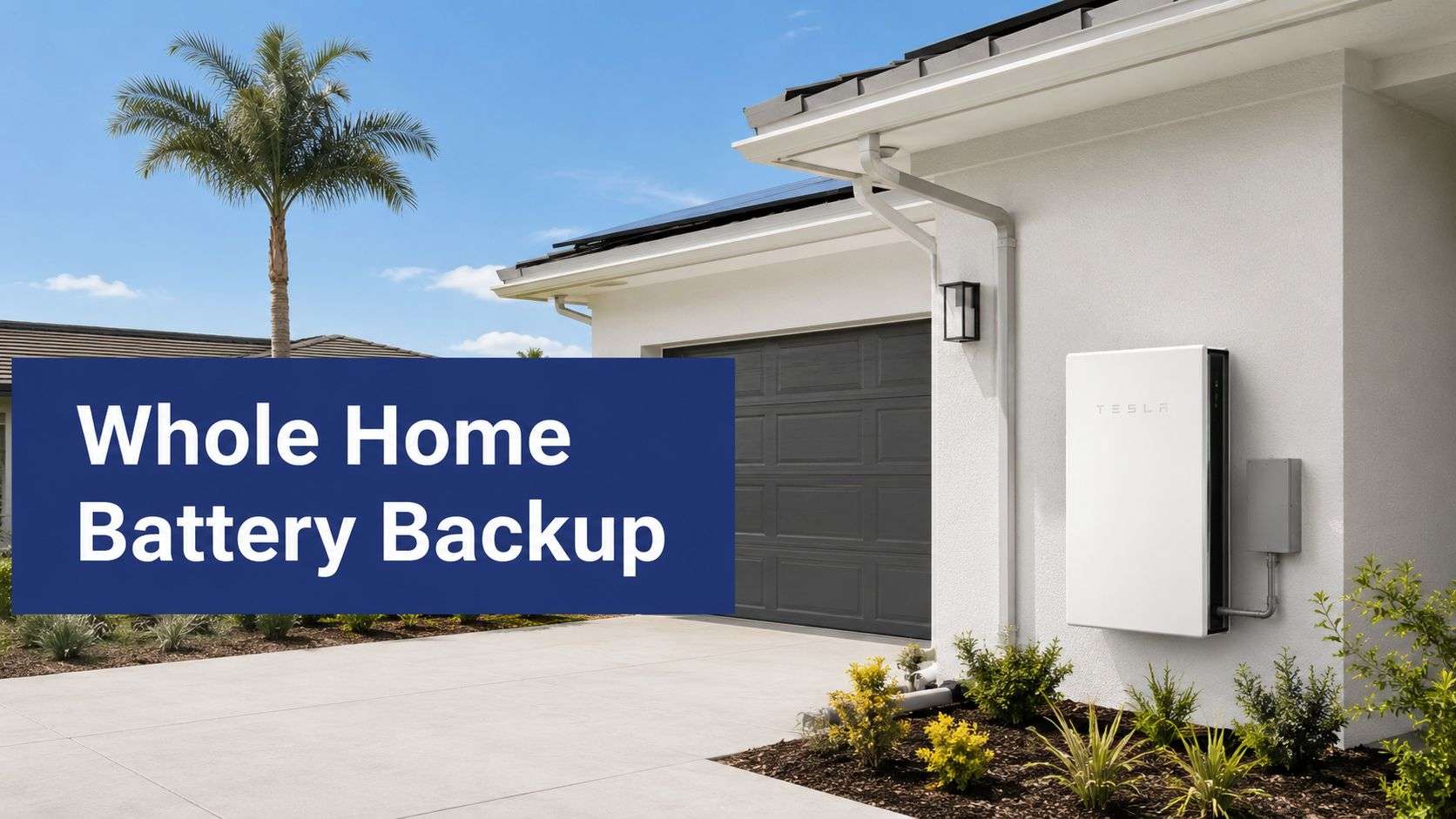
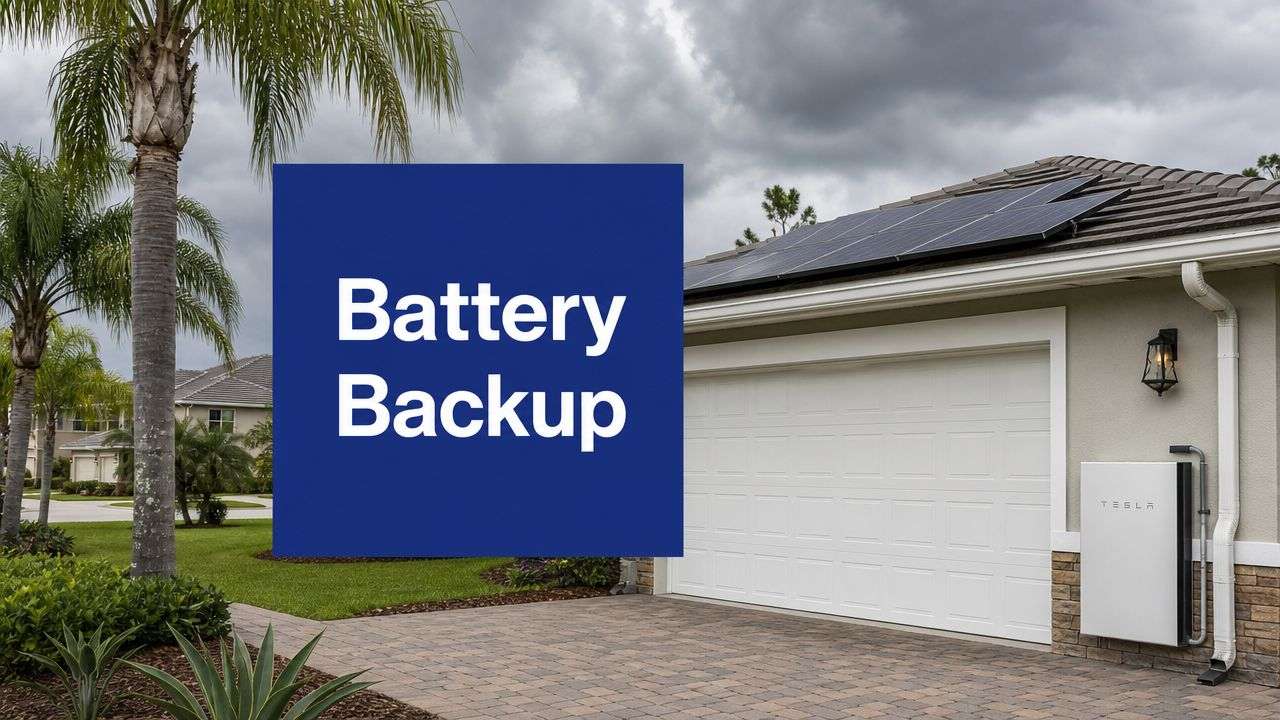
Battery storage in Florida is often a resilience decision first and an energy decision second.
What Battery Storage Really Does to ROI
Battery storage isn't automatically worth it for every home. It is often worth serious consideration in Florida because storms and outages aren't hypothetical.
For commercial sites, storage can become a much stronger financial and operational tool. The same ConsumerAffairs Florida solar cost analysis reports that battery-integrated microgrids can reduce effective costs through resilience rebates and utility demand-response participation. That's the kind of planning many generic residential guides ignore.
If you're modeling a project at that level, this solar power ROI resource is a useful framework.
The Right Way to Judge Payback
Don't ask only, "How fast does this pay for itself?"
Ask these instead:
- What happens if utility costs keep rising?
- How much value comes from outage protection, not just generation?
- Does financing improve cash flow or just hide total cost?
- For a business, how much does tax treatment improve the return?
- What critical loads must stay on during an outage?
A short payback on a poorly planned system is not success. A slightly longer payback on a system that protects your operations and lowers long-term risk may be the better decision.
That is the core difference between price shopping and investment analysis.
How to Get an Accurate Solar Quote in Florida
An online calculator is fine for curiosity. It isn't good enough for a purchase decision.
Accurate solar pricing in Florida depends on real consumption data, roof constraints, electrical conditions, utility structure, and resilience goals. If any one of those is missing, the quote isn't complete. It's a sales estimate.
What You Need Before You Compare Quotes
Bring real inputs to the process:
- Utility history. Pull a full year of bills if you can.
- Property specifics. Roof age, roof material, shading, and available installation area matter.
- Usage goals. Bill reduction, backup power, or both.
- Business constraints. For commercial buyers, include operating hours and critical equipment.
- Budget structure. Decide whether you're evaluating cash purchase, financing, or phased implementation.
What a Good Quote Should Show
A strong proposal should spell out the system design assumptions, identify major equipment, explain expected production logic, and separate generation benefits from resilience benefits.
If a company can't explain why it selected a given system size, inverter type, or storage strategy, don't move forward. Marketing polish doesn't equal engineering discipline. If you want to see how solar companies position themselves commercially, this article on how agencies help firms dominate the solar market is a useful reminder that strong branding and strong project economics are not the same thing.
A persuasive proposal can still be the wrong project.
Why Independent Advice Matters
Understanding the role of installers helps most buyers avoid expensive mistakes. Installers are valuable, but they are not neutral. They have equipment preferences, pricing structures, and sales targets.
A consultant's job is different. The job is to test assumptions, stress the ROI model, challenge battery sizing, and protect you from buying the wrong system for the right reason. If you want a Florida-focused starting point, review these solar energy consultants near you.
The smartest move isn't collecting the most quotes. It's getting the clearest analysis before you ask anyone to install anything.
If you want a clear, numbers-first evaluation before signing with an installer, talk with Solar Energy Management LLC. Their team helps Florida homeowners and businesses model solar cost, storage strategy, ROI, and total cost of ownership so you can make a financially sound decision with confidence.