
TL;DR:
- Residential solar power converts sunlight into electricity through panels, an inverter, and either grid export or battery storage. Utility policies like net metering significantly influence the financial benefits and system design for homeowners. Most Florida homeowners choose grid-tied systems with optional batteries due to lower costs, simplicity, and reliability.
Residential solar power is defined as a system where photovoltaic (PV) panels convert sunlight into electricity that runs your home, with any surplus sent to the grid or stored in a battery. Understanding how residential solar works gives you a clear picture of what you are buying, what to expect from your utility bill, and where the real financial leverage lives. Solar Energy Management has spent over 20 years helping Florida homeowners cut through the noise on this topic. This guide covers every core component, from panels and inverters to net metering and battery storage, so you can make a confident, well-informed decision.
How residential solar works: the core process explained
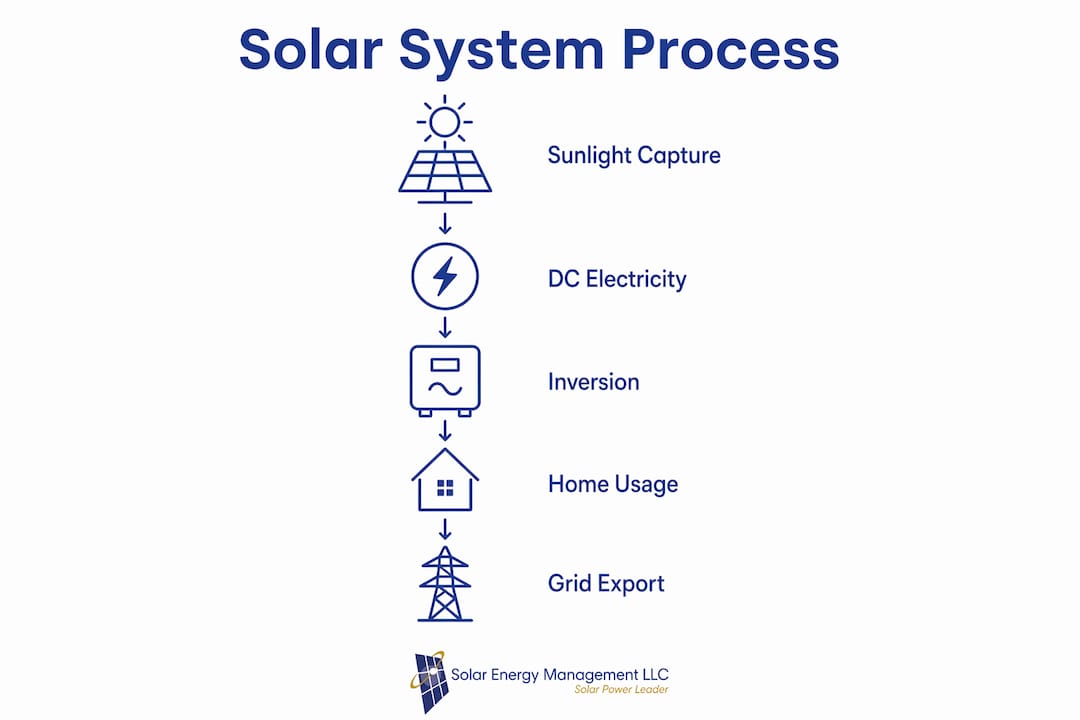
A residential solar system generates electricity in a specific, repeatable sequence. Photovoltaic panels absorb sunlight and produce direct current (DC) electricity. An inverter then converts that DC power into alternating current (AC), which is the form your appliances and outlets actually use. Any electricity your home does not consume in real time either flows back to the grid or charges a battery for later use.
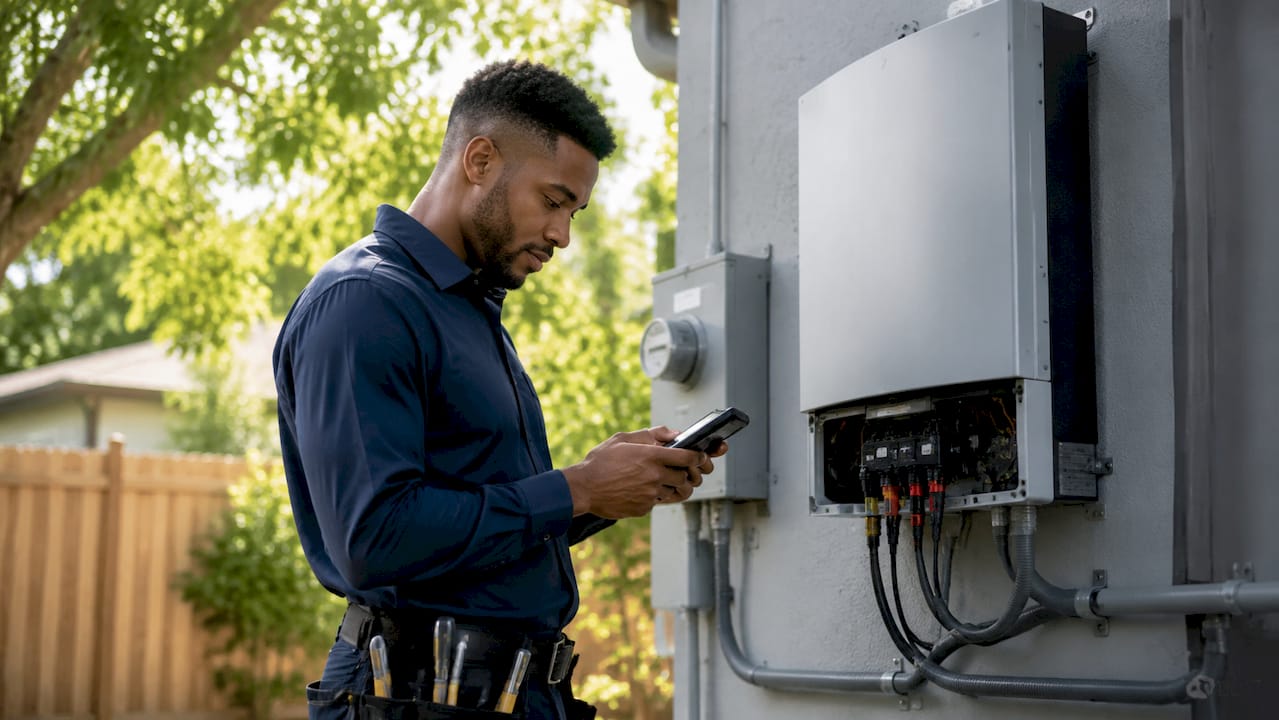
Installation takes 1–3 days for most residential systems. That speed surprises most homeowners, who expect a weeks-long construction project. Panels carry warranties of 25 or more years, while inverters typically last 10–15 years before needing replacement.
The system runs automatically. No switches to flip, no daily decisions to make. Your home draws from solar first, then pulls from the grid only when solar output falls short, such as at night or on heavily overcast days.
What are the main components of a residential solar system?
Every residential solar system shares the same core equipment, though the specific configuration varies by home size, roof type, and energy goals.
- Photovoltaic panels: These convert sunlight into DC electricity. Panels represent 33–50% of total equipment costs and are the most durable component, with warranties exceeding 25 years.
- Inverter: This converts DC to AC power. Inverters account for roughly 10–15% of equipment costs and typically require replacement after 10–15 years.
- Mounting hardware: Racking systems secure panels to your roof. Proper mounting protects the roof structure and keeps panels at the optimal angle for sunlight capture.
- Electrical Balance of System (BOS): Wiring, disconnects, and conduit make up 10–15% of total installation costs and are critical for system safety and code compliance.
- Battery storage (optional): Batteries store surplus solar energy for use after dark or during outages. This component is increasingly common as utility compensation rates shift.
| Component | Share of Equipment Cost | Typical Lifespan |
|---|---|---|
| Photovoltaic panels | 33–50% | 25+ years |
| Inverter | 10–15% | 10–15 years |
| Mounting hardware | 10–15% | 25+ years |
| Electrical BOS | 10–15% | 25+ years |
| Battery storage | Varies | 10–15 years |
Pro Tip: Plan your inverter replacement into your long-term budget from day one. It is the component most likely to need swapping mid-system-life, and the cost is predictable if you account for it early.
How does net metering affect your solar bill?
Net metering is the billing mechanism that credits you for electricity your solar system sends to the grid. A bidirectional meter measures both the power you import from the grid and the power you export from your panels. At the end of each billing cycle, your utility subtracts your exports from your imports, and you pay only the net difference.
Credit rates vary significantly by state and utility. Full retail net metering credits your exports at the same rate you pay for grid electricity, typically $0.12–$0.32 per kilowatt-hour. That is the most favorable model for homeowners. Net billing, a newer model used in states like California, Hawaii, and Arizona, credits exports at wholesale or avoided-cost rates, which run roughly 25–35% of retail. That gap changes the math on your payback period considerably.
Most utilities run an annual true-up process. Credits accumulate throughout the year, and any remaining balance is settled once per year, often in the spring. Net metering policy is set by state public utility commissions, not by the federal government, so the rules in Florida differ from those in California or New York. Checking your specific utility’s tariff before you size your system is not optional. It directly determines how much of your solar production translates into bill savings. For Florida homeowners on Tampa Electric, the TECO net metering rules are a useful starting point.
Pro Tip: If your state has moved to net billing, a battery changes the financial equation. Storing your own surplus and using it at night avoids the low export credit entirely, which often delivers better returns than exporting to the grid.
What practical factors shape system design and performance?
Getting the most from a residential solar system requires more than just putting panels on a roof. Three factors drive the difference between a well-designed system and an underperforming one: inverter architecture, roof geometry, and shading.
String inverters vs. microinverters
A string inverter connects all panels in a series circuit and converts their combined DC output in one unit. This works well for roofs with a single, unobstructed south-facing plane. The weakness is that shading on one panel reduces output for the entire string, not just that one panel. Microinverters attach to each panel individually, converting DC to AC at the panel level. Microinverters prevent shading on one panel from dragging down the entire array. They cost more upfront but recover that cost on complex or partially shaded roofs through higher lifetime generation.
Roof orientation and shading
South-facing roofs at a 30-degree pitch produce the highest annual output in most of the United States. East and west orientations still work well and can actually align better with morning and evening peak usage. Shading from trees, chimneys, or neighboring structures cuts output disproportionately. A shadow covering 10% of a panel can reduce that panel’s output by 50% or more under string inverter architecture. Inverter selection and shading analysis are the two factors professional installers cite most often as determinants of long-term system performance. Proper solar power system design accounts for both before a single panel is ordered.
Installation timeline and maintenance
Most residential installations complete in 1–3 days. Permitting and utility interconnection approval add 2–8 weeks to the total timeline in most jurisdictions. Once installed, solar systems require minimal maintenance. Panels benefit from occasional cleaning, especially in dusty or pollen-heavy environments. Inverters should be monitored through the system’s production app to catch any drop in output early.
How do battery storage systems complement residential solar?
Battery storage stores the surplus electricity your panels produce during peak sunlight hours so you can use it after dark or during a grid outage. Without a battery, any solar energy your home does not use in real time either goes to the grid or is wasted if your utility does not offer net metering credits.
The financial case for batteries has strengthened as net billing replaces full retail net metering. Battery payback periods run 5–8 years in net billing states like California, Hawaii, and Arizona. That is a meaningful return, especially when paired with time-of-use utility rates that charge more for grid power in the evening. The benefits of solar self-consumption are most pronounced when you can shift your own solar energy to the hours when grid rates are highest.
Key benefits of adding battery storage to a residential system include:
- Energy independence: You use your own power after dark instead of buying from the grid.
- Backup power: During outages, a battery keeps critical loads running, including refrigerators, medical equipment, and lighting.
- Rate arbitrage: In time-of-use markets, storing cheap midday solar and avoiding expensive evening grid rates cuts bills further.
- Reduced export losses: In net billing states, storing surplus avoids the low wholesale credit rate entirely.
Battery systems typically last 10–15 years. Sizing a battery correctly to your home’s load profile is as important as sizing the panels. Undersized batteries fill up quickly and still export at low rates. Oversized batteries add cost without proportional benefit. Detailed guidance on battery storage for solar in Florida covers the sizing and financial modeling in full.
Grid-tied vs. off-grid: what most homeowners actually choose
Grid-tied systems are the standard choice for residential solar. They use the utility grid as a virtual battery, exporting surplus during the day and drawing from the grid at night. This eliminates the need for large, expensive battery banks and keeps costs manageable.
Off-grid systems cut the utility connection entirely. Off-grid setups require oversized battery banks and backup generators, and their total cost runs 2–4 times higher than a comparable grid-tied system. The technical complexity is also substantially greater. You must size the battery bank to cover multiple days of cloudy weather, which means buying far more storage capacity than you use on a typical day. A detailed look at how off-grid solar works shows why most homeowners find the tradeoffs difficult to justify.
The practical reasons most homeowners choose grid-tied systems:
- Lower upfront cost with no need for a large battery bank
- Automatic grid backup when solar output falls short
- Simpler permitting and interconnection process
- Access to net metering or net billing credits
- No need to manage a generator for extended cloudy periods
Off-grid makes sense for rural properties where grid connection costs are prohibitive, or for homeowners with a strong preference for complete energy independence regardless of cost. For the vast majority of Florida homeowners, a grid-tied system with optional battery storage delivers the best combination of reliability, savings, and simplicity.
Key Takeaways
Residential solar converts sunlight into usable home electricity through photovoltaic panels, an inverter, and either grid export or battery storage, with net metering policy determining the actual financial return.
| Point | Details |
|---|---|
| Panels and inverters are the core | Panels last 25+ years; inverters need replacement at 10–15 years, so budget for it. |
| Net metering type drives payback | Full retail credits return far more than net billing’s wholesale rates, so verify your utility’s policy first. |
| Inverter choice depends on your roof | Microinverters outperform string inverters on shaded or complex roofs; string inverters suit simple, unshaded arrays. |
| Batteries shift the economics | In net billing states, storing surplus solar beats exporting it at 25–35% of retail value. |
| Grid-tied beats off-grid for most | Off-grid systems cost 2–4 times more and require generators; grid-tied is the practical choice for most homeowners. |
What 20 years of Florida solar consulting has taught us
The most common mistake we see is homeowners sizing their system based on average annual production without first understanding their utility’s compensation model. A system that looks great on paper under full retail net metering can underperform expectations significantly if the utility has already shifted to net billing. We always start with the tariff, not the panel count.
The second pattern we see consistently is undervaluing inverter selection. Homeowners focus on panel brand and wattage, which are visible and easy to compare. The inverter architecture, whether string or microinverter, often determines whether a system delivers its modeled output over 25 years or falls short by 10–15% due to shading losses that were never properly analyzed.
Battery storage is where the conversation has shifted most in recent years. Five years ago, batteries were a premium add-on for homeowners who wanted backup power. Now, in states that have moved to net billing, batteries are often the financially correct choice even without factoring in outage protection. Florida’s net metering rules have remained more favorable than California’s, but that can change. Homeowners who design their systems with battery-readiness today avoid a costly retrofit later.
The broader lesson is this: residential solar is not a product you buy. It is a system you design. The financial outcome depends on component selection, roof analysis, utility policy, and load profile, all of which require real analysis before you commit.
— Solar Energy Management
Planning your next step with Solar Energy Management
Florida homeowners who understand how solar energy systems function are in a far stronger position to evaluate their options clearly. The next decision is usually whether battery storage fits your specific situation, and that answer depends on your utility’s compensation rate, your evening energy load, and your backup power priorities.
Solar Energy Management provides independent consulting that covers all three. With over 20 years of experience in the Florida market, the team builds financial models that show exactly what a battery adds to your payback timeline under your specific utility tariff. The Florida battery storage guide is a strong starting point for homeowners weighing that decision. For homeowners who want to model the full system, the solar panel ROI calculator puts real numbers behind the decision before any commitment is made.
FAQ
How does solar power work at home, step by step?
Photovoltaic panels convert sunlight into DC electricity, an inverter converts it to AC, and your home uses that power in real time. Surplus electricity either charges a battery or flows to the grid for a credit.
What is net metering and how does it affect my bill?
Net metering credits you for solar electricity you export to the grid, offsetting what you import. Credit rates range from full retail ($0.12–$0.32/kWh) to wholesale rates of roughly 25–35% of retail, depending on your state and utility.
How long does a residential solar installation take?
Most installations complete in 1–3 days. Permitting and utility interconnection approval typically add 2–8 weeks to the total timeline before the system can operate.
Do I need a battery to go solar?
No. Most residential systems connect to the grid and use it as a backup source. Batteries become financially attractive when your utility uses net billing instead of full retail net metering, or when backup power during outages is a priority.
What is the difference between a string inverter and a microinverter?
A string inverter converts power from all panels together, so shading on one panel reduces output for the whole array. A microinverter converts power at each panel individually, preventing one shaded panel from affecting the rest of the system.
Recommended
- Residential Solar Energy Florida A 2026 Homeowners Guide – Commercial + Residential Solar Power Florida
- Florida Electric And Solar: A Homeowner’s And Business Guide – Commercial + Residential Solar Power Florida
- Solar Power System Design in Florida: A Complete Guide – Commercial + Residential Solar Power Florida
- Solar Flat Roof Mounting: A Florida Property Owner’s Guide – Commercial + Residential Solar Power Florida


