
TL;DR:
- Multi-tenant solar involves sharing photovoltaic systems to generate and distribute electricity and financial benefits. The success of such projects depends on choosing the right allocation, billing models, and understanding technical and regulatory constraints. Proper planning and utility coordination improve financial returns and tenant participation.
Multi-tenant solar energy management is defined as the practice of generating electricity from a shared photovoltaic system and distributing both the power and the financial benefits across multiple occupants through structured billing frameworks. Understanding how solar works in multi-tenant buildings requires more than knowing how panels generate electricity. It demands a working knowledge of allocation models, utility interconnection rules, and lease structures. At least 18 U.S. states and Washington, D.C. have authorized virtual net metering or shared renewable energy programs. That legal foundation makes multi-tenant solar viable at scale, but the operational complexity is where most developers get stuck. Solar Energy Management works with property owners across Florida to cut through that complexity with financial modeling, feasibility studies, and system design guidance built specifically for shared-occupancy assets.
How solar works in multi-tenant buildings: allocation and billing models
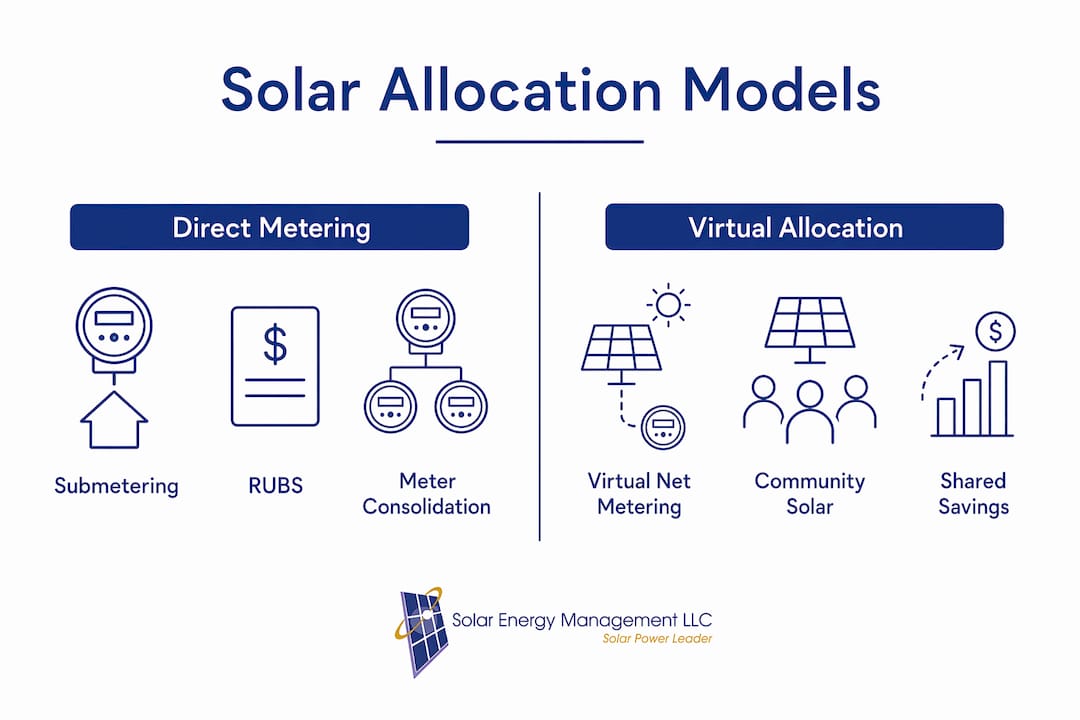
The core question in any multi-tenant solar project is not how many panels to install. It is how to assign the energy and the savings to the right accounts. Three primary models govern this process.

Virtual net metering (VNEM) is the most administratively clean option where it is available. A single solar system feeds the grid through a production meter, and the utility distributes bill credits across tenant accounts based on an allocation table the landlord files. No physical rewiring is required. The landlord sets the percentage each account receives, and the utility handles the credit math on each monthly bill. VNEM works best in states with clear program rules and stable utility tariffs.
Submetering with private billing places individual production meters at each tenant space and bills tenants directly for their solar consumption. This model delivers the highest accuracy and the clearest tenant savings story. The tradeoff is cost and regulatory exposure. Many states require a utility license or reseller authorization before a landlord can bill tenants for electricity, even solar electricity. Confirm your state’s rules before designing around this model.
Master-meter with Ratio Utility Billing System (RUBS) pass-through applies solar savings to the building’s master utility bill and distributes the benefit to tenants as a proportional rent reduction or utility credit. This is the simplest model to implement and requires no tenant-level metering changes. Accuracy suffers because individual consumption patterns are ignored, but it works well for older properties where submetering infrastructure is absent.
| Model | Accuracy | Complexity | Regulatory requirement | Best for |
|---|---|---|---|---|
| Virtual net metering | High | Low | VNEM-authorized state | New or renovated properties in VNEM states |
| Submetering + private billing | Very high | High | Utility resale license | Properties with existing submeters |
| Master-meter RUBS | Low | Very low | Minimal | Older buildings, quick deployment |
Pro Tip: Review your lease structure and local utility tariff before selecting a model. A VNEM-eligible property in a non-VNEM state is not actually VNEM-eligible. Confirm program availability with your utility before committing to a system design.
What technical and regulatory factors affect solar implementation?
Multi-tenant solar projects face technical constraints that single-occupancy commercial rooftop projects do not. Each constraint affects system sizing, interconnection approval, and ultimately your return on investment.
Utility interconnection caps. Utilities typically cap solar production at 100% of a meter’s historical 12-month consumption. In a building with 40 separate tenant meters, this means each meter has its own cap. Oversizing relative to any single meter wastes production and may trigger interconnection rejection.
Meter consolidation costs. Reducing the number of service meters to simplify interconnection is a major capital project. Meter consolidation typically costs $40,000 to $120,000 and takes 6–12 months. That timeline and cost must factor into your project pro forma before you commit to a design.
Split incentive barrier. The U.S. Department of Energy identifies the split incentive as a primary barrier in multifamily solar. The owner pays for the system; the tenant benefits from lower bills. Tools like the DOE’s RESIDE framework address this through energy arbitrage and peak shaving with battery storage.
State regulatory variation. VNEM rules, consumer protection requirements, and solar resale licensing vary significantly by state. Florida, for example, has specific net metering rules that affect how credits are calculated and carried forward.
Utility application timelines. Interconnection applications for multi-meter buildings often take longer than single-meter commercial projects. Budget 3–6 months for utility review, especially if your design involves a new transformer or service upgrade.
Pro Tip: Engage your utility’s interconnection team before finalizing system design. Early conversations reveal cap constraints, application timelines, and any infrastructure upgrades the utility will require. This single step prevents the most common and costly redesigns.
Confirming billing legality and utility tariff applicability before engaging tenants with savings promises is not optional. Variable state and utility rules directly affect whether your chosen model is legal to operate.
What are the practical steps to deploy and manage multi-tenant solar?
Deploying solar across a multi-tenant property follows a defined sequence. Skipping steps creates legal exposure, billing errors, and tenant dissatisfaction.
Conduct a roof and load assessment. Map the available roof area, structural capacity, and shading profile. Then pull 12 months of utility bills for every meter on the property. This load profile analysis tells you the maximum system size each meter can absorb under utility caps. A flat roof mounting assessment is the starting point for most apartment and commercial multi-tenant buildings.
Choose your allocation model early. The billing model determines system architecture. A VNEM design routes all production through a single production meter. A submetered design requires individual inverter circuits tied to tenant meters. Deciding late forces expensive redesigns.
Start with common areas if tenant billing is unresolved. Installing solar on common area meters reduces overhead costs immediately without changing tenant infrastructure. Elevators, hallways, pools, lobbies, and HVAC systems for shared spaces are all eligible loads. This approach generates measurable NOI improvement while you finalize the tenant-facing model.
Partner with a local solar provider experienced in multi-tenant design. Generic residential installers rarely understand interconnection caps, VNEM allocation tables, or utility resale licensing. The design and permitting complexity requires a provider with documented multi-tenant project experience.
Implement billing software before go-live. Multi-family solar projects require specialized billing and subscription management software to handle resident data privacy, consumer protections, and billing accuracy. Enterprise-grade platforms manage tenant subscriptions, credit allocations, and monthly statements automatically.
Plan for battery storage and EV charging from the start. Adding battery storage later is significantly more expensive than designing for it upfront. Battery systems enable peak shaving, energy arbitrage, and backup power, all of which improve project economics and tenant value. EV charging infrastructure follows the same logic: conduit and panel capacity are far cheaper to install during construction than after.
The multifamily solar feasibility process should precede any contractor engagement. A feasibility study confirms roof capacity, load profiles, utility program availability, and financial returns before you spend money on engineering.
How does solar adoption affect property value and tenant relations?
Solar adoption in multi-tenant buildings produces measurable financial and relational benefits. The economics favor the landlord structurally, but tenants receive enough benefit to drive strong participation rates.
Multi-tenant solar billing frameworks allow property owners to retain 70–85% of the net economic benefit, while tenants receive 15–30% as discounts on their utility bills. That split reflects the capital investment the owner makes and the ongoing billing administration the owner manages.
Tenant participation grows over time. Subscription rates for shared solar start at 62% in year one and rise to 78% by year three. Higher participation rates mean more of the system’s production is allocated and monetized, which improves project payback.
| Metric | Impact |
|---|---|
| Landlord economic benefit share | 70–85% of net solar savings |
| Tenant discount range | 15–30% reduction on utility bills |
| Year-one tenant subscription rate | 62% of eligible tenants |
| Year-three tenant subscription rate | 78% of eligible tenants |
Solar also improves net operating income directly. Reduced common area utility costs lower operating expenses, which raises NOI without raising rents. Higher NOI increases asset valuation at standard cap rates, which matters at refinancing or sale. ESG compliance is an additional driver: institutional investors and lenders increasingly require documented sustainability performance from commercial real estate assets. Solar with verifiable production data satisfies that requirement more concretely than most other property upgrades. The sustainability impact on real estate development is well documented across European and American markets alike.
Key Takeaways
Multi-tenant solar delivers the strongest financial returns when the allocation model, billing infrastructure, and utility interconnection strategy are aligned before system design begins.
| Point | Details |
|---|---|
| Choose the allocation model first | VNEM, submetering, or RUBS each require different system architectures and legal clearances. |
| Confirm utility rules before promising savings | Interconnection caps and VNEM availability vary by state and utility, affecting system size and billing legality. |
| Start with common areas | Offsetting shared-space loads generates immediate NOI improvement without tenant billing complexity. |
| Landlords retain the majority of savings | Owners typically keep 70–85% of net economic benefit while tenants receive 15–30% as bill discounts. |
| Plan battery and EV infrastructure upfront | Designing for storage and EV charging during initial installation avoids costly retrofits later. |
What Solar Energy Management has learned from multi-tenant projects
The most common mistake developers make is treating a multi-family solar project like a scaled-up residential installation. It is not. The panels are the easy part. The hard part is the billing architecture, the utility negotiation, and the tenant communication strategy. I have seen projects stall for 18 months because the developer assumed VNEM was available in their utility territory without verifying it first.
The split incentive problem is real, but it is solvable. The DOE’s RESIDE framework and modern energy arbitrage strategies using battery storage shift the economics enough to make the owner’s investment worthwhile even when tenants capture a meaningful share of savings. The key is modeling both sides of the equation before you sign a contract.
Multi-family solar also requires enterprise-grade software that most developers have never heard of. Managing 40 tenant subscriptions, monthly credit allocations, data privacy requirements, and consumer protection compliance is not a spreadsheet job. The developers who deploy successfully treat the billing platform as a core infrastructure decision, not an afterthought.
The future of this asset class points toward virtual power plants and smart grid integration. Buildings with solar, storage, and demand response capability will command premium valuations and access to utility incentive programs that standard buildings cannot touch. The developers who build that infrastructure now will have a significant advantage in three to five years.
— Solar Energy Management
Solar Energy Management can structure your multi-tenant solar project
Multi-tenant solar projects require more than a contractor and a permit. They require financial modeling, utility coordination, billing platform selection, and a feasibility process that confirms viability before capital is committed.

Solar Energy Management brings over 20 years of Florida solar experience to every multi-tenant engagement. The firm’s energy solutions cover independent consulting, system design guidance, battery storage planning, and financial modeling built around the commercial 30% investment tax credit. Whether you are evaluating a first solar installation or restructuring an existing system’s billing model, Solar Energy Management delivers the analysis you need to make a confident decision. Contact the team to schedule a feasibility consultation for your property.
FAQ
What is virtual net metering in multi-tenant buildings?
Virtual net metering allows a single solar system to feed the grid through one production meter, with the utility distributing bill credits across multiple tenant accounts based on a landlord-filed allocation table. No physical rewiring of tenant units is required.
How does solar interconnection work in multi-tenant buildings?
Each utility meter on a multi-tenant property has its own interconnection limit, typically capped at 100% of that meter’s historical 12-month consumption. Developers must size and allocate solar production carefully to stay within each meter’s cap and avoid rejected interconnection applications.
Can tenants in apartments benefit directly from solar panels?
Yes. Under VNEM programs, tenants receive bill credits proportional to their allocated share of the system’s production. Under submetered private billing models, tenants pay a discounted rate for solar electricity directly. Tenant subscription rates reach 78% by year three in well-structured programs.
What does meter consolidation cost in a multi-tenant solar project?
Consolidating service meters to simplify solar interconnection typically costs $40,000 to $120,000 and takes 6–12 months. That investment affects initial project economics and must be included in the feasibility analysis before committing to a design.
Should property managers promise tenants solar savings before the system is installed?
No. Property managers should confirm the legal billing structure, including VNEM availability, submetering authorization, or community solar enrollment, before communicating savings estimates to tenants. Variable state and utility rules can invalidate savings projections if the billing model is not legally confirmed first.
Recommended
- Multifamily Solar Feasibility: A Developer’s 2026 Guide – Commercial + Residential Solar Power Florida
- Ways Solar Improves Property NOI: Investor Guide 2026 – Commercial + Residential Solar Power Florida
- Solar Flat Roof Mounting: A Florida Property Owner’s Guide – Commercial + Residential Solar Power Florida
- Commercial Solar Power Systems a Florida Business Guide – Commercial + Residential Solar Power Florida


