
TL;DR:
- Florida has no state-level solar renewable energy certificate market, so residents cannot buy or sell SRECs for income. Instead, solar owners benefit mainly from net metering credits, tax exemptions, and the federal Investment Tax Credit. Owning your system and applying for these incentives leads to strong financial returns without the need for SRECs.
Solar Renewable Energy Certificates, known in the industry as SRECs, are tradable instruments that represent the environmental attributes of one megawatt-hour of solar electricity generation. Florida does not operate a state-level SREC market, which means residents and businesses cannot obtain or sell SRECs for income. If you are searching for ways to solar renewable energy certificates obtain in Florida, the practical answer is that the state’s financial incentives work differently. Net metering, the federal Investment Tax Credit (ITC), and permanent state tax exemptions replace what SRECs provide elsewhere. Solar Energy Management has spent over 20 years helping Florida clients navigate exactly this landscape.
What are solar renewable energy certificates and why doesn’t Florida have them?
SRECs are certificates issued when a solar system generates one megawatt-hour of electricity. In states with Renewable Portfolio Standards (RPS) that mandate a specific percentage of solar generation, utilities must buy SRECs to prove compliance. That market mechanism creates a secondary income stream for solar owners on top of their electricity savings.
Florida does not have a binding RPS with a solar carve-out. Without that legislative mandate, there is no compliance market and no mechanism for utilities to purchase SRECs. Florida utilities do not provide cash rebates or SREC payments for residential rooftop solar. Savings come entirely from net metering credits and tax exemptions.
The distinction between RECs broadly and SRECs specifically matters here. A REC represents one megawatt-hour of any renewable electricity. An SREC is a solar-specific REC used in compliance markets. Florida has no formal program for either type at the state level for individual solar owners.
Pro Tip: If a solar salesperson in Florida promises you SREC income, that is a red flag. Florida has no state SREC market, and experts confirm that net metering is the primary source of financial savings for Florida solar owners.
The confusion is understandable. Residents who research how to get solar certificates often find information from states like New Jersey, Massachusetts, or Maryland, where SREC markets are active and lucrative. Florida’s financial case for solar is strong, but it is built on a different set of tools entirely.
How Florida solar owners benefit financially without SRECs

Florida’s incentive structure is not a consolation prize. For most owners, the combination of retail-rate net metering, property tax exemptions, sales tax exemptions, and the federal ITC delivers compelling financial returns.
Net metering: Florida’s most powerful solar benefit
Florida’s net metering policy credits excess solar generation at the full retail electricity rate, dollar for dollar against your usage. Credits roll over monthly and reset annually, with unused credits paid out at a lower avoided-cost rate. Think of it as a virtual battery inside the utility grid. Every kilowatt-hour your panels produce but don’t immediately use reduces your bill at the same rate you would otherwise pay.
All major investor-owned utilities in Florida, including FPL, Duke Energy, and Tampa Electric (TECO), provide full retail-rate net metering for solar systems up to 2 MW. Homeowners with a typical 5 kW system save $1,500 to $3,000 annually through net metering credits. That annual savings range, compounded over a 25-year system life, represents the core financial argument for going solar in Florida.
State tax exemptions that cut upfront and long-term costs
Florida offers two permanent tax exemptions that directly reduce the cost of solar ownership.
- Property tax exemption: 100% of the added home value from solar equipment is exempt from property taxes. Over a system’s lifetime, this saves homeowners $10,000 to $15,000.
- Sales tax exemption: Florida exempts solar equipment purchases from the 6% state sales tax. On a typical residential system, this saves $1,200 to $1,800 at the point of purchase.
These exemptions require no application. The sales tax exemption applies automatically at the point of sale when you purchase qualifying solar equipment. The property tax exemption is administered at the county level and takes effect when your system is permitted and installed.
The federal Investment Tax Credit
The federal ITC allows you to deduct 30% of your total solar system cost from your federal income tax liability. For a $25,000 residential system, that is a $7,500 credit applied directly against what you owe the IRS. Businesses claiming the commercial ITC follow the same 30% rate and file through their business tax return. The credit applies to equipment and installation costs, including battery storage when the battery is charged primarily by solar.
| Incentive | Benefit | Who qualifies |
|---|---|---|
| Net metering | $1,500–$3,000/year in bill credits | System owners connected to FPL, Duke, TECO |
| Property tax exemption | $10,000–$15,000 lifetime savings | Florida homeowners with permitted solar |
| Sales tax exemption | $1,200–$1,800 upfront savings | All solar equipment purchasers in Florida |
| Federal ITC (30%) | 30% of system cost as tax credit | Owners with federal tax liability |
Pro Tip: Pair the federal ITC with a solar loan so you can use the tax credit to pay down principal in year one. This approach reduces your effective system cost without requiring full cash payment upfront.
How can you qualify and apply for Florida solar incentives?
Qualifying for Florida’s solar incentives requires meeting specific ownership, installation, and documentation standards. The process is straightforward when you know the checkpoints.
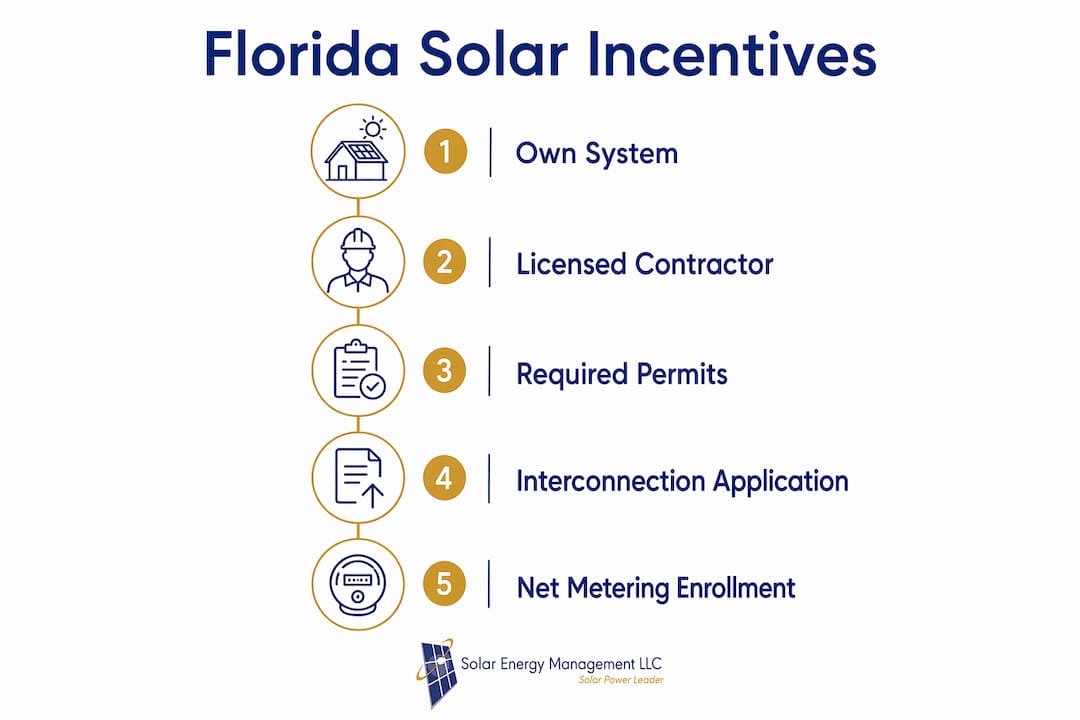
Own your system outright or through a solar loan. Florida prohibits third-party solar ownership for residential net metering. Leases and power purchase agreements (PPAs) disqualify homeowners from standard interconnection agreements. System ownership is mandatory to access net metering and the associated financial benefits.
Use a licensed solar contractor. Florida requires a licensed electrical or solar contractor to install grid-tied systems. Permits must be pulled and inspections passed before your utility will approve interconnection. Unlicensed installations are ineligible for net metering and void most incentive claims.
Submit your interconnection application to your utility. FPL, Duke Energy, and TECO each have their own interconnection application portals. Your installer typically handles this, but you should confirm the application is submitted and approved before your system goes live. Systems up to 10 kW use a simplified process; larger systems require additional technical review.
Claim the sales tax exemption at purchase. No separate application is needed. Confirm with your installer that the invoice correctly excludes Florida sales tax on qualifying solar equipment. Keep the invoice for your records.
File IRS Form 5695 for the federal ITC. Residential solar owners claim the ITC on their personal tax return using Form 5695. Businesses use Form 3468. You need your total system cost documentation and installation date. File in the tax year your system is placed in service.
Verify your county’s property tax exemption process. Most Florida counties apply the solar property tax exemption automatically after your permit is recorded. Some counties require a separate exemption application filed with the county property appraiser’s office. Check with your county before assuming it is automatic.
Explore USDA REAP grants if you operate a rural business or farm. USDA REAP grants can cover up to 50% of solar costs for rural small businesses and agricultural producers in Florida. This grant stacks with the federal ITC and delivers more value than most state-level REC markets in other states.
For a deeper look at Florida net metering rules and how credits are calculated by utility, Solar Energy Management maintains a current guide covering all major Florida investor-owned utilities.
What alternatives exist for businesses seeking renewable energy credits?
Businesses that cannot install on-site solar still have paths to claim renewable energy use and meet sustainability reporting goals. Florida utilities offer subscription programs that provide bill credits and renewable energy attributes without requiring rooftop installation.
FPL SolarTogether and Duke Energy Progress SolarSense are community solar programs that allow customers to subscribe to a share of a utility-scale solar farm. Subscribers receive monthly bill credits proportional to their share’s output and can claim the renewable energy use in their sustainability reports.
Key considerations for businesses evaluating these programs:
- No capital expenditure required. Subscriptions carry no upfront equipment cost, making them accessible for businesses in leased facilities or with structural limitations.
- Renewable energy attributes are transferable. Subscription credits typically include the renewable energy attribute, which supports GHG accounting under frameworks like the GHG Protocol Scope 2 guidance.
- Bill credit rates vary. Credits are based on the program’s generation rate, not the retail rate you pay. The financial return is lower than owning rooftop solar with full retail-rate net metering.
- Subscription terms and availability are limited. Both FPL SolarTogether and Duke SolarSense have waitlists. Businesses should apply early and plan for a lead time of several months.
For businesses weighing subscription programs against ownership, the commercial solar financing options available in Florida often make ownership more accessible than it appears. A detailed financial model comparing subscription credits to owned-system net metering credits typically shows ownership delivering a stronger long-term return. Businesses promoting their sustainability commitments can also benefit from clear energy efficiency messaging that accurately reflects their renewable energy participation.
Key Takeaways
Florida solar owners cannot obtain SRECs, but net metering, the federal ITC, and state tax exemptions together deliver strong financial returns that rival or exceed SREC income in other states.
| Point | Details |
|---|---|
| No Florida SREC market | Florida has no state-level SREC program; savings come from net metering and tax exemptions. |
| Net metering is the core benefit | Full retail-rate credits from FPL, Duke, and TECO save owners $1,500–$3,000 per year. |
| Tax exemptions reduce total cost | Property and sales tax exemptions save $11,200–$16,800 combined over the system’s life. |
| System ownership is required | Leases and PPAs disqualify Florida homeowners from net metering and most incentives. |
| Businesses have subscription options | FPL SolarTogether and Duke SolarSense provide renewable credits without on-site installation. |
What Florida’s solar incentive landscape actually rewards
After two decades of working with Florida solar clients, the pattern is consistent. Owners who go in expecting SREC income are disappointed. Owners who understand net metering from the start make better decisions and see better outcomes.
The misconception about solar renewable energy certificates is not just a terminology problem. It leads people to delay decisions, waiting for a Florida SREC market that has no legislative path to existence. Meanwhile, current net metering rates are favorable and may be protected for 20 years post-interconnection for systems installed under today’s rules. That protection is not guaranteed to extend to future installations if Florida’s regulatory environment shifts.
My strongest advice to any Florida homeowner or business owner is this: own your system. The financial case for ownership versus leasing is not close when you factor in net metering credits, the 30% federal ITC, and the permanent property tax exemption. Leasing trades away the most valuable incentives for the convenience of no upfront cost. That trade rarely makes financial sense in Florida.
For rural businesses and agricultural operations, the USDA REAP grant changes the calculus entirely. Covering up to 50% of system cost before the ITC is applied makes ownership the obvious path. The renewable energy credits application process for REAP is more involved than standard utility interconnection, but the financial payoff justifies the effort.
Florida’s solar market rewards owners who act on accurate information. The state’s incentives are real, substantial, and available now.
— Solar Energy Management
Solar Energy Management’s Florida solar solutions
Florida’s solar incentive structure rewards informed decisions made with the right guidance. Solar Energy Management works with both residential and commercial clients across Florida to model the full financial picture: net metering credits, federal ITC, state tax exemptions, and financing structures that make ownership accessible.

Whether you are sizing a rooftop system for your home, evaluating a commercial installation, or comparing subscription programs against owned solar for your business, Solar Energy Management’s team brings over 20 years of Florida-specific experience to every engagement. Explore the firm’s energy solutions for homes and businesses or review the solar system design guide to understand what a properly sized Florida system looks like. For owners considering storage, the battery storage for solar guide covers how pairing storage with net metering maximizes your energy independence.
FAQ
Does Florida have a solar renewable energy certificate program?
Florida does not operate a state-level SREC market. Residents and businesses cannot obtain or sell SRECs for income in Florida.
What is the best way to financially benefit from solar in Florida?
The most effective path is owning your system and enrolling in retail-rate net metering through your utility, which saves a typical homeowner $1,500 to $3,000 per year.
Can I claim the federal solar tax credit in Florida?
Yes. Florida solar system owners claim the 30% federal Investment Tax Credit by filing IRS Form 5695 (residential) or Form 3468 (commercial) in the tax year the system is placed in service.
What are the requirements for solar certificates or net metering in Florida?
You must own your solar system, use a licensed contractor, obtain the required permits, and submit an interconnection application to your utility. Leases and PPAs disqualify you from net metering.
Where can businesses apply for renewable energy credits without on-site solar?
Florida businesses can subscribe to utility community solar programs like FPL SolarTogether or Duke Energy Progress SolarSense to receive bill credits and claim renewable energy use for sustainability reporting.
Recommended
- Renewable Energy Solutions for Businesses: Florida Solar – Commercial + Residential Solar Power Florida
- Unlock Florida’s Best Residential Solar Energy Solutions – Commercial + Residential Solar Power Florida
- Florida Solar Installer: A Guide To Hiring The Right Expert – Commercial + Residential Solar Power Florida
- Solar Power Systems Florida Your Complete 2026 Guide – Commercial + Residential Solar Power Florida


