Florida homeowners usually start asking this question after the same pattern repeats for months. The air conditioning runs hard, the bill jumps, and the number at the bottom of the statement feels less predictable than it should. You know Florida has abundant sun. What you don't know yet is whether putting panels on your roof is a smart investment or an expensive mistake.
That's the right way to approach it. Home solar isn't a lifestyle purchase. It's a capital decision tied to your roof, your utility bill, your financing method, your time horizon, and increasingly, your interest in battery backup during outages. In Florida, that last point matters more than many generic national articles admit.
As independent solar power consultants, we look at this the same way a financial advisor would look at a major property upgrade. The question isn't whether solar sounds good. The question is whether the numbers work for your house in Florida, after incentives, under your utility structure, and over the years you expect to own the property.
Your Guide to Making a Smart Solar Decision in Florida
A good solar decision starts with a simple shift in mindset. Stop asking whether solar is good in general, and start asking whether your Florida home can turn sunlight into durable financial value.
That means looking at five things together:
- Your Current Utility Spending: If your electric bills are already painful, solar has more room to create meaningful savings.
- Your Roof's Suitability: A roof with poor orientation, heavy shade, or limited usable space can weaken the economics.
- Your Ownership Horizon: Solar usually works best for homeowners planning to stay put long enough to benefit from years of production.
- Your Financing Strategy: Cash, loans, and third-party structures don't produce the same outcome.
- Your Resilience Goals: In Florida, storm outages can matter almost as much as bill reduction.
The most common mistake I see is focusing on the sales payment instead of the full investment case. A monthly loan payment can hide a weak project just as easily as it can support a strong one. A sound review has to compare total installed cost, expected long-term production, tariff structure, maintenance assumptions, and the home's physical constraints.
Practical rule: If a proposal only shows “monthly savings” and doesn't clearly explain system size, export assumptions, roof fit, and ownership structure, you don't have enough information to decide.
Florida adds another layer. Solar can be attractive here because cooling loads are high and sunshine is strong, but that doesn't guarantee a good result. The financial outcome depends on whether your system offsets the right electricity at the right times, and whether your design still makes sense if utility credit rules become less generous over time.
That's why the best answer to “is home solar worth it” in Florida is never yes or no by itself. It's conditional. The homeowners who benefit most usually have strong electricity usage, a suitable roof, realistic expectations, and a plan for how the system will perform under changing policy conditions.
The Core Financial Equation of Home Solar
A Florida homeowner comparing two solar quotes can see the same projected monthly savings on both proposals and still be looking at two very different investments. The difference usually comes down to one question. How much utility spending will the system offset after incentives, financing costs, and changing export rules are accounted for?
The basic equation is simple. Your return depends on the net cost of the system and the value of the electricity it replaces over many years. The difficult part is that both sides of that equation are highly specific to the house, the utility, and the way the system is designed.
According to Solar Energy World's summary of SEIA and Wood Mackenzie pricing data, average U.S. residential system prices have fallen sharply over time, with recent pricing often cited in the range of $2.50 to $3.50 per watt, or about $15,000 to $21,000 for a typical 6 kW system before incentives. That is a reasonable benchmark for Florida homeowners starting the quote review process, but it is only a benchmark. A low per-watt number can still produce a weak outcome if the design underperforms, the roof is poorly suited, or too much production is pushed back to the grid at lower future value.

What You're Actually Buying
A solar purchase is a long-lived energy asset attached to your home. In Florida, total project cost usually shifts for practical reasons:
- System size: Larger systems cost more in total, though cost per watt may decline.
- Equipment mix: Panel efficiency, inverter type, and battery readiness affect both price and long-term output.
- Roof conditions: Steep roofs, complex layouts, shading, and certain materials can increase labor and reduce design flexibility.
- Electrical work: Panel upgrades, meter work, and code-related improvements can materially change the final price.
For a more local pricing frame, this breakdown of Florida solar power cost helps show how state-specific installation factors affect the numbers.
Where The Savings Actually Come From
Solar savings are not created by panel count alone. They come from replacing expensive retail electricity with your own production. In Florida, that means the best systems are usually sized and oriented to reduce the bill you pay, not to maximize raw annual generation on paper.
That distinction matters more than many sales proposals suggest. If your household uses a large share of power during hot afternoons, solar can offset valuable consumption directly. If the system sends a large share of production back to the grid, the economics become more sensitive to utility policy. That is why battery storage is no longer just a backup-power conversation in Florida. As net metering rules face more scrutiny over time, storage can protect the value of excess solar by shifting more of it into evening use inside the home.
Two neighboring houses can therefore get very different financial results from similar-sized systems. One may have high air-conditioning demand, strong sun exposure, and a load profile that matches solar production well. The other may have lower usage, partial shading, or a design that overproduces at midday and depends too heavily on export credits.
Solar Energy World's review also notes that many residential systems still reach payback in about 7 to 12 years. That range is useful as a broad reference point, not a Florida-specific promise. In this state, the stronger projects usually share three traits: a competitive net installed cost, production that offsets high-value utility purchases, and a plan for how the system performs if exporting power becomes less attractive than self-consuming it.
A good solar investment in Florida is less about chasing the biggest system and more about buying the right one at the right net cost.
Maximizing Your Return With Florida Solar Incentives
A gross system price is only the beginning of the analysis. What matters is the net cost after applicable incentives, and Florida homeowners often miss part of the value in this regard.

The Federal Piece
For most owner-occupied residential projects, the federal tax credit is the first lever to examine. It can materially reduce your effective cost, but only if your tax situation allows you to benefit from it. That's why I advise Florida homeowners to review this with a tax professional before assuming the full value will land exactly as shown in a sales proposal.
The key point is practical. A tax credit changes the net investment, not the system's engineering quality. A weak design does not become a strong investment just because incentives lower the entry price.
The Florida Advantage
Florida's state-level treatment is one reason solar deserves a closer look here than in some other markets. The state has benefits that can improve the investment case for eligible homeowners, particularly by reducing certain tax friction around the purchase and ownership of a system.
That matters because every dollar you don't lose to transaction cost improves the odds of a workable return. If you're reviewing what may apply to your property, this overview of Florida solar rebates and incentives is a good place to organize the options.
How To Think About Incentives Correctly
The cleanest way to evaluate incentives is to separate them into three categories:
Upfront Cost Reduction
These directly lower what you effectively pay to acquire the system.Ownership Protection
These preserve more of the system's value after installation rather than creating immediate cash savings.Project Viability Support
These don't guarantee a good deal, but they can push a borderline project into acceptable territory.
Here's the caution. Incentives should improve a project that already makes sense. They shouldn't be used to excuse a bad roof, weak production, or an overpriced proposal.
The best Florida solar projects work twice. They work with incentives, and they still look rational when you stress-test the assumptions behind those incentives.
That stress test matters more now because homeowners need to think beyond the initial tax benefit. The strongest projects are the ones that remain financially durable if utility export values weaken, if ownership plans change, or if you later decide to add storage for resilience.
Modeling Your Payback Period And Return On Investment
A payback period tells you how long it takes cumulative savings to recover your net investment. Return on investment asks a broader question. After the system pays for itself, how much financial value does it continue to create over the rest of its useful life?
Those aren't the same thing, and Florida homeowners should keep them separate. A proposal can advertise an appealing payback estimate while still hiding weak long-term assumptions.
The National Benchmarks And What They Mean In Florida
According to EnergySage's analysis of whether solar panels are worth it, the average shopper saves between $37,000 and $154,000 over 25 years, with a cash-purchase payback of about 10.1 years before incentives. Those are national figures, not a guaranteed Florida outcome, but they help frame the scale of what a successful project can produce over long ownership.
The important lesson is that solar usually behaves more like a long-duration hedge than a quick-return appliance. If you're planning to stay in your Florida home, the system has time to compound value through utility-bill avoidance. If you might move soon, resale treatment and transferability become much more important.
The Inputs That Change Your Result
A real payback model depends on several property-specific variables:
- Electricity Consumption Pattern: High annual use helps, but timing matters too. Homes that consume more power during solar production hours can capture more direct value.
- Utility Rate Structure: The worth of each kilowatt-hour depends on what your utility charges and how exported energy is treated.
- Roof Geometry And Shade: A clean roof plane with strong sun exposure supports better annual production than a shaded or fragmented layout.
- System Sizing: Oversizing can become a problem if too much midday output gets pushed to the grid at reduced value.
- Financing Method: Cash usually maximizes lifetime return. Borrowed money may preserve liquidity but can change the economics.
The Roof Timing Issue Most Homeowners Underestimate
If your roof is aging, the solar decision can't be separated from the roofing decision. Removing and reinstalling panels later is a real complication, so the project timeline matters. That's one reason homeowners often review roof replacement economics alongside solar planning. If you're weighing broader property-upgrade timing, this article on boosting home value with new roofing gives helpful context on why roof condition influences both resale and renovation strategy.
A useful next step is to run your own assumptions through a solar panel return on investment calculator. The value of that exercise isn't the single output number. It's seeing how sensitive your outcome is to usage, cost, and financing inputs.
If a small change in assumptions makes the project stop working, the deal was fragile to begin with.
The Battery Question Resilience And Future-Proofing
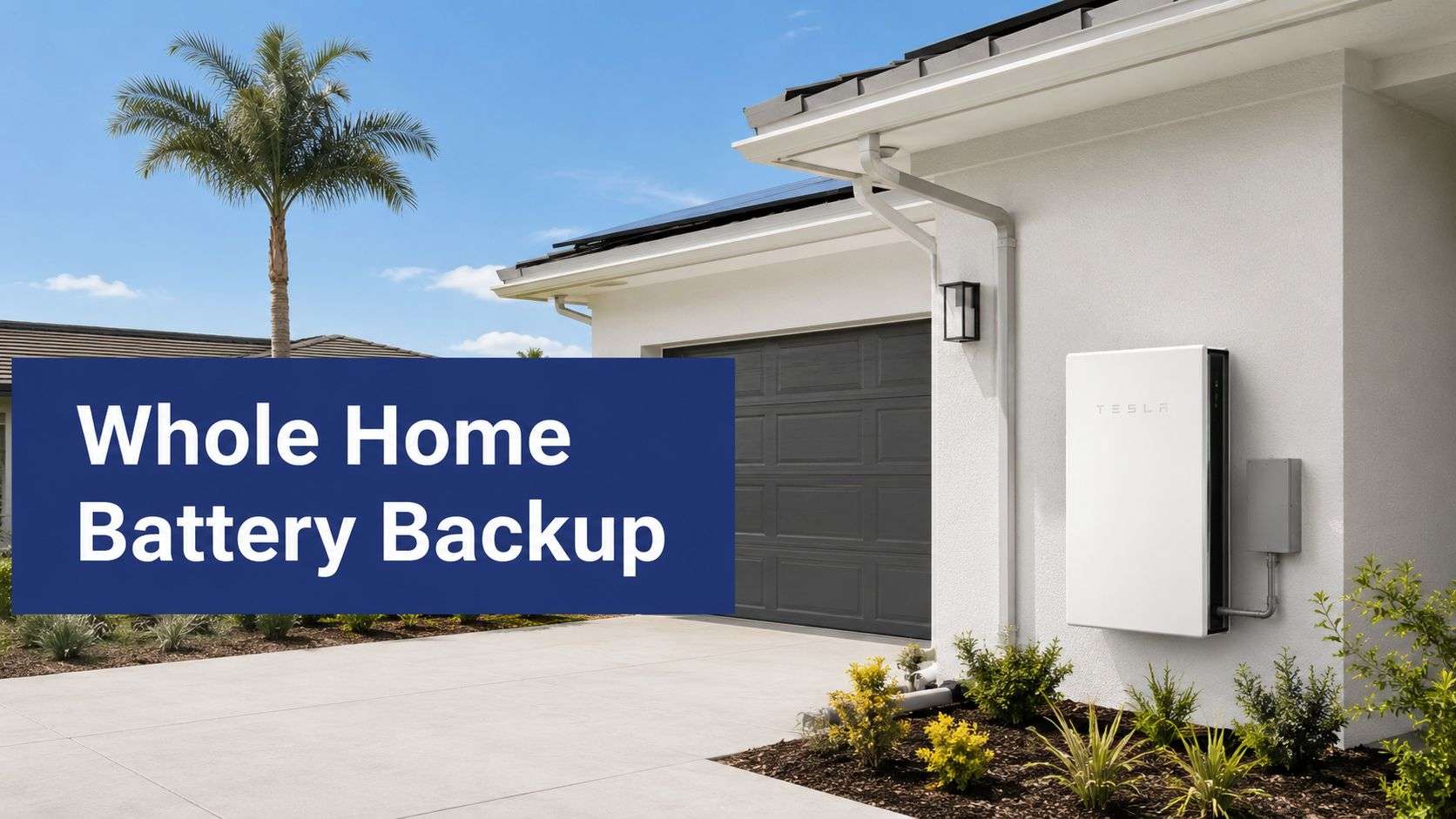
In Florida, a battery used to be framed as a premium add-on. That framing is outdated. Storage is becoming a strategic part of the solar conversation because it solves two separate problems at once. It improves household resilience during outages, and it can protect the economics of solar as export compensation becomes less favorable.

Why Storage Matters More Now
The old rooftop-solar model assumed excess daytime production would receive strong value when sent back to the grid. That assumption is getting weaker in parts of the U.S. The market is moving toward tighter export economics, and that changes what “worth it” means for homeowners whose systems overproduce during midday hours.
As SolarReviews notes in its discussion of changing net metering and storage economics, California's NEM 3.0 sharply cut export compensation, and Nevada, Hawaii, and other markets have also reduced the value of exported power. The same source says the value of pairing storage is rising because batteries can shift solar into evening peak periods, and the U.S. Energy Information Administration reported record battery additions in 2024, signaling that storage is no longer niche.
Florida homeowners should pay attention even if their current utility structure still looks workable. Policy risk doesn't announce itself politely. A battery can reduce dependence on future export terms by helping you consume more of your own generation behind the meter.
The Florida Case For Resilience
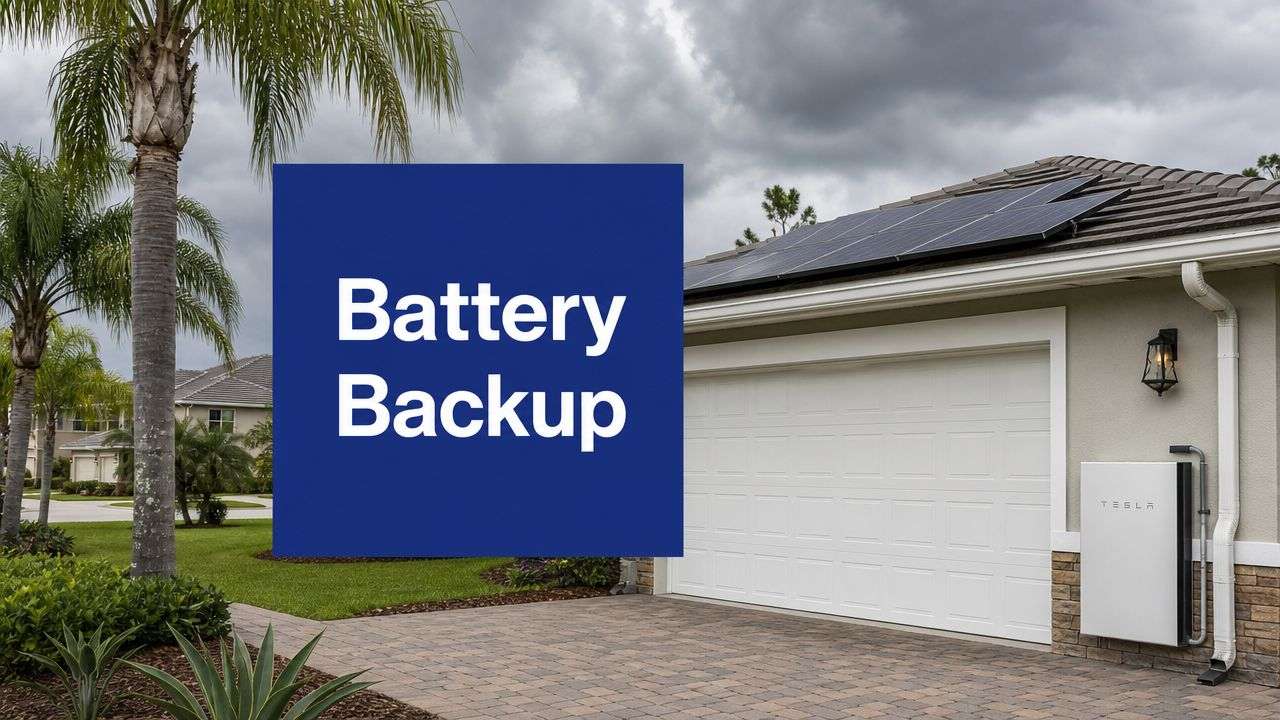
Financial modeling matters, but Florida adds a practical reality that spreadsheets don't fully capture. Storms and outages happen. If you work from home, store medication, depend on refrigeration, or want critical circuits available during a grid interruption, battery backup has value beyond tariff math.
A battery doesn't make every solar project worth doing. It does change the design question from “How much can I export?” to “How much value can I keep on-site?”
Consider these two use cases:
- Backup Power For Critical Loads: Refrigeration, internet, lights, selected outlets, and medical or communications needs.
- Load Shifting For Better Economics: Store solar generation during the day and use it later when utility power is more expensive or less favorably credited.
If resilience is part of your goal, it helps to review how solar battery backup for power outages is typically planned around critical-load selection, system sizing, and household priorities.
The bigger conclusion is this. In Florida, batteries are no longer only about peace of mind. They're part of future-proofing a solar investment against changing utility policy while improving household continuity during severe weather.
Practical Realities Roofs Siting And Financing
A solar project can look excellent in a proposal and still fail in the field. Roof condition, siting constraints, and financing structure decide whether the theoretical savings ever become real.
Roof And Site Fit
Start with the roof, not the equipment brochure. The ideal Florida roof for solar has enough usable area, limited shading, and a remaining service life that aligns with the solar asset you're about to mount on it. If the roof is already near replacement age, the cleaner move is often to solve that issue first.
Flat and low-slope roofs deserve extra scrutiny because drainage, membrane condition, attachment method, and service access all affect project design. Homeowners comparing repair-versus-replace decisions may find this Tampa Bay flat roof cost analysis helpful as background when evaluating whether the roof is ready to host a long-term energy system.
For a broader planning view, this guide on solar and roof coordination can help you think through sequencing and structural questions.
Financing Changes The Outcome
Cash, loans, and leases should not be treated as interchangeable.
With a cash purchase, you keep the direct economic upside of the system, and the long-term value case is usually strongest because there's no financing cost eroding savings. With a loan, you preserve cash but need to compare interest cost against expected energy savings and ownership benefits. With a lease or similar third-party structure, the monthly payment may look simple, but you don't receive the same ownership economics.
That ownership distinction matters for resale. According to ConsumerAffairs' 2026 summary on solar and home value, homes with owned solar systems have sold for about 4% to 10% more than comparable homes without solar, while a Zillow analysis found a 4.1% premium, or about $20,500 on a $500,000 home. Those figures don't mean every Florida home will get the same result, but they do support a practical point: ownership structure affects more than monthly cash flow. It can affect resale value too.
A Short Feasibility Screen
Before moving forward, check these items carefully:
- Roof Age And Condition: If the roof needs major work soon, solar timing may be wrong.
- Shade Profile: Trees, chimneys, and neighboring structures can undercut production.
- Ownership Horizon: The longer you expect to stay, the easier it is to harvest lifetime value.
- Financing Fit: Monthly affordability is not the same as a strong investment.
This is one area where independent modeling matters. Solar Energy Management LLC provides feasibility studies and financial modeling for Florida properties, which can help homeowners compare roof readiness, ownership options, and projected return before signing an installation contract.
Your Solar Decision Checklist And Next Steps
A Florida homeowner with a high summer power bill, a 12-year-old roof, and a quote that looks attractive after the federal tax credit still has one unanswered question. Will this system produce enough savings, for long enough, under Florida utility rules to justify the cash outlay or financing cost?

That is the right frame for a final decision. In Florida, the strongest solar outcomes usually come from homes with solid daytime or early evening usage, a roof that will not need major work soon, and a buyer who evaluates battery storage as a financial and resilience tool rather than an add-on.
The Florida Homeowner Checklist
Use this checklist before you request final bids or sign a contract:
Pull 12 Months Of Electric Bills
Confirm how much you spend across the year, not just in peak summer months. The pattern matters because system value depends on when you use power, not only how much you use.Verify Roof Readiness
Check age, condition, shade, usable square footage, and wind-exposure considerations. A good solar quote cannot fix a marginal roof.Test The Battery Case Separately
Ask for one proposal with storage and one without. In Florida, that comparison is becoming more important as homeowners place a higher value on outage protection and prepare for the possibility that export compensation becomes less favorable over time.Model The Net Investment, Not The Sticker Price
Use after-incentive cost, financing terms, expected production, and utility bill offsets. A low advertised price can still produce a weak return if assumptions are too aggressive.Pressure-Test The Assumptions
Ask the installer to show results under lower export credits, modest load changes, and a shorter ownership period. If the economics only work under best-case conditions, the project is fragile.
Long-term output assumptions belong in that stress test. A homeowner case study on panel degradation shows that panels degrading at 0.25% per year were still expected to operate at about 92% of original output in year 25, as discussed in this panel degradation example.
A sound solar decision rests on assumptions that remain reasonable after you reduce projected savings, extend payback, and account for policy risk.
The practical next step is a property-specific feasibility review. That review should cover roof condition, shading, bill history, utility rate structure, ownership timeline, and whether storage improves the economics under your household's usage pattern.
If you want an independent, numbers-first review before committing to a solar proposal, Solar Energy Management LLC helps Florida homeowners evaluate feasibility, model payback, compare storage options, and make a data-driven decision based on their roof, utility usage, and long-term financial goals.