
A solar feasibility study for multifamily properties is the structured process of determining whether a solar energy system will deliver cost-effective, sustainable returns given a building’s physical characteristics, utility rules, and financial targets. The industry term for this process is a solar project feasibility study, though developers often refer to it informally as multifamily solar analysis. Understanding how solar feasibility works multifamily requires evaluating three distinct layers: technical site conditions, financial modeling, and operational design. A 150 kWp rooftop system on a 50-unit apartment building typically achieves a 7–10 year payback and a 6%–10% IRR over 20 years. Those numbers are achievable, but only when the feasibility process is executed correctly from the start.
How solar feasibility works for multifamily properties
The feasibility process begins before any equipment is specified. Think of it the way an architect approaches a high-rise: no structural engineer commits to a design without first understanding the soil, load requirements, and zoning constraints. Solar feasibility works the same way. The study maps physical conditions, utility rules, and financial assumptions into a single go or no-go decision framework.

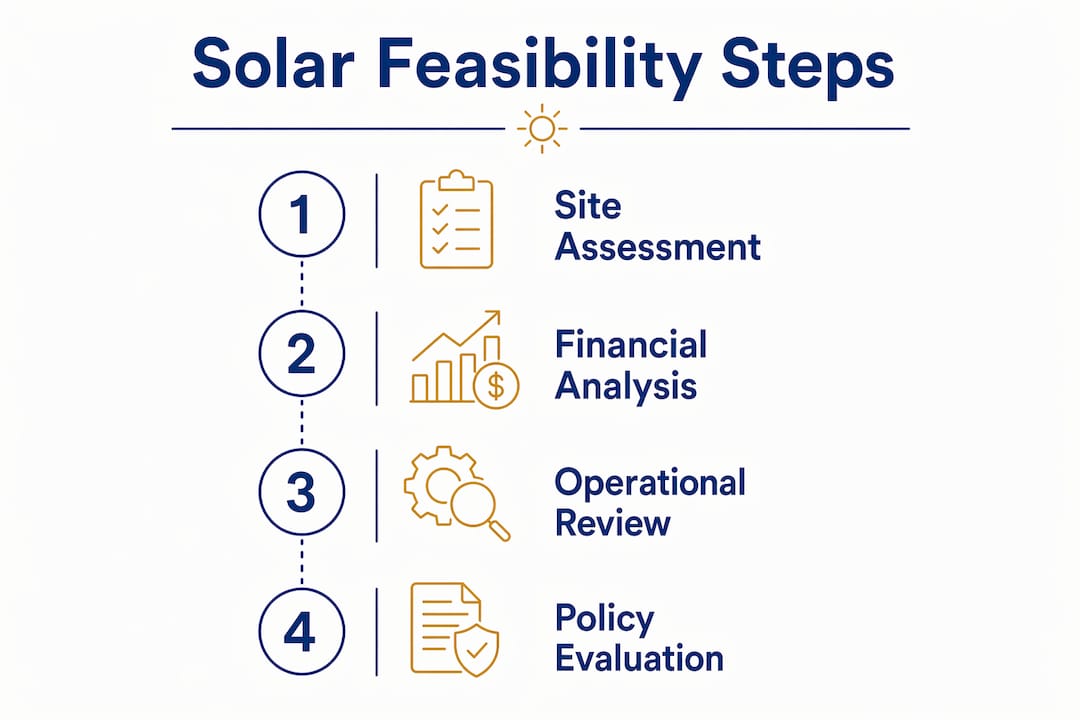
The process covers three core checkpoints. First, the site must physically support a solar array. Second, the financial model must show returns that meet investor thresholds. Third, the operational structure must allow tenants and landlords to share benefits in a way that sustains participation. Skipping any checkpoint produces a flawed study and a project that underperforms.
Solarenergymgmt conducts solar feasibility studies that address all three checkpoints for Florida multifamily properties. The firm’s 20-plus years of experience in the Florida market gives developers a clear picture of what works and what does not before capital is committed.
What physical factors determine solar viability on a multifamily site?
The physical assessment covers roof area, orientation, structural capacity, shading, and metering topology. Each factor directly limits or enables the system size you can install and the energy you can actually use.
- Roof size and orientation: South-facing roofs in Florida produce the most annual output. Flat roofs on apartment buildings allow for tilt-mounted arrays that can be angled for maximum yield, but usable area shrinks once HVAC equipment, parapet walls, and setbacks are accounted for.
- Structural capacity: Older multifamily buildings often require structural reinforcement before panels can be installed. Flat roof mounting adds distributed load, and a structural engineer must confirm the roof can carry it.
- Shading analysis: Nearby trees, adjacent buildings, and rooftop equipment create shading losses that reduce annual production. A shading analysis using tools like PVsyst or Helioscope quantifies this loss before system sizing begins.
- Metering topology: This is the most underestimated factor in multifamily solar analysis. Metering topology analysis is the first step because knowing whether the utility permits Virtual Net Energy Metering (VNEM) or requires separate sub-metering defines how the system is designed and how credits are allocated to individual units.
- Interconnection constraints: Most utilities cap behind-the-meter solar production credits at the 12-month historical consumption of each meter. That cap directly limits how large a system you can size without generating orphaned electricity.
Pro Tip: Request 12 months of interval data from the utility for every meter on the property before sizing the system. Interval data reveals actual load profiles, not just peak demand, and prevents oversizing.
Matching system size to real consumption is not a preference. It is a financial requirement. Oversized systems export electricity at low credit rates, reducing overall returns and extending payback periods well beyond projections.
How do financial models shape multifamily solar project economics?
Financial modeling for multifamily solar is more complex than for a single-family home. You are not modeling one meter. You are modeling a system that serves multiple load profiles, splits benefits between a landlord and tenants, and must account for infrastructure costs that have nothing to do with the solar panels themselves.
The financial model must address five specific areas:
- Cost separation: Solar costs must be separated from building upgrade costs such as roof repairs or electrical panel upgrades. Bundling these costs into a single project figure inflates the apparent cost of solar and produces a misleading payback calculation.
- Payback period and IRR: A well-designed 150 kWp system on a 50-unit building achieves a 7–10 year payback and a 6%–10% IRR. Poorly designed projects can run 3–4 years longer in payback due to low self-consumption rates.
- Self-consumption targets: Self-consumption above 55% is the threshold required to hit an 8-year payback floor. Below that rate, the economics deteriorate quickly.
- Landlord-tenant benefit split: Landlords typically retain 70%–85% of net economic benefits, passing 15%–30% savings to tenants. That split must be modeled explicitly because it drives tenant participation rates, which in turn affect self-consumption.
- Infrastructure costs: Re-metering or service consolidation can cost $40,000–$120,000 and take 6–12 months to complete. These costs must appear in the financial model from day one, not as a late-stage surprise.
Pro Tip: Use a dedicated solar ROI calculator to model scenarios with different self-consumption rates before committing to a system size. A 10% drop in self-consumption can shift your payback by two or more years.
| Financial variable | Impact on project returns |
|---|---|
| Self-consumption rate below 55% | Payback extends 3–4 years beyond projections |
| Infrastructure costs excluded | IRR overstated; project may fail post-construction review |
| Landlord-tenant split not modeled | Low tenant participation reduces self-consumption |
| Solar costs bundled with upgrades | Misleading payback figures; false positive investment case |
The commercial 30% Investment Tax Credit (ITC) applies to qualifying multifamily solar installations. Solarenergymgmt’s financial modeling incorporates the ITC alongside Florida-specific net metering policies to produce accurate, defensible return projections.
What operational factors drive successful multifamily solar implementation?
A technically sound system with a solid financial model can still underperform if the operational structure is poorly designed. Tenant engagement is the variable most developers underestimate.
Tenant subscription rates for shared solar projects start at 62% in year one and rise to around 78% by year three. That trajectory matters because higher subscription rates increase self-consumption, which directly improves financial returns. A project that launches with low tenant participation may never reach the self-consumption threshold needed to hit its payback target.
The operational design must address:
- Billing framework: The landlord-as-supplier model, where the landlord purchases solar output and resells it to tenants, requires legal billing authority in most states. Allocation software can automate credit distribution, but the legal framework must be established first.
- Benefit sharing transparency: Tenants participate when they see a clear, consistent bill reduction. A 15%–30% savings pass-through must be communicated plainly, not buried in lease addenda.
- Administrative overhead: Ongoing meter reading, credit reconciliation, and system monitoring add operational costs. These costs are manageable but must be budgeted. Ignoring them produces an optimistic operating expense forecast.
- Maintenance planning: Rooftop solar systems require periodic cleaning, inverter monitoring, and occasional panel replacement. A maintenance reserve fund, typically 1%–2% of system cost annually, protects long-term performance.
Distributed energy resources including solar and battery storage can reduce annual community electricity costs by up to 45% compared to traditional baselines in electrified multifamily buildings. Reaching that level of savings requires both high self-consumption and an operational structure that keeps tenants engaged year after year.
How do utility rules and state policy affect multifamily solar feasibility?
Utility tariff structures and state policy are not background context. They are design constraints. The wrong metering configuration or an overlooked export limit can make an otherwise viable project financially unworkable.
Key regulatory factors that shape every multifamily solar feasibility study include:
- Virtual Net Energy Metering (VNEM): VNEM allows a single solar system to allocate credits across multiple meters on the same property. Not all utilities offer it, and those that do often impose capacity limits. Confirming VNEM availability is a prerequisite for system design.
- Export limits and tariff structures: Utilities that cap credits at 100% of each meter’s annual consumption effectively limit system size. Exporting beyond that cap earns only avoided-cost rates, which are substantially lower than retail rates.
- Incentive programs in 2026: The federal 30% ITC remains the most significant financial incentive for commercial multifamily solar. Florida does not impose a state income tax, which affects how the ITC is applied, and property tax exemptions for solar installations reduce carrying costs.
- Permitting and interconnection timelines: Interconnection approval from the utility can take 3–9 months depending on the utility and system size. Building permit timelines vary by county. Both must be factored into project scheduling and cash flow modeling.
- Community solar regulations: Some Florida developers access community solar programs that allow tenants without direct roof access to subscribe to off-site generation. Eligibility rules and credit structures vary by utility territory.
Solarenergymgmt’s independent consulting model means the firm has no equipment sales incentive. That independence produces utility rule analysis and tariff impact assessments that reflect the property’s actual conditions, not a preferred product configuration.
Key Takeaways
Multifamily solar feasibility requires separating physical, financial, and operational analysis into distinct checkpoints, with self-consumption rates, metering topology, and cost separation determining whether a project meets its return targets.
| Point | Details |
|---|---|
| Metering topology first | Confirm VNEM availability or sub-metering requirements before sizing the system. |
| Separate all costs | Exclude roof repairs and electrical upgrades from solar cost calculations to avoid misleading IRR figures. |
| Target 55% self-consumption | Projects below this threshold face payback periods 3–4 years longer than projections. |
| Model the landlord-tenant split | A 15%–30% tenant savings pass-through drives subscription rates and self-consumption. |
| Budget infrastructure costs early | Re-metering can cost $40,000–$120,000 and must appear in the financial model from day one. |
What I’ve learned after 20 years of multifamily solar feasibility in Florida
The most common mistake developers make is treating a solar feasibility study as a formality. They have already decided to install solar. The study becomes a document that justifies the decision rather than one that tests it. That approach produces projects that underperform and, in some cases, destroy value.
The second most common mistake is conflating project costs. A roof that needs replacement before panels can be installed is a building maintenance cost. It is not a solar cost. When those costs are bundled together, the apparent payback period for solar looks worse than it actually is. Developers walk away from viable projects because the numbers were built wrong. Solarenergymgmt’s feasibility methodology explicitly separates these cost categories, which is why the firm’s financial models hold up under investor scrutiny.
The third mistake is sizing for maximum capacity rather than maximum returns. A larger system feels like a better investment. It is not, if the building cannot consume the output. Every kilowatt-hour exported at avoided-cost rates instead of offset at retail rates is a return that never materializes. Matching system architecture to actual load profiles is the single most important technical decision in the feasibility process.
Tenant engagement is where most operational plans fall short. Developers model 80% subscription rates because that is what makes the numbers work. Actual year-one rates average 62%. Build your financial model around realistic participation, then design an engagement program to improve it over time. The projects that reach 78% subscription by year three do so because the landlord-tenant benefit split was transparent and the billing process was simple.
— Solarenergymgmt
Solarenergymgmt’s multifamily solar feasibility and storage services
Solarenergymgmt brings over 20 years of independent consulting experience to multifamily solar feasibility studies in Florida. The firm’s process covers metering topology analysis, load profile assessment, cost separation modeling, and IRR projections that account for the commercial 30% ITC and Florida-specific utility tariffs.

For developers adding battery storage to a multifamily solar project, Solarenergymgmt’s battery storage guide covers system sizing, financial modeling, and resilience planning specific to Florida’s grid conditions. Battery storage increases self-consumption rates and reduces exposure to time-of-use tariff peaks, both of which improve project returns. To discuss a feasibility study for your property, contact Solarenergymgmt directly through the solar feasibility study service page.
FAQ
What is a solar feasibility study for multifamily buildings?
A solar feasibility study for multifamily buildings is a structured analysis that evaluates whether a solar energy system is physically, financially, and operationally viable for a specific property. It covers roof conditions, metering topology, utility rules, financial modeling, and tenant engagement design.
How long does a multifamily solar project take to pay back?
A well-designed 150 kWp system on a 50-unit building typically achieves a 7–10 year payback period and a 6%–10% IRR over 20 years, provided self-consumption rates stay above 55%.
What is VNEM and why does it matter for multifamily solar?
Virtual Net Energy Metering (VNEM) allows a single rooftop solar system to distribute energy credits across multiple utility meters on the same property. Without VNEM, each unit requires its own sub-metered solar allocation, which increases infrastructure costs significantly.
Why does self-consumption rate affect payback so much?
Self-consumption above 55% is required to hit an 8-year payback floor. Below that threshold, excess generation is exported at low avoided-cost rates rather than offsetting retail electricity costs, which reduces annual savings and extends the payback period by 3–4 years.
How should landlords split solar savings with tenants?
Landlords typically retain 70%–85% of net economic benefits and pass 15%–30% savings to tenants. That split balances project economics with tenant participation incentives, which drives the subscription rates needed to maintain high self-consumption.
Recommended
- A Guide to the Solar Power Feasibility Study in Florida – Commercial + Residential Solar Power Florida
- Solar Power Financing Options in Florida: A 2026 Guide – Commercial + Residential Solar Power Florida
- Is Home Solar Worth It in Florida? a 2026 Financial Guide – Commercial + Residential Solar Power Florida
- Residential Solar Energy Florida A 2026 Homeowners Guide – Commercial + Residential Solar Power Florida


