Your electric bill lands, and the total is higher than you expected. Again. Maybe you run a warehouse in Tampa, an office in St. Petersburg, a school campus, or a light industrial facility on the Gulf Coast. The pattern is the same. Utility costs feel harder to predict, outages are more disruptive, and every solar salesperson claims their system is the obvious answer.
It usually isn't.
For Florida businesses, the right move isn't to rush into panels because solar sounds modern. The right move is to treat energy like a business line item you can actively manage. That means reducing waste first, sizing solar second, adding storage where it improves resilience or peak management, and choosing a financing structure that fits your tax position and cash flow.
That's what serious renewable energy solutions for businesses look like in Florida. Not hype. Not oversized proposals. Not generic payback talk. Just disciplined planning built around utility costs, downtime risk, and long-term control.
Why Florida Businesses Should Strategically Invest in Solar Power
Florida business owners don't need another lecture about sustainability. You need a way to control operating costs and reduce exposure to utility volatility.
Solar power belongs in that conversation because it has crossed the line from alternative technology to mainstream infrastructure. In 2024, renewables supplied 32% of global electricity generation, and solar photovoltaics accounted for 81% of the total renewable electricity capacity increase, according to the Center for Climate and Energy Solutions renewable energy data. That matters because it tells you this market is no longer running on pilot projects and good intentions. It's running at global scale.

Solar Is Now A Financial Tool
If you're evaluating a first major project, stop thinking about solar as a badge. Start thinking about it as a hedge.
A well-planned commercial system can help a Florida business do three things at once:
- Reduce purchased electricity by generating power on-site during expensive daytime operating hours
- Improve budget predictability by locking in part of your future energy supply
- Support resilience planning when paired with storage and critical-load strategy
That's why I tell owners to review solar the same way they'd review a major equipment upgrade. The question isn't whether solar is trendy. The question is whether it improves margin, reduces risk, and protects operations.
Practical rule: If your utility bill is large enough to get management's attention every month, it's large enough to justify a structured solar feasibility review.
Waiting Usually Doesn't Improve The Decision
Many companies delay because they assume the market still needs to mature. That argument made sense years ago. It doesn't now.
The technology base is established. Procurement and financing channels are established. Businesses that move carefully can make rational, numbers-driven decisions instead of waiting for a mythical “perfect time.” If you want to understand what that looks like in project terms, this guide to solar ROI for commercial systems is a good next step.
The bigger point is simple. In Florida, solar power is no longer a fringe energy choice. It's part of a serious operational strategy for businesses that want more control over cost and continuity.
The Smartest First Step Is Not Buying Solar Panels
The most common mistake I see is a business asking for panel pricing before it understands its own load.
That's backwards.
You wouldn't let a doctor prescribe treatment before running diagnostics. Your facility deserves the same discipline. If you skip the diagnostic work, you'll probably overspend on generation, underspend on controls, and miss easier savings that should have come first.

Start With Waste, Not Hardware
Industry guidance is clear that solar isn't always the first or largest investment a facility should make. In some buildings, efficiency upgrades, controls, and load shifting can reduce the required system size and storage cost more effectively than adding more generation capacity, and battery storage can shift load to cheaper hours and help protect against utility price volatility, as noted in CRB's sustainable energy guidance.
That's especially relevant in Florida, where HVAC loads, humidity control, refrigeration, and occupancy schedules often drive bills as much as anything on the roof.
Before you approve a solar layout, you should know:
- When your building peaks during the day and why
- Which equipment wastes energy through poor scheduling, aging components, or bad controls
- Whether operational changes could cut demand before you buy generation
- Which loads are critical during an outage and which are not
A basic building walkthrough isn't enough. You need interval data, billing analysis, and a real look at equipment behavior.
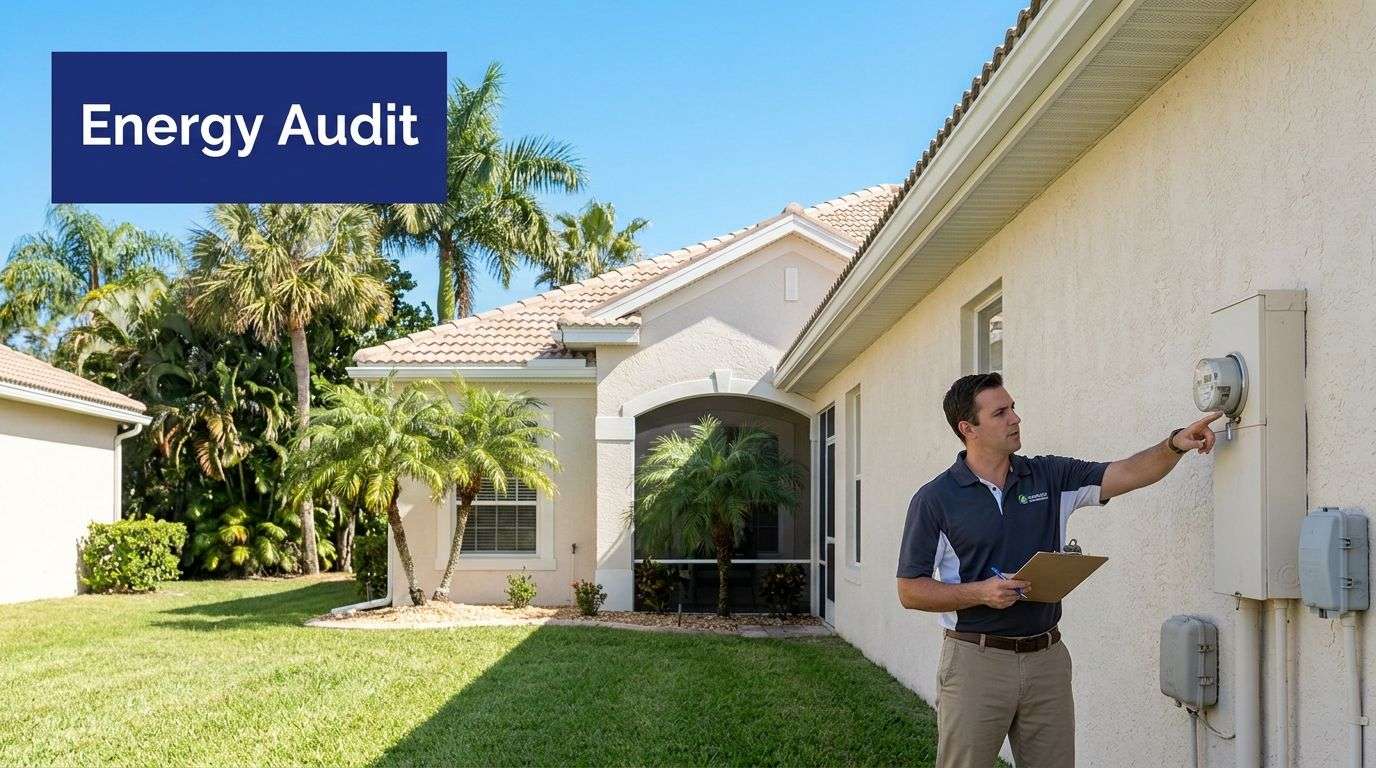
The Best Solar Projects Usually Start With An Audit
Some business owners hear “energy audit” and think it's a bureaucratic exercise. It isn't. It's how you keep from buying the wrong system.
For example, if old rooftop units, poor insulation, or outdated lighting are forcing unnecessary daytime demand, a smaller optimized solar-plus-storage system may outperform a larger solar-only design on financial return. Owners who want a plain-language primer can review this South Florida home energy guide. It's residential in framing, but the core logic carries over well. Measure waste first. Then decide what equipment belongs in the project.
Most businesses don't have a solar problem first. They have a load-shape problem first.
A proper commercial review should lead to a sequence, not just a quote. The usual order looks like this:
- Analyze utility bills and interval data to identify demand patterns and expensive operating windows.
- Inspect major loads such as HVAC, process equipment, refrigeration, ventilation, and lighting controls.
- Model efficiency measures first so the final solar and battery design reflects the building you want, not the waste you currently tolerate.
- Separate critical and noncritical loads for resilience planning.
- Size solar around optimized demand, not around sales targets.
If you're at the beginning of that process, a structured business energy audit review is usually the smartest first spend you can make.
Designing Your Optimal Florida Solar And Storage System
Once your load is cleaned up, the project gets easier. Not simpler, but clearer.
A good Florida commercial energy system has three jobs. It should lower utility purchases, support critical loads when the grid fails, and avoid forcing you into expensive design choices that don't match how the facility operates. That's why I don't look at solar panels in isolation. I look at the relationship between PV generation, battery storage, and controls.
What Each Piece Actually Does
Solar panels are the production asset. They generate electricity during daylight hours and reduce how much power you buy from the utility.
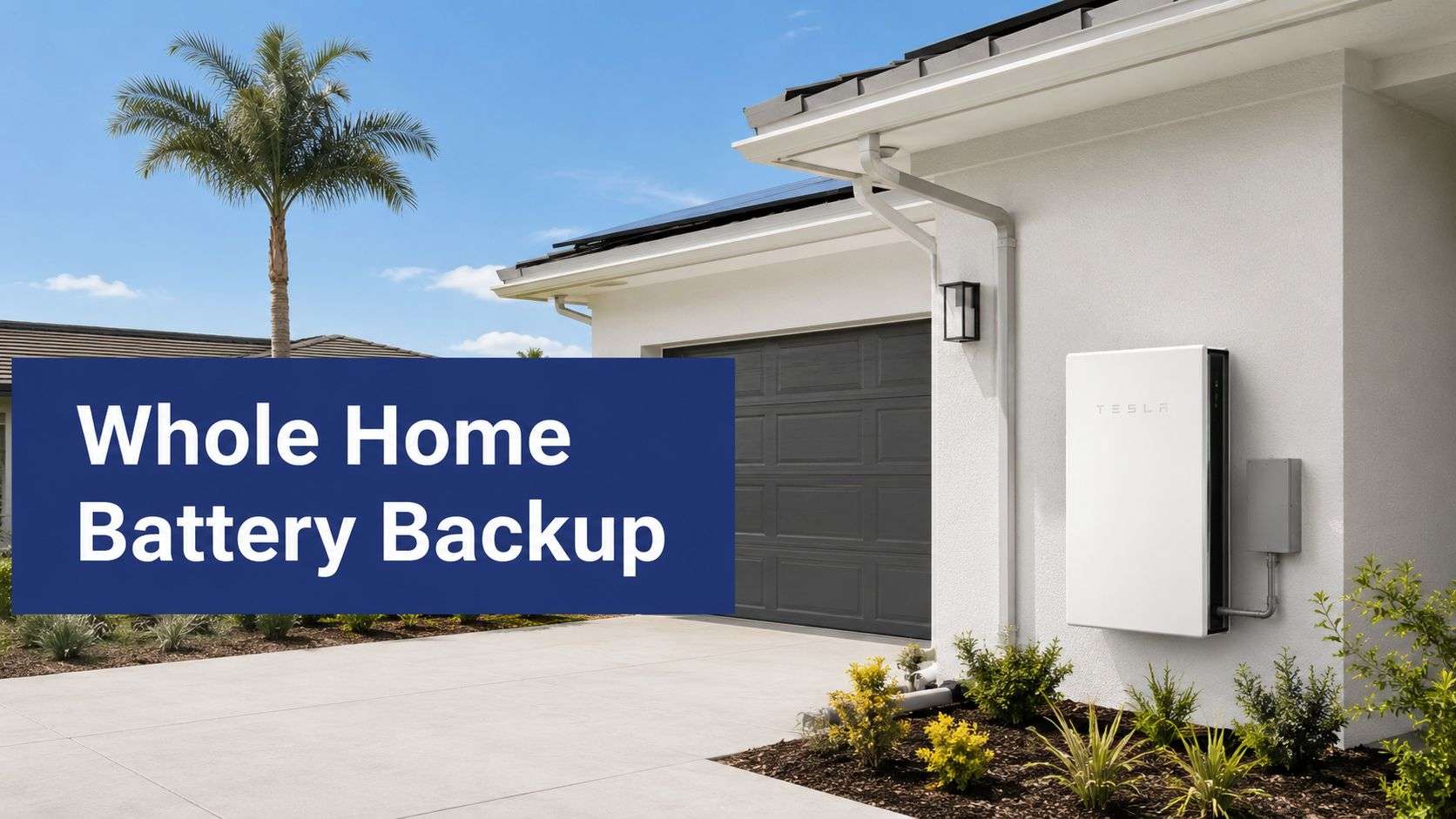
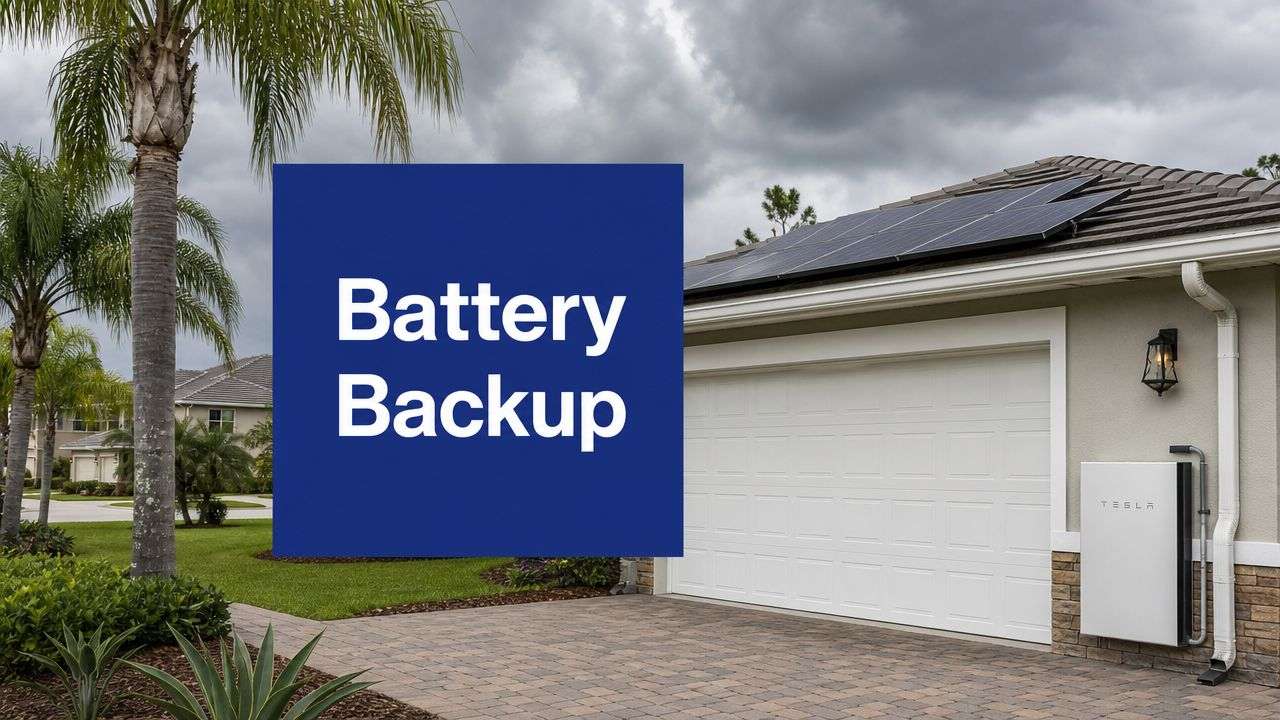
Battery storage is the timing asset. It lets you hold energy and use it when it matters more, whether that means riding through an outage, supporting critical equipment, or shifting consumption away from expensive periods.
Controls are the decision layer. They determine what gets powered, what gets prioritized, and how the system behaves during grid interruption or normal operation.
For a business owner, the easiest way to think about it is this:
- Solar makes power
- Batteries decide when that power is most valuable
- Controls decide where it goes first
Design Around Critical Loads
For commercial sites, early integration of renewable generation with storage and backup power improves operational resilience, especially when the system is right-sized to support critical loads rather than trying to cover everything at once, according to SLR Consulting's guidance on integrated energy design.
That principle matters in Florida because not every outage scenario justifies whole-site backup. In many facilities, the smartest design protects the loads that preserve revenue, inventory, safety, or business continuity.
Examples are straightforward:
- A refrigerated warehouse may prioritize compressors, monitoring systems, and essential lighting.
- A medical office may prioritize core IT, limited HVAC zones, and critical equipment circuits.
- A manufacturer may keep one production line, compressed air support, and control systems available instead of trying to energize the full plant.
- An office building may support server racks, communications, security, and limited tenant services.
Don't ask whether the system can back up the whole building. Ask which loads actually justify protection.
Right-Sizing Beats Overbuilding
Oversized systems look impressive in proposals and often underperform in practice. If the battery is too small, it won't cover the operational window you care about. If the PV system is too large for the optimized load, you may be paying for capacity that doesn't deliver equivalent value.
A sound design process should evaluate roof condition, shading, usable area, interconnection constraints, storage duration, equipment sequencing, and operating schedules. It should also account for whether a future microgrid approach makes sense for the site.
If you're comparing concepts and need technical guidance before procurement, a focused solar power system design review can help you pressure-test whether the proposed architecture fits the facility instead of the installer's template.
Calculating The True Financial Return Of Commercial Solar
A commercial solar project should never be approved on a simple “monthly bill savings” pitch. That's amateur analysis.
True return comes from stacked value. Energy offset matters, but it's only one piece. In Florida, the better question is how solar and storage affect tax position, peak demand exposure, capital planning, and operating risk over time.

What A Serious ROI Model Should Include
A proper commercial model should account for more than panel production. At minimum, I'd expect these inputs:
- Utility rate structure including demand components, not just energy charges
- Tax treatment if the ownership entity can use available incentives and depreciation
- Battery dispatch value if storage will be used for load shifting or resilience support
- Escalation risk from future purchased-power costs
- Operational continuity value for sites where downtime hurts revenue or inventory
That's why generic online savings estimates are often misleading. They flatten a complex project into one shallow number.
Why The Timing Matters
The broader energy market is moving fast. In 2025, global investment reached a record $3.3 trillion, with $2.2 trillion directed toward clean energy, and clean-energy investment has exceeded fossil-fuel investment for the past 10 years, according to World Resources Institute clean energy investment analysis. The same analysis notes that electricity demand is projected to increase by 4.5% in 2025 over 2024 and grow by at least 2.8% per year through 2030.
For a Florida business owner, that doesn't mean “go solar because the world is changing.” It means energy demand and infrastructure pressure are increasing, which makes cost control and resilience planning more valuable.
If your ROI model ignores demand charges, tax structure, and outage exposure, it isn't an ROI model. It's a sales sheet.
One more point. Financial return isn't just what you save. It's what risk you remove. Price certainty has value. Backup capability has value. The ability to avoid buying utility power during expensive periods has value.
If you want to test those assumptions against your own billing data, use a commercial solar ROI calculator as a starting point, then validate the result with project-specific modeling before making a capital decision.
Navigating Solar Financing And Incentives In Florida
Good projects fail all the time because the financing structure is wrong.
A profitable company, a nonprofit school, and a local government entity should not approach the same Florida solar project the same way. Their tax position is different. Their capital constraints are different. Their decision criteria are different. If you ignore that, you can end up with a technically good project that never gets approved.

For Profit Owners Need To Focus On Tax Efficiency
If your business has taxable income and wants long-term control, ownership often deserves serious consideration. That's because the economics may improve when the owner can directly benefit from tax credits and depreciation treatment.
But ownership isn't automatically the right answer. A company with strong tax appetite but tight cash flow may prefer debt. A business that wants minimal operational involvement may compare lease or power purchase structures. The point is to model after-tax cash flow, not just upfront price.
When I review proposals, I usually compare these paths:
- Direct purchase if the company wants maximum control and can deploy capital efficiently
- Commercial loan if ownership still makes sense but liquidity matters
- Lease or PPA when preserving cash is the priority and the business accepts lower long-term upside
- PACE-style structures if property-based repayment aligns with the ownership profile and legal review supports it
Nonprofits And Public Entities Finally Have A Real Path
Tax-exempt organizations used to hit a wall because they couldn't directly use tax credits. That changed in a very meaningful way.
The IRA's Direct Pay provision allows nonprofits and state, local, and Tribal governments to directly access tax credits for clean-energy projects, which can significantly change project economics for those entities, according to the Rockefeller Foundation's explanation of Direct Pay and underserved clean-energy financing.
That matters in Florida for:
- Private schools and charter schools
- Nonprofit campuses
- Municipal buildings
- Community organizations
- Certain public-interest facilities that previously lacked tax appetite
Practical decision-making begins here. The key question isn't “Are incentives available?” The key question is “Can your ownership structure monetize them?”
Match The Financing To The Entity
A lot of business-facing content skips this. It shouldn't.
For-profit entities should evaluate incentive use, depreciation, debt capacity, and target hold period. Tax-exempt entities should evaluate Direct Pay eligibility, procurement rules, board approval process, and whether third-party ownership still makes sense.
If you need an independent view before negotiating term sheets or installer financing, commercial solar financing guidance can help frame the tradeoffs clearly. Solar Energy Management LLC is one Florida consultancy that works on this planning side before installation contracts are finalized.
Your Roadmap From Evaluation To Implementation
The cleanest way to de-risk a Florida solar project is to run it like a capital planning exercise, not a product purchase.
A strong business case depends on feasibility studies, ROI modeling, and expert grid-tied or hybrid architecture, with evaluation of load profiles, storage sizing, and incentive pathways so the final system matches demand and supports resilience requirements, as described in Capstone's renewable energy consulting overview.
The Order That Usually Works
If you want a practical roadmap, use this one:
Confirm baseline performance
Review bills, interval data, major equipment, and operational pain points.Eliminate waste first
Reduce avoidable load before sizing solar or storage.Run feasibility and ROI modeling
Compare system sizes, ownership structures, battery scenarios, and critical-load strategies.Lock the design intent
Define what the project must accomplish financially and operationally before procurement starts.Vet implementation partners
Compare EPC bids, equipment assumptions, warranties, controls strategy, and interconnection approach.Oversee execution
Make sure the installed system matches the modeled system. That sounds obvious, but it often doesn't happen without someone watching.
Why Independent Guidance Matters
Installers sell installed systems. That's their role. A consultant should protect the owner's decision process.
That distinction matters most on first-time projects, where owners are sorting through battery options, resilience claims, financing language, and production assumptions all at once. An independent review keeps the project tied to business outcomes instead of sales momentum.
The best commercial solar projects are boring on purpose. Clear assumptions. Clean modeling. Tight scope. No surprises.
If you're still at the stage where you need to decide whether the project should happen at all, start with a formal solar feasibility study. That's the point where costs, constraints, financing paths, and resilience goals come into focus.
If you want an independent, Florida-based advisor to help you evaluate solar, storage, ROI, and financing before you commit to installation, talk with Solar Energy Management LLC. They help businesses, nonprofits, and property owners turn utility data and facility needs into a practical solar plan with feasibility analysis, financial modeling, and design guidance.