Florida homeowners are making this decision at scale. Residential solar installations have climbed quickly in recent years, and for many households, solar is now a serious home investment rather than a niche upgrade.
That does not mean every project pencils out.
From an independent consultant's perspective, the biggest mistake happens before any equipment is chosen. Homeowners start with installer proposals instead of starting with their own numbers. A better process is to evaluate annual usage, roof geometry, shading, utility rate structure, outage priorities, and financing terms first. Then compare proposals against a clear target.
For homeowners, residential solar energy in Florida makes sense only when the system matches the house and the goal. Some families want lower lifetime electric costs. Others care just as much about backup power during outages. Those are different projects, and they should be sized and priced differently.
The policy side matters too. Before talking to sales teams, review the current Florida solar incentives and net metering rules so you know what affects savings, payback, and interconnection. That baseline helps you spot inflated production claims, oversized systems, and battery proposals that add cost without solving the outage problems you have.
Why Florida Is A Solar Hotspot Now
Florida homeowners are not entering an early trend. They are buying into a market that has already reached meaningful scale, and that changes the decision. In a mature market, the main question is no longer whether solar can work in Florida. The essential question is whether it works on your house, under your utility's rules, at a price that produces a reasonable return.
From an independent consultant's perspective, that distinction matters. Mature markets attract more installers, more financing offers, and more aggressive production claims. Homeowners who start with their own load profile, roof constraints, and outage priorities usually make better decisions than homeowners who start with a sales presentation.
Florida stands out for a practical reason. The same homes that spend heavily on air conditioning also sit in a state with strong solar production potential. That pairing creates a better match between daytime energy use and daytime solar generation than you see in many lower cooling-demand markets.
Storm exposure also changes the conversation. In some states, solar is mostly a bill-reduction project. In Florida, many households are weighing two separate goals at the same time: lower long-term electric costs and better resilience during outages. Those goals can work together, but they do not always point to the same system design. A grid-tied panel-only system is usually the lower-cost path to savings. A solar-plus-battery system can support selected circuits during outages, but it raises project cost and needs tighter load planning.
What Changed For Homeowners
Several factors have pushed solar into the mainstream for Florida households:
- Electric bills create a stronger savings case. High cooling loads give well-sited systems more useful consumption to offset.
- Outage planning is now part of the buy decision. After major storms, many homeowners look at batteries and critical-load backup much earlier in the process.
- Equipment and proposal tools are better. Buyers can ask for clearer production modeling, battery runtime estimates, and payback scenarios.
- Roof timing matters more than many people expect. A roof with limited remaining life can turn a good solar project into an expensive sequencing mistake.
One pattern shows up repeatedly in consultations. Homeowners who review roof age, insurance considerations, interconnection rules, and current Florida solar incentives and policy details before collecting bids have more control over system size, financing structure, and installer selection.
Solar works best here when it is treated as a planning decision first. Equipment comes second.
Understanding Solar Power and Policy In Florida
Florida solar policy matters because it determines whether your system offsets expensive utility power in real time only, or also earns useful bill credits when production exceeds demand. Homeowners who understand that distinction before requesting bids make better sizing decisions and catch inflated savings projections early.
A standard residential system follows a simple sequence. Panels generate electricity during daylight hours. The inverter converts it into usable household power. Your home uses that power first, and any surplus can flow back through the meter to the grid. When solar production drops, the utility supplies the balance.

How Power Moves Through A Home System
For a homeowner, the key point is not the electronics. It is timing.
Solar production changes hour by hour based on sun angle, cloud cover, roof orientation, shading, and season. Air conditioning demand also shifts through the day, especially in Florida. That means a good proposal should show more than annual production. It should show how production lines up with your actual usage, because that affects both bill reduction and the value of exported power.
The operating sequence is straightforward:
- Panels produce DC electricity when sunlight hits the modules.
- An inverter converts DC to AC power for household use.
- Your home consumes solar power first before drawing from the grid.
- Excess production can export to the utility through the meter.
- Monitoring software tracks output and system status so underperformance is easier to catch.
That last point matters more than many buyers expect. Monitoring is not just a nice app. It is how homeowners notice a failed inverter string, storm-related production drop, or ongoing performance gap before a full billing cycle is lost.
Why Net Metering Matters
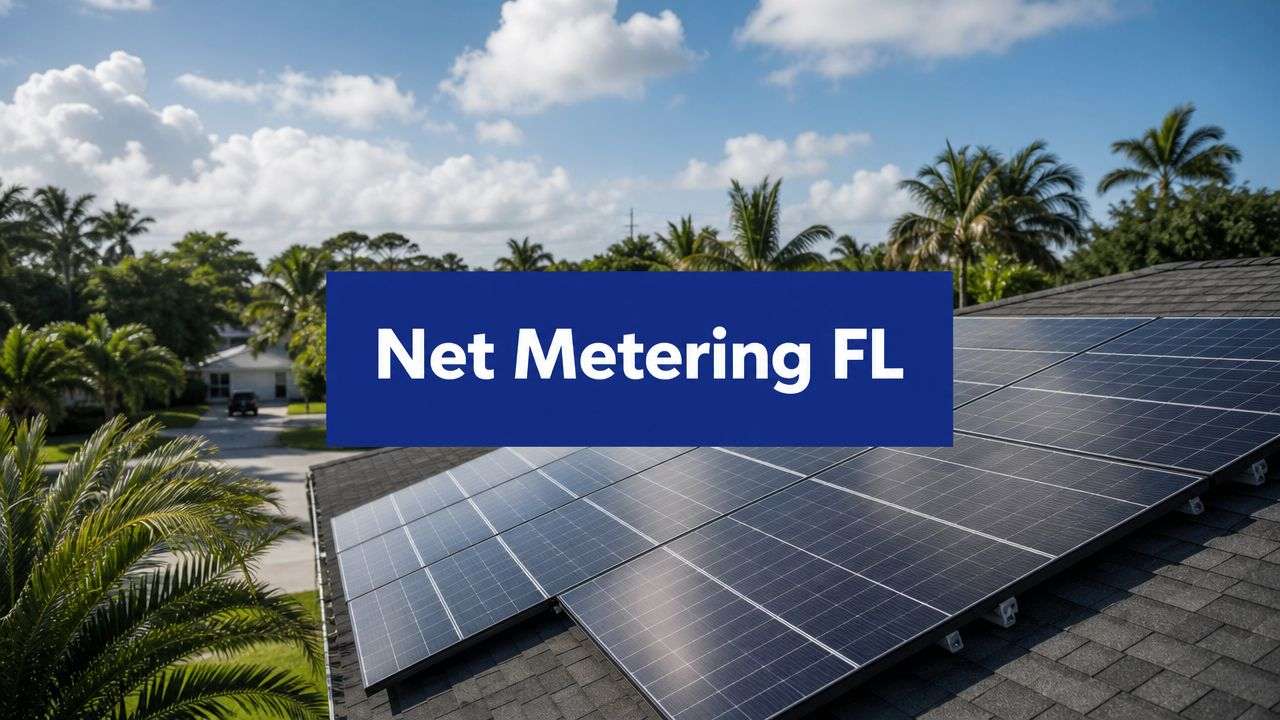
Florida's net metering rules are a major part of the savings case. According to Florida net metering policy details, the policy has credited residential excess generation at full retail rates, with an example value of 13.14¢/kWh. In practical terms, that means exported solar can still carry meaningful bill value instead of being treated as low-value wholesale power.
For homeowners, this is the policy question to settle before talking to installers: how much of your expected savings comes from direct self-consumption, and how much depends on credited exports? A proposal that ignores that split is hard to trust.
One issue comes up often in consultations. Homeowners ask whether rooftop solar creates problems for the grid. The Florida rooftop solar report cited above notes Lawrence Berkeley National Lab analysis finding negligible grid impact from distributed solar up to 10% penetration. For an individual household, that debate usually matters less than the basics: roof condition, realistic production estimates, utility bill structure, and whether backup power is part of the goal.
Net metering also does not mean every utility handles customer billing in exactly the same way. Credit treatment, true-up details, interconnection paperwork, and proposal assumptions need to be checked against your provider's rules. If you are served by Duke, this plain-language guide to Duke Energy net metering rules and billing treatment is a useful starting point.
The practical takeaway is simple. Policy sets the economic framework, but design decides whether the project performs well inside that framework. Homeowners who verify both before collecting quotes usually avoid the biggest mistakes.
Estimating Your System Costs And Potential Savings
Most homeowners jump to purchase price too early. Price matters, but price without production is just a number. The better first question is this: how much useful electricity can your roof produce, and what does that offset over time?
A common benchmark in Florida is a 10 kW residential system. According to Florida residential system performance data, a typical 10 kW system can generate about 11,500 to 14,000 kWh per year. At 13.14¢/kWh, that can translate into $1,500 to $2,000 in annual net savings after net metering credits, with 25-year savings exceeding $40,000. The same source notes that solar costs have fallen 42% since 2015.

What Actually Changes The Price
Two homes can receive very different quotes even if they use similar amounts of electricity. That's normal. Cost usually moves because of factors like:
- System size: Larger systems generally produce more energy and require more equipment.
- Roof complexity: Multiple roof planes, steep pitches, or harder access can complicate design and labor.
- Electrical scope: Main panel upgrades or reconfiguration can change project cost.
- Equipment choices: Panel type, inverter architecture, and battery-ready design all affect the proposal.
- Permitting and utility requirements: Florida projects still have local approval and interconnection steps that can shape final pricing.
How To Make A First-Pass Estimate
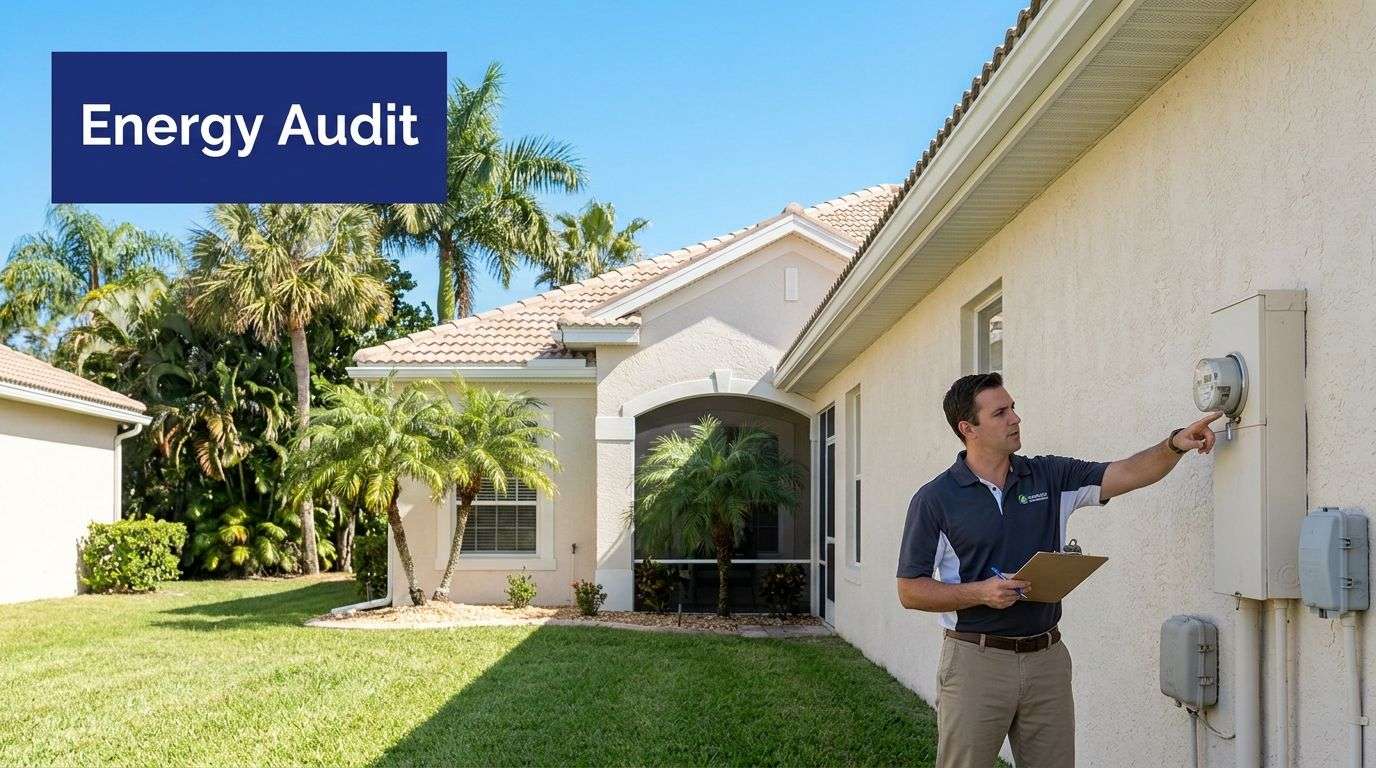
Before talking to installers, gather a full year of electric bills. Then compare that usage with realistic solar production for your roof. Don't assume your bill tells the whole story. A low bill can come from efficient behavior, while high annual usage may point to cooling loads, pool equipment, or an older HVAC system.
A rough homeowner workflow looks like this:
- Collect your annual usage: Review total kWh across all seasons, not just one high summer bill.
- Check roof suitability: Look for broad unshaded roof areas during prime sun hours.
- Separate savings goals from backup goals: A bill-offset system and a resilience-focused system aren't always the same design.
- Ask for output assumptions in writing: Production estimates should show the reasoning behind them.
If you want a pricing framework before you request proposals, this guide on how much solar panels cost in Florida helps homeowners interpret quotes more accurately.
Is Your Florida Home A Good Candidate For Solar
A lot of homes in Florida can support solar. Not every home should. The difference comes down to roof condition, sunlight access, electrical layout, and your actual objective. Some homeowners want the lowest utility bill possible. Others care more about keeping refrigeration, communications, and a few circuits running after a storm. Those goals can lead to different system recommendations.
Start With The Roof, Not The Panels
The roof is the foundation of the whole project. If the roof is near the end of its useful life, solar may need to wait until reroofing is complete. Removing and reinstalling panels later adds cost and hassle.
Use this quick screen:
- Roof age: If the roof may need replacement soon, evaluate that first.
- Roof condition: Look for cracked shingles, active leaks, soft decking, or known structural issues.
- Available area: Solar works better when designers have flexibility to place panels in clean, uninterrupted sections.
- Storm-readiness: Florida's building environment is demanding, so the mounting approach matters.
Orientation And Shade Usually Decide The Outcome
The ideal layout in Florida generally favors a roof area with strong sun exposure and minimal shading. Trees, dormers, plumbing vents, chimneys, and neighboring structures can all reduce usable production. A roof can still work without being perfect, but mismatch between roof conditions and system design creates disappointment later.
One issue homeowners underestimate is partial shade. A few shaded modules can drag down output in ways that aren't obvious from a street view. That's why satellite imagery alone isn't enough. Good pre-design work should include a roof-specific shade assessment and a realistic production model.
A roof that's sunny at noon can still underperform if trees cut production during key morning or afternoon hours.
Property Questions Worth Answering Early
Before requesting proposals, be ready to answer these:
- Do you plan to stay in the home long enough for the economics to matter to you?
- Is your current electric usage stable, or are major changes coming, such as a new HVAC system or EV charging?
- Do you live in an HOA community that may add review steps?
- Do you want battery backup for critical loads, or are you focused only on bill reduction?
Florida homeowners also need to think beyond panel placement. Wind exposure, attachment details, and code-compliant design matter more here than in milder climates. That's one reason an independent feasibility review is valuable before equipment selection. It helps you identify whether the house is a strong candidate, a marginal candidate, or better served by efficiency upgrades first.
Battery Storage The Key To Energy Resilience
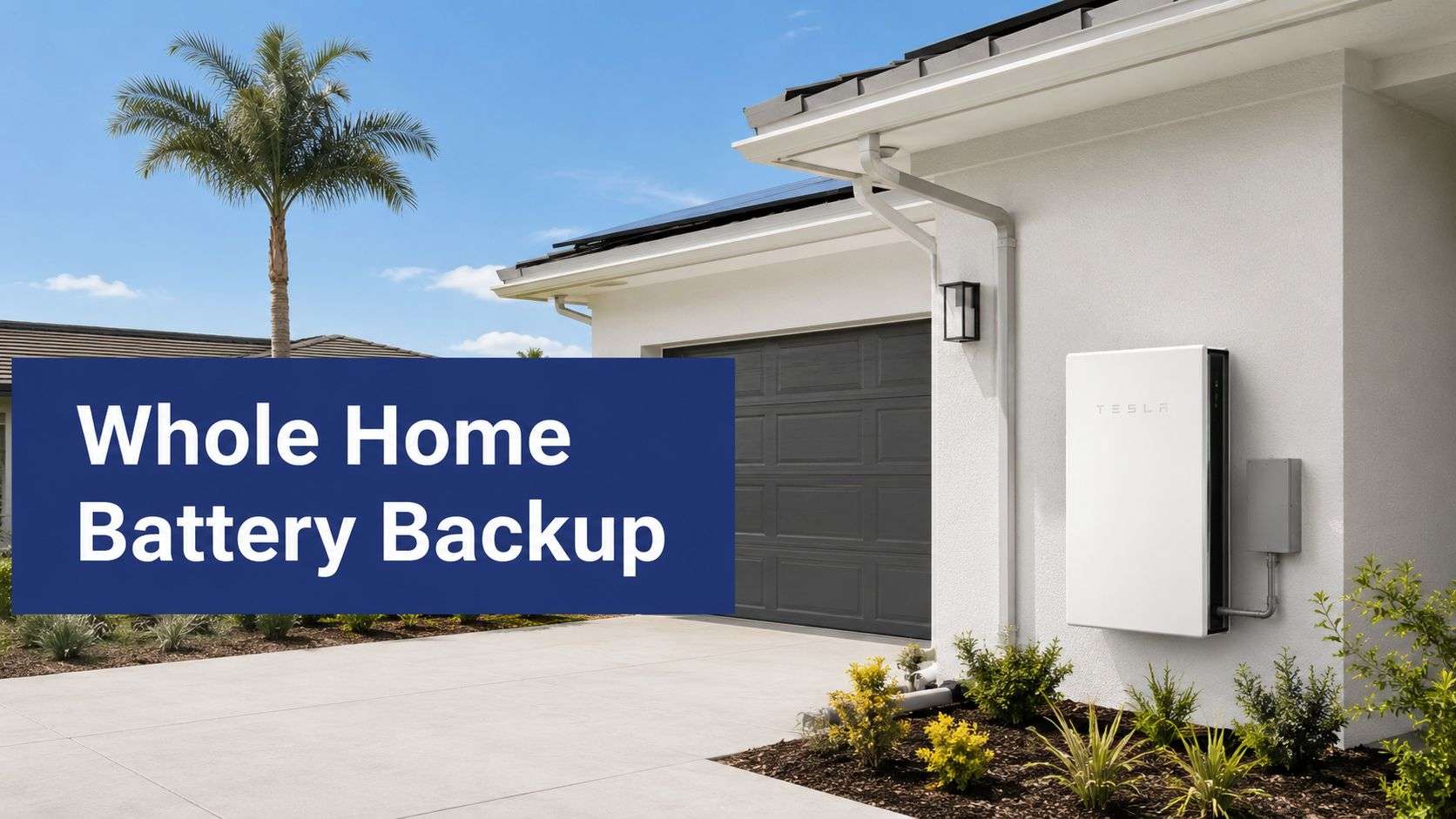
A grid-tied solar system without a battery can lower utility costs. It usually won't keep your home running during an outage on its own. That's the point many homeowners discover too late.
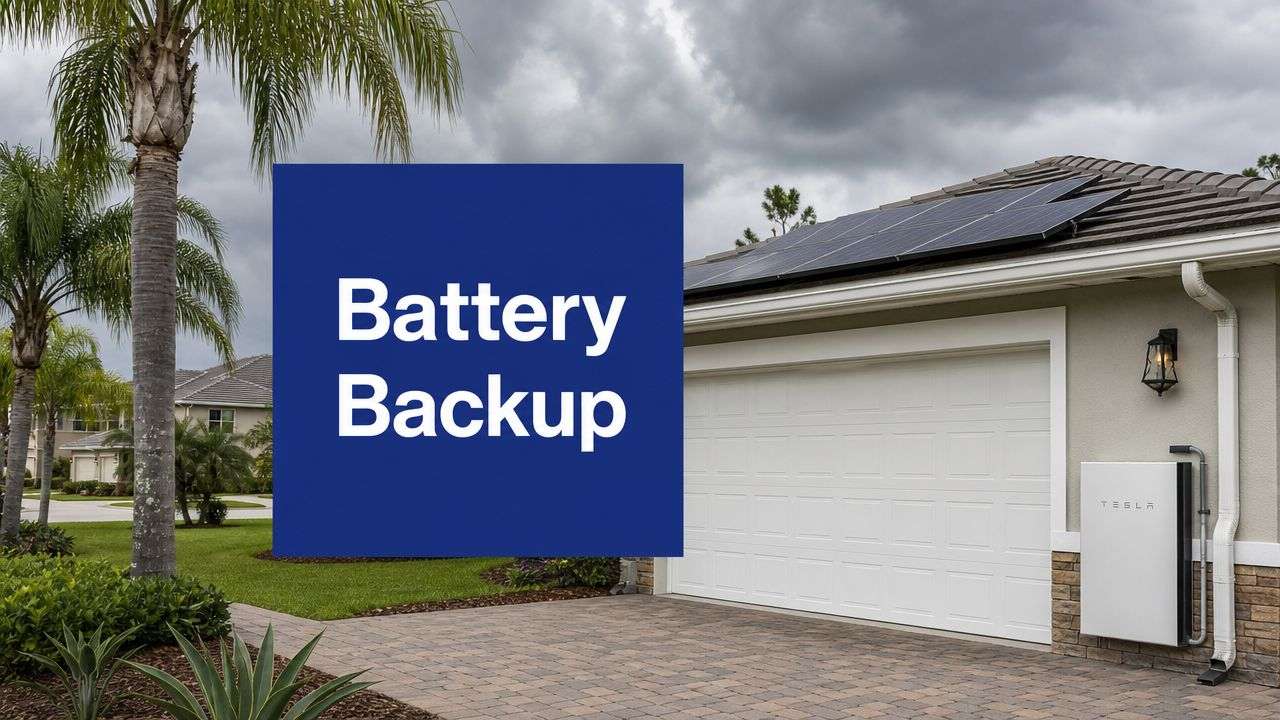
In Florida, battery storage changes solar from a bill-management tool into a resilience asset. If outages during tropical weather are part of your planning concern, storage deserves serious attention.

What A Battery Actually Does
A battery stores usable electricity so selected household circuits can keep operating when utility power drops. The important phrase is selected household circuits. Most homes don't back up everything. They prioritize.
Common critical loads include:
- Refrigeration and freezer circuits
- Internet and device charging
- Lighting in key rooms
- Medical equipment
- Garage access and security systems
- Limited cooling where system design allows
That design choice matters. A battery plan should match how the family lives during an outage, not a generic template.
What Works And What Doesn't
What works in Florida is a critical-load strategy. Homeowners decide what must stay on, then size storage and backup subpanels around those priorities. That approach is usually more practical than trying to energize every load in the house.
What doesn't work is assuming battery storage is automatic whole-home backup. It isn't, unless the system is specifically designed for that purpose and the load profile supports it. Large air conditioning loads, pool pumps, electric resistance heating, and other major draws can exhaust stored energy quickly if they aren't managed carefully.
Another common mistake is treating storage as a product choice instead of a design exercise. The right battery setup depends on your outage expectations, roof production, daytime occupancy, and whether you want solar to recharge the battery during extended disruptions.
If you're comparing options, this overview of Tesla battery storage systems is a good starting point for understanding how storage fits into a Florida home energy plan.
Backup planning starts with circuits, not with brand names.
Maximizing Your Return On Investment
The strongest residential solar decisions in Florida come from modeling, not guessing. A proposal can look attractive because the monthly payment appears manageable. That doesn't tell you whether the system is financially efficient, correctly sized, or aligned with your ownership horizon.
The better lens is return on investment. That includes the upfront structure, the expected utility offset, the value of incentives, and the quality of the production assumptions.
What The Payback Range Looks Like
A nuanced Florida analysis shows average residential payback of 6 to 9 years when the 30% federal ITC and net metering are included. For well-sited 7 to 10 kW systems in the Tampa/St. Pete area, that same analysis indicates a 12% to 15% internal rate of return, as summarized in this Florida solar payback and IRR analysis.
Those figures don't mean every house lands in that range. They do show that the old claim that solar is automatically "too expensive" no longer holds for many Florida homes with solid roof conditions and strong solar exposure.
The Variables That Move ROI
A real ROI model should test several inputs, not just present one optimistic outcome.
- Roof productivity: A well-sited roof performs differently from a shaded one.
- Usage timing: Homes with strong daytime consumption may self-use more solar production.
- Financing structure: Cash, loan, lease, and PPA models shift both risk and long-term value.
- Battery inclusion: Storage can improve resilience, but it changes the financial profile.
- Ownership horizon: If you expect to move soon, your evaluation criteria should be different.
For most homeowners, ownership delivers the clearest long-term economics because the homeowner can use the federal tax credit and capture the ongoing bill reduction directly. Lease and PPA structures can reduce upfront barriers, but they also change who receives the key incentives and can complicate resale decisions.
Don't Ignore Operations And Maintenance
Even a strong financial model can drift if the system underperforms because it isn't maintained. In much of Florida, pollen, salt exposure, humidity, and debris can affect panel condition over time. Homeowners don't need to obsess over constant cleaning, but they should have a maintenance plan and know when inspection makes sense. For a practical overview, this solar panel cleaning guide is a useful resource.
The best solar ROI models include a simple question many quotes skip: what has to go right for these numbers to be true?
That question forces better decisions. If the answer depends on unrealistic production, unclear assumptions, or aggressive financing terms, the proposal needs more scrutiny.
Why Independent Modeling Matters
Homeowners benefit from an advisor who isn't starting with a sales package. An independent consultant can model multiple scenarios, compare ownership structures, and stress-test assumptions before equipment is chosen. For example, Solar Energy Management LLC provides feasibility studies, ROI analysis, system design guidance, battery planning, and procurement support for Florida property owners who want to evaluate solar before committing to an installation path.
That kind of process usually produces cleaner decisions because it separates three issues that often get blurred together:
- Can the house support a high-performing system?
- Does the investment meet your financial goals?
- Does the design support your resilience goals, not just your utility savings?
When those answers are clear, installer proposals become easier to compare. Without that groundwork, homeowners often end up comparing monthly payments instead of comparing value.
The Solar Project Journey From Plan To Power
A residential solar project feels complicated when everything arrives at once. It becomes manageable when you break it into stages and know what each stage is supposed to deliver.

Step One Through Step Three
The early phase determines whether the rest of the project goes smoothly.
Feasibility review Start with utility usage, roof fit, shade conditions, backup goals, and budget boundaries. Bad-fit projects should stop early at this stage.
System design and proposal review
Once the home qualifies, compare equipment layouts, inverter strategy, production assumptions, and warranty terms. Ask every bidder to explain what the system is expected to do during normal operation and during an outage.Installer selection
Choose the implementation partner only after the design and financial logic make sense. The right installer isn't just the lowest bid. They need to match the technical scope and local compliance requirements.
Permitting Through Interconnection
The middle and final stages are more procedural, but they still need oversight.
- Permitting: Local building departments review plans for code compliance.
- Installation: The crew mounts racking, installs modules and inverters, and completes electrical work.
- Inspection: Local authorities inspect the completed work.
- Utility interconnection: The utility signs off so the system can operate as intended.
What homeowners often need most during this phase is someone translating the process. Delays can happen in design revisions, permit comments, equipment lead times, or utility approvals. None of that is unusual. What's important is having a clear record of responsibilities and expected deliverables.
Where Homeowners Need To Push Hardest
The most common project issues don't usually come from the panels themselves. They come from mismatched expectations.
Push for clarity on these points:
- Scope ownership: Who handles permits, utility paperwork, and inspections?
- Design intent: Which circuits are backed up if a battery is included?
- Change orders: What triggers extra cost after signing?
- Commissioning: How do you verify the monitoring platform is reporting correctly?
- Documentation: Will you receive final plans, warranty documents, and operating instructions?
If you want a plain-English reference for the installation sequence, this guide on how to install rooftop solar panels gives helpful context before you review contractor timelines.
A good solar project doesn't feel mysterious by the end. You should know what was promised, what was installed, how it operates, and who to call if performance drifts.
If you're evaluating residential solar energy florida and want an independent analysis before speaking with installers, Solar Energy Management LLC helps Florida homeowners assess feasibility, model ROI, plan battery backup, and compare system options with a consultant's perspective rather than a sales script.