In Florida, a typical residential solar system in 2026 costs $2.50 to $3.50 per watt, which puts a common 10 kW system at about $25,000 to $35,000 before incentives. After the federal 30% Investment Tax Credit, that same 10 kW system usually lands around $17,500 to $24,500 in effective cost.
That's the answer most homeowners want first, especially when the power bill spikes and the thought hits: should I finally do something about this? In Florida, that question isn't just about the sticker price. It's about whether the system is sized correctly, whether the roof and insurance picture make sense, whether battery backup is worth it in your area, and whether the proposal in front of you is built for a hurricane-prone state instead of a generic national sales script.
Understanding Your Florida Solar Investment
A lot of Florida homeowners start in the same place. The A/C runs hard, utility bills keep coming, and the first solar quote feels both promising and expensive.
The baseline is straightforward. Residential solar pricing in 2025 and 2026 has stabilized between $15,000 and $25,000, with a typical installed price of $2.50 to $3.50 per watt, and a 10 kW system generally costs $25,000 to $35,000 before the federal tax credit according to Lawrence Berkeley National Laboratory. For many homes in Florida, that's the right range to use when you sanity-check a proposal.
What matters next is how you frame that number. A solar quote is not just a purchase price. It's the front end of a long-term utility cost strategy. Florida's sunlight, local utility structure, and available tax treatment can make that investment look very different from the number on page one of the proposal.
Why The First Price Is Not The Whole Story
A strong solar decision in Florida depends on more than panel count. The full financial picture includes:
- System sizing: An undersized array leaves too much utility exposure. An oversized one can weaken the economics if export credits aren't favorable.
- Roof condition: A good solar design on a bad roof is still a bad project. Florida homeowners should understand how roof age and condition can affect underwriting and premiums. This overview from Schneider Insurance Agencies on how your roof impacts insurance costs is useful context before you commit.
- Battery strategy: Backup power has a different value proposition in Florida than in states where batteries are used mainly for daily rate arbitrage.
- Soft costs and permitting: Those line items often drive price more than panel brand alone.
Practical rule: If two quotes have a similar system size but one is dramatically cheaper, don't assume you found a bargain. In Florida, lower price can mean weaker engineering, shallow production modeling, or missing scope that shows up later.
When homeowners evaluate residential solar system cost the right way, they stop asking only “what does it cost?” and start asking “what does this protect me from, and what will it save over time?”
Typical Florida Solar System Costs By Home Size
System size drives most of the cost conversation, but it doesn't scale in a perfectly straight line. Larger systems often work out better on a per-watt basis, especially when the roof is simple and the design is clean.

Small Homes And Lower Usage Profiles
A 6 kW system is a common fit for a smaller Florida home or a household with modest electric use. Verified data places a 6 kW system between $15,000 and $25,000 before tax credits, and that system usually needs about 350 to 400 square feet of roof space based on the cost framework summarized by the U.S. Department of Energy.
That range is broad for a reason. A simple south- or west-facing roof with minimal obstructions usually prices better than a chopped-up roofline with multiple planes, setbacks, or shade constraints.
Mid-Range Homes And The Common 10 kW Benchmark
For many Florida households, 10 kW is the reference point because it aligns with heavier cooling demand and more all-electric usage. The verified national benchmark for 2025 and 2026 remains $25,000 to $35,000 before incentives at $2.50 to $3.50 per watt, as reported by Lawrence Berkeley National Laboratory.
That's why I often tell homeowners to evaluate bids in both total price and cost per watt. Total price tells you cash exposure. Cost per watt tells you whether the quote is reasonably competitive for the system size.
Larger Florida Homes And Higher Loads
A larger home, or one with heavier electric loads like pool equipment, EV charging, or high daytime A/C demand, can push into the 12 kW and above category. Verified data shows a 12 kW residential system at about $30,505 before incentives.
Here's the practical takeaway:
- Smaller systems: Often carry a higher effective cost per watt because fixed design, permitting, and mobilization costs are spread across fewer watts.
- Mid-size systems: Usually strike the most balanced combination of household coverage and workable economics.
- Larger systems: Can be more cost-efficient per watt when the roof layout supports them cleanly.
A low per-watt price only matters if the design matches how the home actually uses electricity. In Florida, the best-performing system on paper can still disappoint if it ignores roof geometry, storm hardening, or utility rules.
Deconstructing Your Solar Quote What You Are Paying For
Most homeowners look at a proposal and assume the panels are the main expense. They aren't.

According to the cost breakdown published at PowerOutage solar cost data, hardware accounts for only about 12% of the final installed price, while 88% comes from soft costs such as permitting, labor, customer acquisition, overhead, and interconnection. The same benchmark notes that customer acquisition and origination average about $0.84 per watt, making it the largest single soft-cost component.
That explains why two quotes with similar panel brands can still come in far apart.
Hard Costs You Can See
These are the visible parts of the project:
- Panels: Premium monocrystalline panels, which are standard for many Florida homes, run $0.30 to $0.50 per watt, and a 400-watt panel costs about $120 to $200.
- Inverters: The equipment that converts solar production into usable household electricity.
- Racking and mounting: This matters in Florida because attachment quality, roof interface details, and wind-resistance design are not boxes to check casually.
- Electrical balance of system: Wiring, conduit, breakers, disconnects, and related components.
Homeowners tend to compare these items because they're tangible. They can point to a panel brand or an inverter model and feel like they're comparing substance.
Soft Costs That Usually Drive The Price
The bigger pricing drivers are usually less visible:
- Permitting and inspections with the local authority having jurisdiction.
- Utility interconnection requirements and coordination.
- Engineering and system design, especially where wind loads and roof conditions complicate the layout.
- Labor, which NREL benchmarks at about $0.22 per watt.
- Sales and acquisition overhead, which can be substantial.
Florida adds its own friction points. Local permitting can vary by municipality. Utility coordination can be slow. Storm code compliance isn't optional.
What to ask when reviewing a quote: “How much of this price is equipment, how much is labor and permitting, and what engineering is included for my roof and wind exposure?”
That question quickly separates a transparent proposal from a sales sheet.
What Usually Does Not Work
The wrong way to compare solar bids is to focus only on panel wattage or total panel count. That misses the actual cost drivers.
The better approach is to compare these side by side:
- Installed price per watt
- Scope of engineering
- Roof attachment method
- Interconnection support
- Warranty terms and who stands behind them
- Assumptions about annual production
A cheaper quote can become the expensive quote if it triggers change orders, delays approval, or leaves the homeowner with a system that isn't designed for Florida conditions.
Incentives And Credits That Lower Your Final Cost
The gross proposal number is not the number most Florida homeowners should use when deciding whether solar makes financial sense.
The most important adjustment is the federal 30% Investment Tax Credit. Verified data shows that a 10 kW system priced at $25,000 to $35,000 drops to an effective cost of about $17,500 to $24,500 after the credit. That's a meaningful reduction in net cost, and it changes the payback math immediately.
Florida homeowners should also pay attention to state-level tax treatment. Property-tax treatment matters because one of the biggest hidden benefits of a well-planned system is that it can improve the home's economics without punishing the owner on the tax side. If you want a focused breakdown of what applies locally, this guide to Florida solar incentives is worth reviewing.
Why Incentives Matter More In Florida Than People Assume
In Florida, solar is rarely a lifestyle purchase alone. It's a utility cost strategy. Once incentives reduce the net installed cost, the remaining question becomes whether the home can convert sunlight into bill savings efficiently enough to justify the investment.
Verified Florida-specific guidance indicates that the payback period for a well-designed residential solar system typically ranges from 6 to 10 years, influenced by solar irradiance, local utility rates, and property tax exemptions, according to TerraSol's analysis of the true costs of solar.
Common Mistakes Homeowners Make
- They evaluate pre-incentive pricing only. That inflates the perceived cost.
- They assume every quote handles the tax credit discussion correctly. It's better to verify exactly how the figures are presented.
- They ignore property-side effects. A strong financial model looks at taxes, utility savings, and long-term ownership together.
The best solar economics in Florida usually come from a system that is sized carefully, priced realistically, and modeled on net cost instead of sticker price.
That's the point where residential solar system cost becomes less about expense and more about controlled long-term energy spending.
The Financial Impact Of Adding Battery Storage
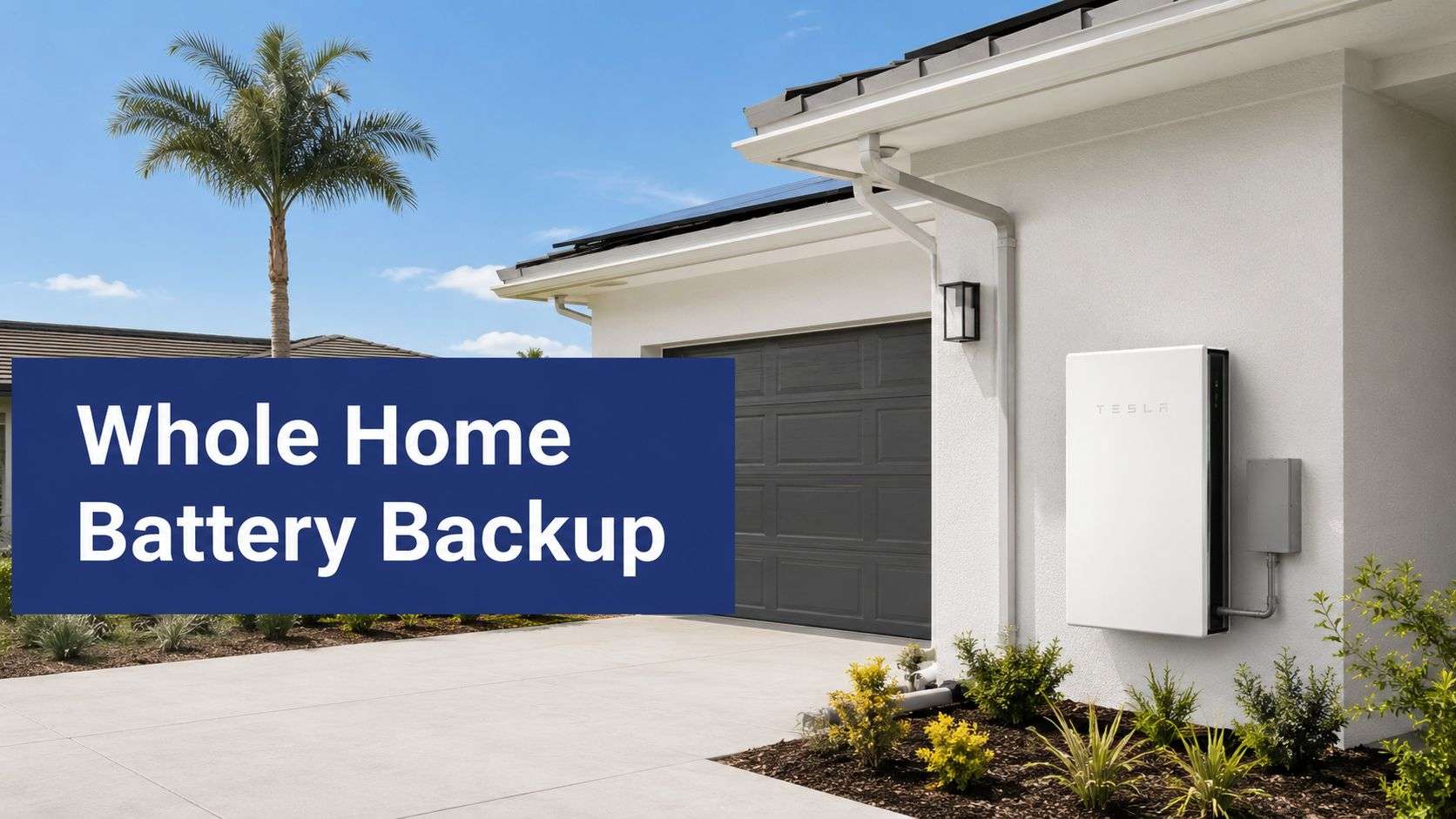
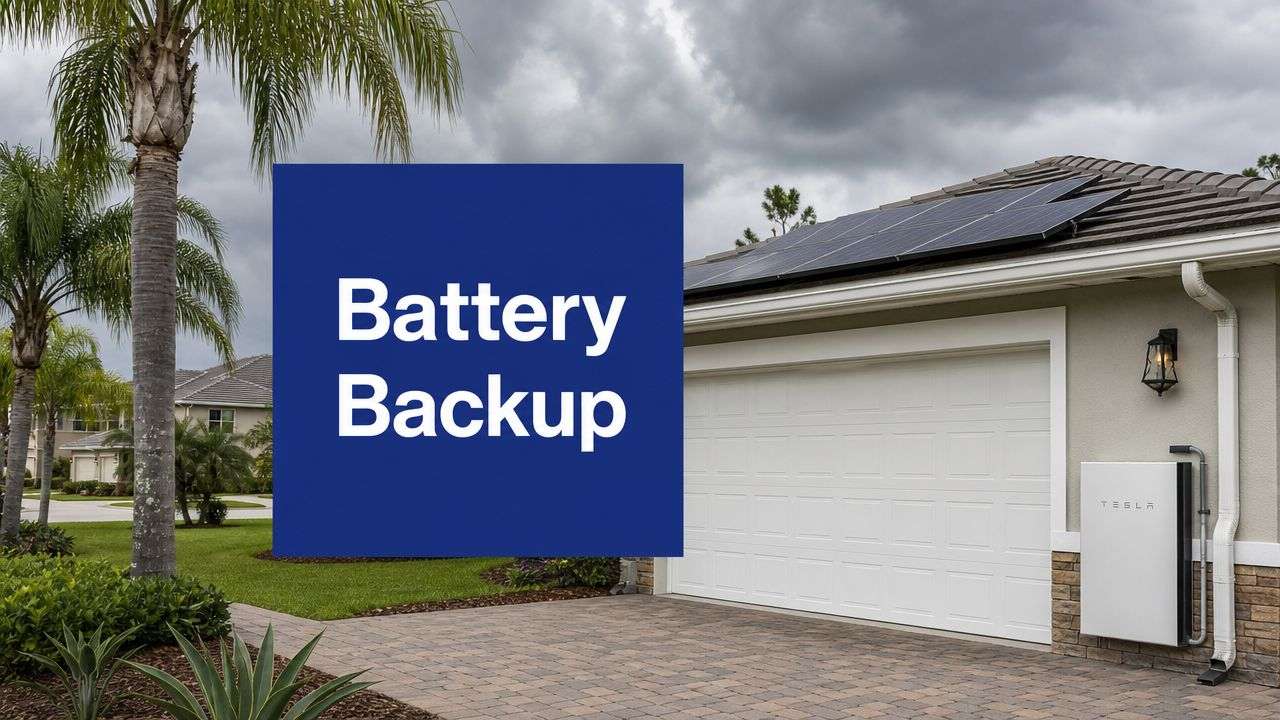
Battery storage changes the conversation in Florida because it solves a different problem than solar alone. Solar lowers dependence on utility purchases. A battery protects critical loads when the grid goes down.

The cost side is simple enough. Verified guidance identifies battery storage as a major add-on, often discussed in the $15,000 to $25,000 range. The harder part is valuing it correctly in Florida.
Bill Savings Versus Resilience
National content often treats batteries as a bill-optimization tool. That's incomplete for Florida. Verified guidance from Tesla's solar cost breakdown notes that in Florida, where net metering rules can cap export credits, a battery's primary value is often resilience during outages, not daily arbitrage. The same source frames the question as Resilience ROI, meaning the homeowner should compare a $20,000 battery against the true value of outage protection.
That's the right lens.
If you're in Florida, ask what you want the battery to do:
- Keep refrigeration, lighting, internet, and selected circuits running
- Support medical or work-from-home needs during outages
- Reduce generator dependence during storm season
- Provide a smoother backup transition than a portable unit can offer
If your goal is only maximum utility-bill reduction, expanding the array may create stronger economics than adding storage. If your goal is continuity during storms, storage can justify itself differently.
What Resilience ROI Looks Like In Practice
A battery should be evaluated like an insurance-backed resilience asset, not just a savings device. Homeowners comparing options should think through:
- Which loads must stay on
- How long those loads need support
- Whether solar will recharge the battery during extended outage conditions
- Whether a generator, battery, or hybrid approach fits the home better
Generic proposals often fail. They present a battery as a simple add-on instead of matching storage size to critical-load priorities.
For a deeper planning view, this resource on solar battery storage cost helps frame that decision around backup needs, not just hardware price.
A battery in Florida should earn its place by protecting comfort, safety, and continuity. If the proposal can't show which loads it will support, the design work isn't finished.
Calculating Your Payback Period And ROI In Florida
A Florida homeowner gets a solar quote that looks strong on day one. The monthly savings look attractive, the tax credit lowers the net price, and the installer shows a fast payback. Then the critical questions start. How much of that return depends on current net metering rules? How much depends on utility rate increases? How much risk sits in the roof, wind design, or battery plan?

That is why payback should be calculated as total cost of ownership, not just sticker price divided by estimated annual savings.
Start with a common example. A 10 kW system at $25,000 qualifies for the 30% federal tax credit, which brings the net effective cost to $17,500 if the homeowner can use the credit. That part is simple. The harder part is estimating how much utility spending the system will offset over time under Florida conditions.
A Simple Florida Example
Use this as a decision framework, not a sales promise:
- Gross system cost: $25,000
- Federal tax credit: $7,500
- Net effective cost: $17,500
Payback often falls in a broad range because it depends on several variables at once: system production, household usage pattern, utility billing structure, financing terms, and how long the equipment performs as expected. In Florida, I also look at storm exposure and policy risk. A system that performs well on paper can still produce a weaker return if the design ignores wind-zone requirements, roof age, or future changes to export compensation.
What Actually Improves ROI In Florida
Better ROI usually comes from disciplined design and realistic assumptions.
| Factor | Why It Matters |
|---|---|
| Roof orientation and shading | A better solar window improves production without increasing equipment cost |
| System sizing tied to real usage | Prevents overbuilding for credits that may be less valuable later |
| Utility bill analysis | Shows whether savings come from self-consumption, exports, or both |
| Tax credit eligibility | Affects true net cost, not just quoted price |
| Wind and installation quality | Protects long-term performance and reduces the chance of costly problems |
Notice what is not on that list. Sales projections with aggressive utility inflation assumptions rarely hold up well.
Cash Purchase Versus Financing
Cash gives the cleanest ROI picture because the project cost and the energy savings are easier to compare. Financing adds another layer. Interest, dealer fees, and loan term can change a good project into an average one, even when the monthly payment still looks acceptable.
That does not mean financing is a bad choice. It means the quote should separate system price from financing cost so you can see what you are really buying.
A homeowner planning to stay in the house for years may accept a slower payback if the long-term savings are strong and the system is built to last. A homeowner who may move sooner should be more conservative. In that case, resale value, roof condition, and transferability of any loan matter almost as much as projected utility savings.
If the payback model depends on unexplained production numbers, high utility escalation assumptions, or vague language around net metering, the numbers are not ready for a signature.
For a cleaner estimate, use a Florida solar ROI calculator that breaks down payback inputs before comparing bids.
How An Independent Consultant Protects Your Investment
Florida solar projects fail for predictable reasons. The system is oversized for the billing structure. The roof wasn't evaluated carefully enough. The battery plan doesn't match the loads. The homeowner compares sales presentations instead of engineering and economics.
An independent consultant changes that process by representing the homeowner's side of the decision, not the installer's sales target.
Where Independent Guidance Makes The Biggest Difference
A strong advisor helps with the parts most homeowners can't easily validate on their own:
- Feasibility review: Does the roof, service equipment, and load profile support the project cleanly?
- Financial modeling: Are the projected savings grounded in realistic assumptions?
- Installer vetting: Which local firms are qualified for the design and scope?
- Design review: Is the layout optimized for Florida wind exposure, roof condition, and utility interconnection?
- Battery planning: Does the storage proposal support actual critical loads?
That work matters because Florida has state-specific risk. Hurricane exposure, local code interpretation, and utility process details can turn a decent-looking quote into a weak investment if nobody is checking the assumptions independently.
Questions Every Homeowner Should Ask
Before moving forward, get direct answers to these:
- How was the system size determined from my real usage?
- What roof and attachment assumptions are built into this design?
- What happens if permitting or interconnection requires changes?
- If a battery is included, which loads will it support first?
- Who is accountable for validating production assumptions?
Homeowners who want an advocate during that process often benefit from working with an independent solar consultant, especially when comparing multiple bids or evaluating storage.
Value lies in risk reduction. Not hype. Not speed. A better process usually leads to a better system, better financial clarity, and fewer expensive surprises after installation.
If you want a Florida-specific review of your solar quote, battery plan, or ROI assumptions, Solar Energy Management LLC can help you evaluate the true total cost of ownership before you commit. Their team provides independent consulting, feasibility analysis, and financial modeling so you can make a smart decision based on your roof, your utility profile, and your resilience goals.