The pattern is familiar across Florida. A storm tracks closer, phones start charging, ice sells out, and someone in the house says, “At least we have solar.” Then the grid drops, the lights go out, and the solar system on the roof doesn't keep the refrigerator running.
That surprise is one of the most expensive misunderstandings in residential and commercial energy planning. Rooftop panels can lower utility bills. They can produce excellent energy over time. But solar panels alone usually do not provide backup power during an outage. If you want a building in Florida to stay livable through a blackout, you need a system designed for backup from the beginning.
That matters more here than in many other states. Florida owners don't just deal with random utility interruptions. They plan around hurricane season, prolonged restoration timelines, heat, humidity, refrigerated food loss, communications needs, and in some cases medical equipment or business continuity. A good solar battery backup for power outages isn't a gadget purchase. It's resilience planning.
Why Your Florida Home Needs More Than Just Solar Panels
A lot of Florida buyers start in the right place and still end up with the wrong expectation. They know utility prices matter. They know solar can offset daytime consumption. They know storms can take the grid down. The mistake is assuming those three facts automatically add up to blackout protection.
They don't.
Standard grid-tied solar systems usually shut down during an outage. That means your roof may still have panels and sunlight, but your house can still be dark. For many owners, that only becomes clear after the first real outage.
The Florida Problem Is Resilience, Not Just Production
In Florida, backup planning is rarely about convenience alone. It's about keeping the basics operating when the grid is unstable or unavailable.
For a homeowner, that often means preserving food, maintaining lighting, powering internet and phones, and keeping selected outlets live. For a business, it may mean maintaining point-of-sale systems, network gear, refrigeration, security, or a critical office zone while the rest of the facility rides through the outage.
Practical rule: If your goal is outage protection, judge the system by what stays on when the grid goes down, not by how much solar production it generates on a normal day.
That shift in thinking changes the entire conversation. You stop asking, “How many panels fit on my roof?” and start asking, “Which loads matter most, for how long, under Florida storm conditions?”
Why More Owners Are Asking Better Questions
Interest in backup power isn't theoretical anymore. A Sunrun survey noted that nearly 40% of U.S. homeowners increased interest in backup power sources due to outages, and 47% of homeowners who experienced summer outages felt unprepared, as summarized by Stanford's overview of solar-plus-storage resilience research.
That lines up with what Florida owners already know from experience. A short outage is annoying. A multi-day outage during heat and storm recovery is a planning failure.
Before deciding whether solar makes sense for your property, it helps to separate bill savings from backup value. The two can overlap, but they are not the same thing. A useful starting point is to review the pros and cons of solar panels in Florida with outage resilience in mind, not just payback.
How Solar Battery Backup Actually Works During an Outage
A battery-backed solar system works because it can separate your building from the utility grid and create a controlled pocket of power for selected circuits. In the industry, that's called islanding.
The simplest analogy is a water system. Think of the grid as the city water main. Think of your battery as a storage tank. Think of the inverter and transfer equipment as the valves and pump that redirect flow when the main supply fails. If the city line goes down, the system has to close the connection safely before your own stored supply can serve the house.

What Happens The Moment The Grid Fails
A properly designed backup system doesn't wait for you to throw manual breakers around the house. It detects grid loss and changes operating mode automatically.
According to this explanation of solar batteries during blackouts, a solar battery backup system can only power a home during an outage if it is designed for islanding. When grid loss is detected, a transfer switch disconnects the property from the grid to prevent dangerous backfeeding, and the battery plus inverter supply power to selected loads. If the equipment supports it, solar can also recharge the battery during a multi-day outage.
That last point is critical. Panels don't become useful in an outage merely because they exist. They become useful when the system architecture allows them to feed a battery-backed islanded system safely.
What Usually Gets Powered
Most backup systems in Florida are not designed to run everything. They're designed to power a protected load set.
That usually means a backup subpanel or protected circuits such as:
- Food protection loads: Refrigerator, freezer, and sometimes a kitchen outlet circuit
- Communication loads: Wi-Fi, phone charging, modem, router, and selected office equipment
- Health and safety loads: Medical devices, security systems, garage access, and key lighting
- Selective comfort loads: Ceiling fans or a small section of cooling, if the battery system is sized for it
What usually doesn't work well on battery-only backup is the assumption that the whole home will operate normally without careful design. Large HVAC systems, electric resistance heat, dryers, ovens, pool equipment, and water heating can empty storage quickly.
Why Equipment Matching Matters
Many proposals prove too simplistic. Buyers get shown battery capacity, but not the control logic and electrical design that determine whether the system behaves well under stress.
The hardware has to work as a coordinated package:
- Solar array provides generation when the sun is available.
- Battery stores energy for later use.
- Inverter or inverter-charger converts and manages power flow.
- Transfer equipment isolates the property from the grid.
- Critical loads panel limits what stays energized during backup.
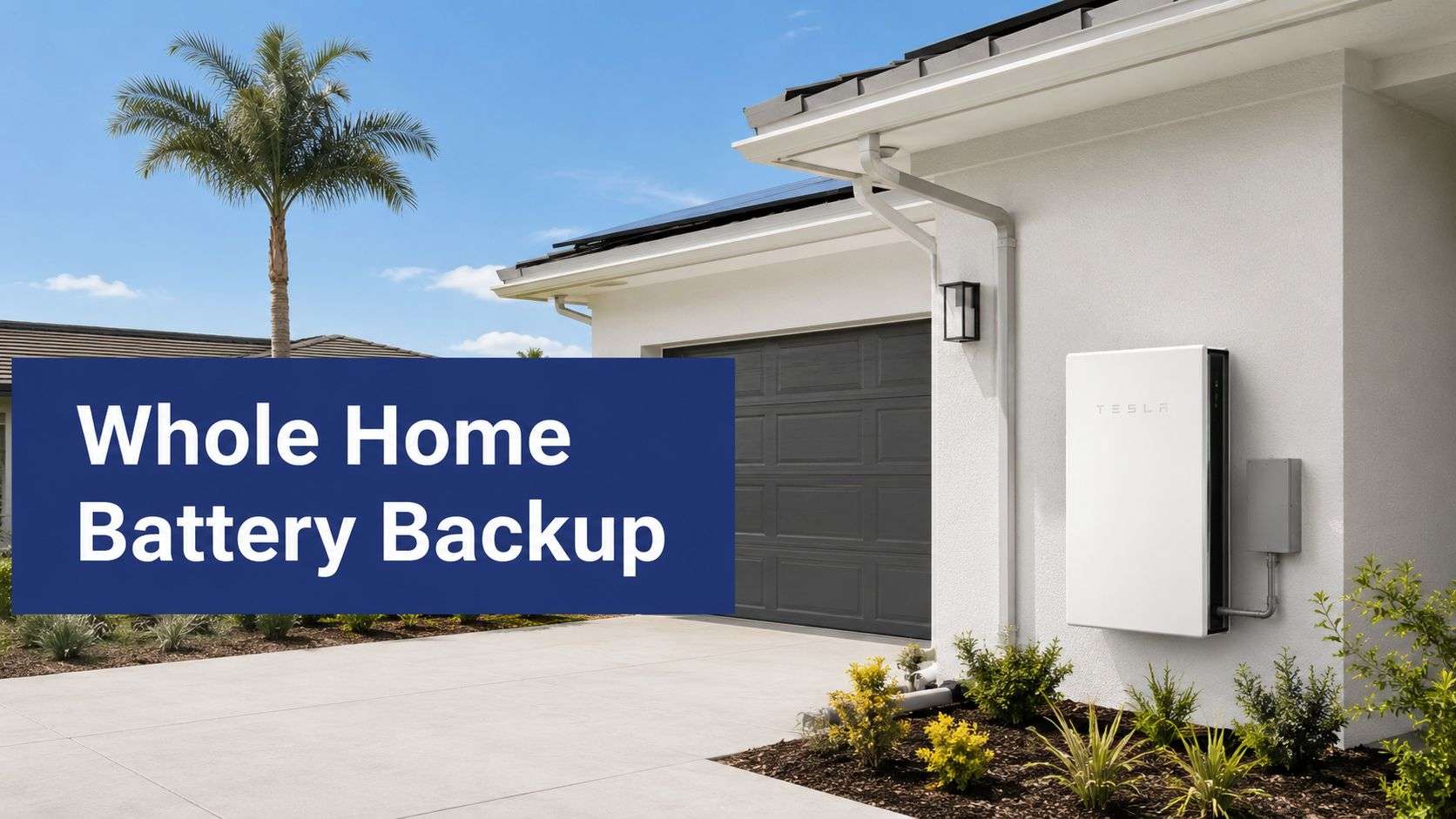
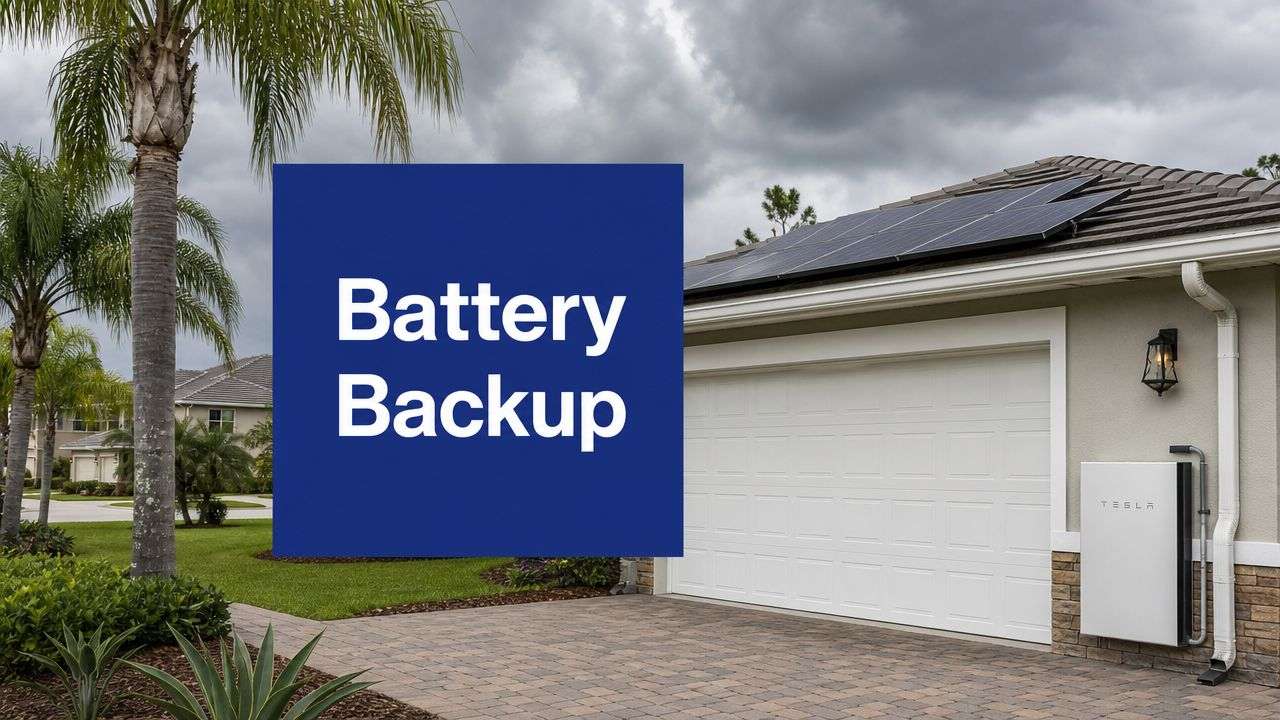
If you're comparing platforms, it helps to understand how different battery systems package these functions. A practical overview of current options is available in this guide to Tesla battery storage systems, especially if you're trying to understand integrated battery and inverter behavior rather than just battery nameplate capacity.
A backup system is electrical choreography. If one part is mismatched, the whole performance suffers.
Choosing Your System Components Battery And Inverter Options
Once you understand backup operation, the next question is what hardware makes sense in Florida. This isn't just about brand preference. Heat, salt air exposure in coastal areas, enclosure placement, retrofit conditions, and outage goals all influence the right equipment mix.

Battery Chemistry Trade Offs
Two battery chemistries dominate serious residential and light commercial discussions today: LFP and NMC.
LFP, or lithium iron phosphate, is often favored when owners care most about thermal stability, cycle life, and conservative long-term operation. In Florida, where equipment may sit in garages, utility rooms, or exterior-rated enclosures exposed to persistent heat, those traits matter.
NMC, or nickel manganese cobalt, can be attractive where compact energy density and product ecosystem fit are stronger priorities. Some well-known home batteries use that chemistry successfully. But chemistry alone never decides the project. The enclosure, controls, warranty structure, ventilation assumptions, and installation location matter just as much.
For many Florida buyers, the better question isn't “Which chemistry is best?” It's “Which battery platform fits my outage plan, operating environment, and service strategy?”
Inverter Architecture Changes The Entire Project
The inverter is the traffic controller. It decides how solar, battery, house loads, and grid interaction work together.
You'll generally hear these approaches discussed:
- AC-coupled systems: Often useful when adding batteries to an existing solar system. They can be practical for retrofit projects because they don't require rebuilding the original solar architecture.
- DC-coupled systems: Often attractive in new builds or major redesigns where solar and storage are planned together from the start. They can simplify some energy flow pathways.
- Hybrid inverters: These combine solar and battery management in one coordinated platform, which can reduce complexity when the system is designed cleanly from day one.
None of those options is automatically superior. A Florida home with existing rooftop solar may benefit from one path. A new custom home or commercial facility planning for resilience from the electrical design stage may benefit from another.
Don't Ignore Environmental Ratings
Florida equipment doesn't live in a mild lab environment. It lives with humidity, airborne salt in some markets, driving rain, heat, and occasional debris exposure. That's why enclosure quality and environmental protection ratings deserve attention during design review.
If you want a useful primer before talking through battery and inverter placement, this guide to industrial component IP ratings helps explain how ingress protection relates to dust and water exposure. That's directly relevant when equipment may be mounted in garages, on exterior walls, or in utility areas with variable conditions.
What Works Better In Practice
In consultant-led planning, the strongest component selections usually come from the site conditions first and the product shortlist second.
A practical review often looks like this:
| Decision Area | What To Ask In Florida |
|---|---|
| Battery location | Will the unit sit in conditioned space, a garage, or outdoors? |
| Inverter type | Is this a retrofit or a new coordinated solar-plus-storage design? |
| Critical load support | Can the inverter start and sustain your priority circuits reliably? |
| Equipment exposure | Do enclosure and installation details match Florida weather conditions? |
| Serviceability | Can a qualified technician troubleshoot the system easily after a storm? |
For owners comparing systems, the best conversation is rarely about marketing labels. It's about thermal conditions, backup behavior, load support, and whether the system can be maintained sensibly over time. If you want a technical baseline before a design review, this overview of inverter and solar installation is a useful place to start.
Sizing Your System Planning For Critical Loads
A lot of expensive mistakes occur because people shop for battery size before they define what the battery is supposed to do.
Battery backup should start with a critical load audit. Not a wish list. Not a generic package. A real list of what must stay on when Florida weather knocks the grid out.

Start With Three Load Tiers
Most Florida homes and small businesses can organize loads into three practical tiers.
Tier one is essential. This usually includes refrigeration, lighting in key rooms, internet, charging, medical devices, and a few convenience outlets.
Tier two improves livability. That might include a garage door circuit, security equipment, office electronics, selected kitchen loads, or ceiling fans.
Tier three is what you can live without during an outage. Pool pumps, dryers, ovens, large water heating loads, and many whole-home comfort loads usually belong here unless the budget and design support them intentionally.
That framework gets people out of the vague “I want backup” mindset and into actual electrical planning.
Runtime Depends On Load, Not Marketing
The key sizing principle is simple. Backup duration is governed by the ratio of usable storage to your home's load. One common benchmark notes that a 10 kWh battery might provide about 20 to 24 hours for a small home's essential loads, but only 3 to 6 hours in a large house using 30 to 40 kWh per day, according to EcoFlow's backup duration guide.
That's why a battery can feel oversized in one house and undersized in another. The battery didn't change. The load profile did.
Field advice: The fastest way to waste money on battery backup is to size around total house habits when your real outage goal is only a protected set of critical circuits.
What A Good Load Audit Looks Like
A useful audit doesn't need to be complicated at first. It needs to be honest.
Walk through the property and list:
- Must-run items: Refrigerator, freezer, internet, communications, medical equipment, key lights
- Important but optional items: One small cooling zone, selected outlets, workstation, garage access
- Heavy loads to exclude unless deliberately engineered: Central HVAC, electric range, dryer, pool equipment, large resistance heating loads
Then add a second layer of thinking. Ask what changes during storm season. A Florida outage plan in August may require different decisions than one during a mild winter week.
For example, some households can tolerate no air conditioning for a short outage. Others can't, especially where health, age, or occupancy conditions change the safety equation. That doesn't mean the answer is always “buy more battery.” Sometimes the right answer is targeted cooling in one room, better insulation, fans, or a hybrid strategy.
Small Home And Large Home Expectations
A compact home with disciplined essential loads can stretch backup much farther than a large home trying to preserve normal living patterns. That's one reason small-home owners often get strong value from focused battery planning.
If that's your situation, it helps to think in terms of selected circuits and daily discipline rather than whole-home continuity. This page on solar power for a small house is relevant because the same logic that improves solar design also improves battery sizing. Tight load definition almost always beats vague oversizing.
A Better Florida Sizing Conversation
Ask your consultant or installer these questions before you agree on battery capacity:
- Which exact circuits stay on during an outage?
- What is the expected runtime at night with no solar recharge?
- How does the system perform in a multi-day storm sequence with limited sun?
- Will a critical-load subpanel be used, and what is excluded from it?
- What changes if I want one cooling zone included?
Those questions produce better projects than asking how many batteries your neighbor installed.
Florida Incentives And Permitting For Solar Storage
In Florida, storage planning isn't only a technical exercise. The economics and paperwork shape the project from the beginning.
A battery may make sense for resilience even when the financial return isn't identical to the solar array itself. But state tax treatment can improve the math, and permitting realities affect schedule, equipment layout, and design choices.
The Florida Sales Tax Exemption Matters
One of the clearest Florida-specific benefits is the state sales tax treatment for residential solar.
According to the Florida Department of Revenue solar tax guidance, Florida's Residential Solar Energy Sales Tax Exemption covers the entire cost of a solar energy system, including battery storage equipment when purchased as part of the installation. This provides a direct 6% savings on the total project cost for homeowners.
That matters because battery storage is often the part of the project buyers hesitate over. A direct reduction in total installed cost can improve the financial case for including resilience upfront instead of trying to retrofit it later.
If you're comparing scenarios, it's helpful to review broader Florida solar incentive considerations at the same time so you're evaluating the storage decision in the full state context.
Permitting Shapes Design More Than People Expect
Florida permitting isn't one uniform process. Local jurisdictions, utility requirements, structural review, electrical review, and interconnection steps all affect project timing and scope.
That's especially true once batteries enter the conversation. Storage systems introduce additional design issues such as equipment placement, disconnecting means, protected loads configuration, and documentation of backup operation. On the homeowner side, this often affects where batteries can be located and how backup circuits are organized. On the commercial side, it can influence electrical room planning and operational sequencing.
A clean project usually starts with these practical questions:
- Where can the battery and inverter equipment be placed legally and sensibly?
- Does the existing electrical service support the intended backup design?
- Will the system back up the whole building or only selected loads?
- Does the local authority require specific labeling, clearances, or plan details?
Incentives Should Support Strategy, Not Replace It
Tax savings are helpful, but they shouldn't drive the entire decision. In Florida, resilience value often comes from getting the design right before the storm season, not from chasing the largest theoretical savings line item.
That's why consultant-led feasibility work matters. It connects incentives, electrical constraints, outage goals, and site conditions into one plan. A battery installed for the wrong loads in the wrong location is still the wrong battery, even if the tax treatment is favorable.
Best Practices For True Energy Resilience
A battery is a component. Resilience is a system strategy.
That distinction matters because many Florida owners buy storage thinking they bought certainty. What they bought was one piece of a larger outage plan that still needs load control, operating discipline, and in some cases another backup layer.
Why Generic Battery Planning Falls Short
A nationwide assessment found that 63% of households could achieve affordable backup power, but that backup would cover only an average of 51% of essential energy needs, according to this OSTI-published analysis of solar-plus-storage backup coverage.
That finding is especially useful in Florida because it cuts through marketing language. A system can be financially reasonable and still fall short of your actual outage expectations. For hurricane-driven outages, that gap matters.
Don't ask whether a battery provides backup. Ask what it won't cover, for how long, and under what weather conditions.
The Most Reliable Florida Approach Is Layered
For short outages, a well-designed solar-plus-storage system can work very well. For long outages with poor weather, fuel-based backup may still deserve a place in the conversation.
That doesn't mean every property needs a generator. It does mean owners should evaluate whether they are solving for:
- Short interruptions
- Overnight outages
- Multi-day outages with daylight recharge
- Extended storm recovery with uncertain solar production
If the answer is the last one, many properties benefit from a layered strategy that combines batteries, protected loads, and a generator path for unusual events. The battery handles normal cycling and clean instant backup. The generator becomes the contingency plan for prolonged low-solar conditions or heavier operational needs.
Load Management Extends Runtime More Than Most People Expect
The best battery system in Florida can underperform if the building runs as if nothing happened. Good resilience design includes active or planned load shedding.
That can include:
- Protected subpanels: Keep only critical circuits on backup
- Manual discipline: Turn off nonessential loads immediately after outage begins
- Selective cooling: Condition one room or one zone instead of the whole structure
- Operational sequencing: Stagger equipment use rather than stacking loads all at once
For some owners, communications resilience is part of that planning too. If your outage strategy depends on internet availability away from normal wired service, it's worth reviewing external options that explore off-grid connectivity for travelers. The use case is different, but the mindset is the same. Backup planning works better when power and connectivity are considered together.
Maintenance And Readiness Are Part Of Resilience
A backup system isn't finished on commissioning day. It needs periodic review.
Firmware, battery health reporting, transfer behavior, and circuit labeling all matter when an outage hits at night in high wind. For larger homes and commercial sites, it's smart to maintain a written outage sequence so occupants or staff know what remains live, what should stay off, and when to escalate to a generator or other contingency.
In Florida, readiness beats improvisation every time.
Your Feasibility And Planning Checklist
Most owners don't need another sales pitch. They need a cleaner way to prepare for a serious conversation about solar battery backup for power outages.
The most productive feasibility review starts with your data, your building, and your outage priorities. If you gather the right information before speaking with a consultant, the design discussion gets sharper fast.

What To Gather Before A Consultation
Bring these items together first:
- Recent electric bills: A consultant needs to see how the property uses energy over time, not what you think it uses.
- Critical load list: Write down the exact appliances, devices, circuits, and business functions that must remain operational in an outage.
- Outage goal: Decide what success means. Overnight protection, a full day of essentials, or a plan for multi-day hurricane outages are very different design targets.
- Photos of electrical equipment: Clear images of the main panel, subpanels, meter area, and proposed battery location help identify constraints early.
- Roof and site notes: Note shade, roof age, available wall space, and any flood or exposure concerns.
- Comfort expectations: Be honest about whether you're trying to preserve basic function or near-normal living conditions.
Questions Worth Answering In Advance
A lot of battery proposals look polished because they avoid hard questions. Ask them anyway.
- Do you want whole-home backup or critical-load backup?
- Can your household change behavior during an outage, or do you need automation?
- Is one room of cooling enough, or is broader comfort essential?
- How long do you want to operate if storm clouds reduce recharge?
- Would a layered battery-plus-generator strategy make more sense?
Those answers affect almost every design choice.
What A Feasibility Study Should Deliver
A serious planning process should produce more than a parts list. It should show whether the project fits the building and the resilience goal.
Look for these outputs:
- Load prioritization
- Preliminary battery sizing
- Protected-load strategy
- Equipment placement guidance
- Financial modeling
- Permitting and interconnection considerations
- Trade-offs between budget, comfort, and runtime
Solar Energy Management LLC provides Florida-focused consulting in that exact planning space, including feasibility studies, battery storage planning, and system design guidance before procurement. For owners who want independent analysis before committing to installation, that kind of advisory process can prevent oversizing, undersizing, and unrealistic outage assumptions.
A well-planned backup system doesn't promise everything. It protects the things that matter most, in the conditions you're likely to face in Florida.
If you want a data-driven plan before speaking with installers, Solar Energy Management LLC can help you evaluate your property, define critical loads, compare battery and inverter options, and build a Florida-specific resilience strategy that matches your budget and outage goals.