
Selecting a solar energy vendor is defined as the process of evaluating and choosing a qualified installer or supplier to design, install, and support your solar power system. The right vendor determines whether your system performs as promised, qualifies for incentives like the federal 30% Investment Tax Credit, and holds up under Florida’s demanding weather conditions. A structured solar energy vendor selection guide separates qualified professionals from high-pressure salespeople who prioritize closing deals over system quality. Solarenergymgmt has spent over 20 years helping Florida homeowners and businesses make this decision with confidence, using criteria that go well beyond the bottom-line price.

What certifications and licenses should you verify in a solar energy vendor?
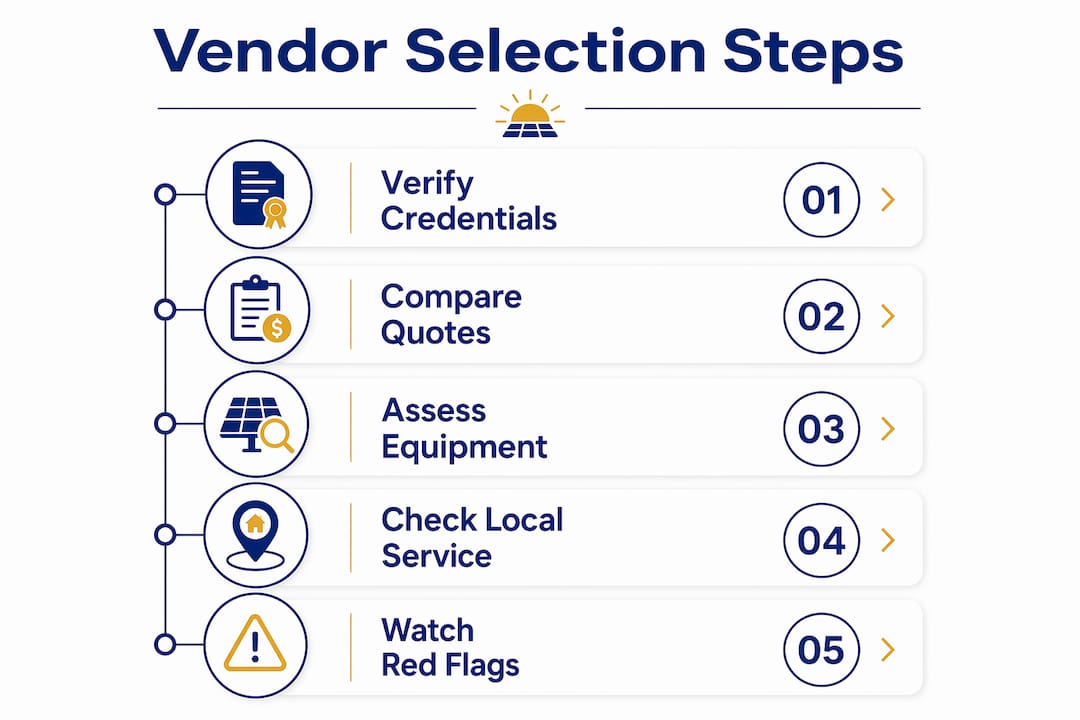
Credentials are the first checkpoint in any vendor evaluation. A vendor without proper certification is a financial and safety risk, regardless of how competitive their quote looks.
The most important credential to verify is the NABCEP PV Installation Professional certification. NABCEP, the North American Board of Certified Energy Practitioners, sets the national standard for solar installer competency. A vendor holding this credential has passed rigorous technical exams and demonstrated real field experience. It is the closest thing the solar industry has to a licensed professional designation.
Beyond NABCEP, verify the following before signing anything:
- State electrical contractor license. Florida requires solar installers to hold a valid state-issued electrical contractor license. Ask for the license number and verify it directly with the Florida Department of Business and Professional Regulation.
- General liability and workers’ compensation insurance. If a worker is injured on your roof, you need proof the vendor carries coverage. Request certificates of insurance, not just verbal assurances.
- Surety bond. Bonding protects you financially if the contractor fails to complete the work or causes damage.
- Local trade association membership. Membership in organizations like the Florida Solar Energy Industries Association signals a commitment to professional standards and ongoing education.
A comprehensive vendor vetting requires verifying at least three itemized written quotes, NABCEP PV certification, and a valid state electrical contractor license. That combination filters out unqualified bidders before you spend time comparing prices.
Pro Tip: Ask the vendor to provide their NABCEP certificate number and cross-reference it on the NABCEP public registry at nabcep.org. This takes two minutes and confirms the credential is current.
How to effectively compare itemized solar installation quotes
Price is the last thing you should compare. The first thing is scope. Two quotes priced $3,000 apart may cover entirely different systems, warranties, and post-installation services.
Comparing identical-looking quotes requires close attention to mounting hardware, wiring, and conduit materials. Cheaper mounts can void your roof’s waterproofing warranty and increase the risk of leaks over time. That risk does not show up in the total price line.
Follow this process when reviewing quotes:
- Request at least three written, itemized quotes. Verbal estimates are not quotes. Each document should list panel brand and model, inverter brand and model, mounting system specifications, wiring and conduit materials, labor, permit fees, and monitoring setup.
- Compare equipment specifications directly. A 400-watt panel from a Tier 1 manufacturer is not equivalent to a 400-watt panel from an unrated brand, even if the wattage matches.
- Identify exclusions. Look for what is missing: utility interconnection paperwork, inspection fees, system commissioning, and post-install monitoring are often excluded from low bids.
- Evaluate financing terms separately. A vendor offering in-house financing may roll costs into the loan that inflate the total. Compare the cash price first, then evaluate financing independently.
- Confirm warranty coverage in writing. Each quote should specify the panel performance warranty, inverter warranty, and installer workmanship warranty duration.
| Quote component | What to look for |
|---|---|
| Panel brand and model | Tier 1 manufacturer, wattage, efficiency rating |
| Inverter type | String, microinverter, or power optimizer; brand and warranty |
| Mounting hardware | Rail brand, attachment method, roof penetration sealing |
| Wiring and conduit | Material grade, UV resistance for Florida exposure |
| Permit and interconnection | Included or itemized separately |
| Workmanship warranty | Duration and what it covers |
Pro Tip: Ask each vendor for a full Bill of Materials before signing. This document lists every component by brand and part number. It is the only way to make a true apples-to-apples comparison across quotes.
What equipment quality, warranties, and bankability factors affect your vendor choice?
Equipment quality determines how much energy your system produces over 25 years. Warranty terms determine who pays when something fails. Both factors carry more long-term weight than the upfront price.
Tier 1 bankability, as defined by BloombergNEF, indicates that a panel manufacturer has the financial stability to honor long-term warranties. A manufacturer that goes out of business in year 10 cannot honor a 25-year performance guarantee. For commercial buyers especially, selecting a BloombergNEF Tier 1 manufacturer reduces both financial and warranty risk significantly.
Warranties in solar come in three distinct layers, and most buyers confuse them:
- Panel performance warranty. Typically 25 years. Guarantees the panel will produce at least 80–90% of its rated output by the end of the warranty period.
- Inverter warranty. Typically 10–25 years depending on the brand and type. Microinverters generally carry longer warranties than string inverters.
- Installer workmanship warranty. Covers labor and installation quality. Duration varies widely, from 1 year to 10 years or more.
Installer workmanship warranties often disappear if the installer goes out of business. The manufacturer warranty stays with the product, but the labor coverage vanishes. This is a real risk in a market where many small installers operate on thin margins.
A structured evaluation framework helps you weight these factors objectively. One published framework for PV equipment selection assigns quality 28%, warranty and bankability 22%, efficiency 18%, price 14%, supply chain transparency 10%, and reputation 8%. That weighted decision framework confirms that price should represent less than 15% of your total evaluation. Most buyers do the opposite.
Why local experience and service quality matter in selecting a solar energy provider
A vendor who has worked in your county for a decade knows things a national chain does not. They know which utility has a 90-day interconnection backlog. They know which permit office requires a structural engineering stamp. They know which roof types in your neighborhood need additional flashing.
Solar is inherently local. Vendors with regional knowledge understand permit requirements, weather codes, and utility interconnection rules that national brands frequently overlook. That knowledge translates directly into fewer delays, fewer change orders, and fewer surprises on your final bill.
Local installers with 10+ years of operation typically offer 10–20% better pricing than national chains, largely because they avoid the overhead and subcontracting markups that larger organizations carry. That cost advantage compounds when you factor in faster permitting and fewer post-installation service calls.
When evaluating local service quality, check these signals:
- Better Business Bureau rating. A pattern of unresolved complaints is a clear warning sign.
- Google and Yelp reviews from the past 12 months. Recent reviews reflect current service quality, not historical reputation.
- References from completed local projects. Ask for two or three customers you can call directly, not just names on a list.
- Responsiveness before the sale. A vendor who takes five days to return a call before you sign will not be faster after installation.
Pro Tip: Always request a physical site walkthrough before accepting any quote. Satellite-based designs miss roof material conditions, shading from neighboring structures, and microclimatic factors that affect system output. An on-site visit by the installer reveals risks that no satellite image can detect.
You can also use Solarenergymgmt’s questions to ask solar vendors as a structured checklist during your evaluation calls.
Common mistakes and red flags to avoid when choosing a solar vendor
The most common mistake buyers make is prioritizing the lowest initial quote without evaluating the full scope of work. Low bids frequently mask poor system design, missing services, and substandard components that create problems years after installation.
Watch for these red flags before you commit:
- No itemized quote. A vendor who only provides a total price is hiding something.
- Large upfront deposit requirements. Reputable installers typically require 10–25% upfront, not 50% or more.
- Extensive use of subcontractors. When the company you hire hands your project to an unknown third party, accountability disappears.
- Unrealistic savings claims. If a vendor promises you will eliminate your electric bill entirely without reviewing your actual usage data, that is a sales tactic, not an engineering assessment.
- High-pressure sales tactics, door-to-door cold calls, and unwillingness to provide detailed quotes are documented warning signs of vendors who prioritize volume over quality.
- Poor or no workmanship warranty. Any installer unwilling to stand behind their labor for at least two years is signaling low confidence in their own work.
“The cheapest quote is rarely the best value. When a vendor cannot explain why their price is lower than competitors, the answer is almost always found in what they left out of the scope, the equipment, or the warranty.”
Verify the vendor’s legal standing by checking their state contractor license status, their business registration age, and any active complaints with the Florida Attorney General’s office. A vendor with less than three years in business carries meaningful continuity risk.
Key Takeaways
Selecting the right solar vendor requires evaluating certifications, comparing itemized quotes, assessing equipment bankability, and prioritizing local expertise over the lowest price.
| Point | Details |
|---|---|
| Verify credentials first | Confirm NABCEP certification and a valid state electrical contractor license before comparing prices. |
| Compare full scope, not price | Request itemized Bills of Materials to identify hidden exclusions in mounting, wiring, and warranty coverage. |
| Prioritize bankable equipment | Choose Tier 1 manufacturers listed by BloombergNEF to protect your 25-year warranty investment. |
| Value local expertise | Vendors with 10+ years of regional experience navigate permits and utility interconnection faster and cheaper. |
| Recognize red flags early | Avoid vendors who use high-pressure tactics, refuse itemized quotes, or require large upfront deposits. |
What I’ve learned after 20 years of solar vendor evaluations in Florida
The buyers who get the best outcomes are not the ones who negotiated the lowest price. They are the ones who asked the hardest questions before signing.
The detail that surprises most clients is the workmanship warranty gap. Manufacturers will honor a panel defect claim 15 years from now. But if the installer who mounted your system is out of business by then, no one is paying for the labor to fix it. That distinction is rarely explained during the sales process, and it costs homeowners real money.
Florida adds another layer of complexity that national vendors consistently underestimate. Interconnection timelines, hurricane wind-load requirements, and county-specific permitting processes vary significantly across the state. A vendor who installed 500 systems in Arizona does not automatically know how to navigate a Florida utility’s interconnection queue. I have seen projects delayed by months because a national chain submitted paperwork that did not meet local utility standards.
The vendors worth trusting are the ones who slow down the sales process. They ask about your energy usage before quoting system size. They schedule a site visit before finalizing the design. They explain the difference between a manufacturer warranty and a workmanship warranty without being asked. That level of transparency is not common, but it is the clearest signal that a vendor is building a long-term relationship rather than closing a transaction.
For Florida buyers specifically, working with an independent solar consultant before committing to any vendor gives you an objective second opinion on system design, equipment selection, and pricing. That step alone has saved clients thousands of dollars and months of frustration.
— Solarenergymgmt
How Solarenergymgmt helps you select the right solar vendor
Solarenergymgmt brings over 20 years of Florida solar experience to every client engagement, offering independent consulting that sits entirely on your side of the table. The firm does not sell panels or installation services, which means every recommendation is based on your financial targets and system requirements, not a sales quota.
Solarenergymgmt helps you compare vendor quotes line by line, evaluate equipment bankability, and model the financial return of competing proposals using real utility rate data. For businesses, the firm’s commercial solar systems guidance covers the 30% Investment Tax Credit, load profile analysis, and interconnection planning. For homeowners, the battery storage planning resource helps you evaluate whether a vendor’s storage proposal matches your actual energy independence goals. Contact Solarenergymgmt for a personalized vendor evaluation before you sign any solar contract.
FAQ
What is the most important credential to verify in a solar vendor?
The NABCEP PV Installation Professional certification is the most critical credential. Pair it with a valid state electrical contractor license to confirm both technical competence and legal authorization to work in your jurisdiction.
How many quotes should I get before choosing a solar vendor?
Get at least three itemized written quotes. Comparing three to five detailed proposals filters out unrealistic pricing and reveals differences in equipment quality, scope, and warranty terms that a single quote cannot expose.
What does Tier 1 solar panel bankability mean?
Tier 1 bankability, as rated by BloombergNEF, indicates a manufacturer has the financial stability to honor long-term warranties. Choosing a Tier 1 manufacturer reduces the risk that your 25-year panel warranty becomes worthless if the company fails.
Why does local solar experience matter more than national brand recognition?
Local vendors understand regional permit requirements, utility interconnection rules, and weather-specific installation codes that national chains frequently miss. That knowledge reduces project delays, change orders, and compliance failures.
What are the biggest red flags when evaluating a solar installer?
High-pressure sales tactics, refusal to provide itemized quotes, large upfront deposit demands, and poor BBB ratings are documented warning signs. Any vendor unwilling to explain their pricing in detail is a vendor worth avoiding.
Recommended
- Top Solar Power Contractors Florida: Your 2026 Guide – Commercial + Residential Solar Power Florida
- Solar Panel Tech in Florida: A Consultant’s Guide For 2026 – Commercial + Residential Solar Power Florida
- Solar Power Systems Florida Your Complete 2026 Guide – Commercial + Residential Solar Power Florida
- Commercial Solar Power Systems a Florida Business Guide – Commercial + Residential Solar Power Florida


