
A solar feasibility study is a structured technical and financial assessment that determines whether a solar energy project is viable at a specific site before any significant capital is committed. Think of it as the architectural planning phase before construction: you would not build a high-rise without engineering drawings, and you should not invest in a solar system without this analysis. The study synthesizes site conditions, energy yield modeling, zoning requirements, and financial risk modeling into a single go/no-go decision framework. Solar Energy Management conducts these assessments for both residential and commercial clients across Florida, where site-specific variables like roof orientation, utility tariff structures, and interconnection rules can make or break a project’s economics.
What are the main components of a solar feasibility study?
A solar feasibility study is broader than a financial pro forma. It synthesizes technical, zoning, and capital considerations to deliver a clear decision. Each component answers a distinct question about project risk.
Technical evaluation covers the physical realities of your site:
- Solar irradiation analysis: How much usable sunlight does the site receive annually, accounting for seasonal variation?
- Shading and topography: Trees, neighboring buildings, roof pitch, and orientation all reduce effective output. A shading loss of even 10% can shift a project from profitable to marginal.
- Roof or land condition: Structural integrity for rooftop systems, or soil bearing capacity and drainage for ground-mount arrays.
- Load profile analysis: Your actual electricity consumption patterns, broken down by time of day and season, determine the right system size.
Financial modeling translates the technical data into dollars:
- Capital expenditure (CAPEX) and operating expenditure (OPEX) estimates
- Return on investment projections using IRR, NPV, and LCOE metrics
- Debt service coverage ratio (DSCR) for financed projects
- Sensitivity analysis showing how results change if electricity prices rise or fall
Grid connection assessment evaluates proximity to the utility interconnection point, available grid capacity, and estimated interconnection costs. In Florida, utility interconnection queues and tariff structures vary significantly by territory, so this step carries real financial weight.
Regulatory and zoning analysis confirms that your project can actually be permitted. This includes land use restrictions, HOA rules for residential projects, environmental setbacks, and applicable building codes.

Pro Tip: Ask any feasibility provider to separate their technical assumptions from their financial assumptions in the final report. If those two sections are blended together, you cannot tell which risks are physical and which are financial.
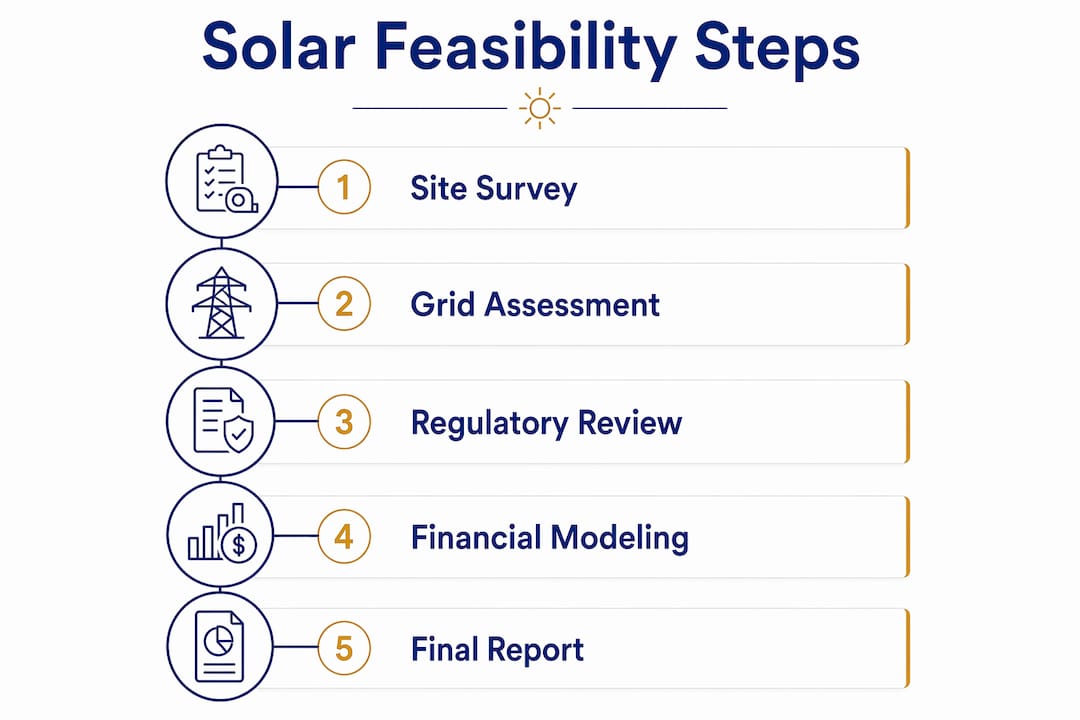
How is a solar feasibility study conducted step by step?
The process follows a logical sequence from information gathering to final recommendation. Skipping steps increases the risk of costly surprises during detailed engineering.
Client consultation and scope definition. The study begins with a clear brief: system size range, budget constraints, financing preferences, and timeline. A commercial client targeting the federal 30% Investment Tax Credit needs different modeling assumptions than a homeowner focused on monthly bill reduction.
Data gathering. The analyst collects utility bills, site coordinates, roof or land drawings, and any existing electrical single-line diagrams. Satellite imagery and GIS data are pulled to begin remote site characterization.
Desktop analysis. Desktop analysis uses satellite imagery, GIS, and solar resource data and is typically completed within 2–3 days. This phase produces a preliminary shading model, an estimated system size, and a first-pass energy yield figure.
Site visit and physical inspection. Physical site visits include inspection of land usability, shading, and grid access to verify what remote analysis cannot confirm. An analyst checks roof condition, electrical panel capacity, meter location, and the physical path for conduit runs. This step catches deal-breakers that satellite imagery misses entirely.
Technical modeling and energy yield simulation. Using validated solar resource databases, the analyst runs energy yield simulations. The output includes both P50 projections (the most likely annual yield) and P90 projections (a conservative estimate with a 90% probability of being met or exceeded). Lenders and investors require P90 figures for bankable proposals.
Financial analysis and report delivery. The analyst builds a full financial model incorporating CAPEX, OPEX, IRR, NPV, LCOE, and DSCR. The final report presents a clear recommendation with supporting data, risk flags, and suggested next steps.
Pro Tip: Request that your provider include a sensitivity table in the financial model showing how your IRR changes if electricity rates increase by 2% annually versus staying flat. Florida utility rates have historically trended upward, and that assumption alone can shift a project’s payback period by two or more years.
What are typical costs and timelines for solar feasibility studies?
Cost and timeline vary with project scale, but realistic benchmarks exist. Solar feasibility studies typically require 7–14 days to complete from kickoff to final report delivery. Larger projects with multiple sites or complex grid interconnection requirements sit at the higher end of that range.
For commercial projects in the 50–500 kW range, bankable feasibility studies generally cost between $15,000 and $35,000. That figure reflects the depth of technical modeling, site inspection, and financial analysis required to produce a report that lenders will accept. Residential feasibility assessments are typically less involved and priced accordingly.
Several factors push costs and timelines higher:
- Multiple buildings or parcels requiring separate site visits
- Complex shading environments requiring 3D modeling software
- Utility interconnection studies with long queue wait times
- Projects requiring environmental impact assessments or special use permits
The cost of a feasibility study is best understood as risk mitigation spending. A feasibility study identifies early deal-breakers, saving the far greater expense of detailed engineering on a project that was never viable. Detailed engineering for a commercial solar project routinely costs several times more than the feasibility study itself. Spending $20,000 to avoid a $150,000 engineering mistake is straightforward financial logic.
You can get a preliminary sense of Florida solar installation costs before commissioning a full study, which helps you set realistic budget expectations from the start.
How to interpret and apply the results of a solar feasibility study?
The final report delivers both technical findings and financial projections. Knowing which numbers matter most helps you make a confident decision.
Energy yield projections are the foundation of everything else. P50 and P90 probability models produce conservative, bankable projections vital for investment risk evaluation. P50 is your expected annual output in a typical year. P90 is the output you can count on with 90% confidence, even in a poor solar year. Use P90 for any financing or lease agreement.
Key financial metrics to understand:
- IRR (Internal Rate of Return): The annualized return on your investment. A project with an IRR above your cost of capital creates value.
- NPV (Net Present Value): The total value of future energy savings in today’s dollars, minus your upfront cost. A positive NPV means the project pays.
- LCOE (Levelized Cost of Energy): The true cost per kilowatt-hour your system produces over its lifetime. Compare this directly to your current utility rate.
- DSCR (Debt Service Coverage Ratio): For financed projects, this confirms the system generates enough cash to cover loan payments. Lenders typically require a DSCR above 1.25.
Go/no-go signals from the report include negative NPV, IRR below your financing rate, DSCR below lender thresholds, or unresolvable zoning conflicts. Any one of these is a clear stop signal. A strong report will flag these explicitly rather than burying them in appendices.
Next steps after a positive feasibility outcome include commissioning detailed engineering drawings, securing financing, and applying for utility interconnection. You can use a solar ROI calculator to cross-check the study’s financial projections against your own assumptions before moving forward.
Key Takeaways
A solar feasibility study is the single most effective tool for de-risking a solar investment before committing to detailed engineering or financing.
| Point | Details |
|---|---|
| Study scope is broad | A feasibility study covers technical, financial, zoning, and grid factors, not just cost estimates. |
| Timeline is short | Most studies deliver a go/no-go report within 7–14 days of kickoff. |
| P90 is the bankable number | Use P90 energy yield projections for any financing, lease, or lender submission. |
| Early deal-breakers save money | Identifying fatal flaws at the feasibility stage costs far less than discovering them during detailed engineering. |
| IRR and DSCR drive decisions | A project with positive NPV but DSCR below 1.25 will not qualify for standard commercial financing. |
What 20 years of feasibility work has taught us
Feasibility studies are widely misunderstood. Most clients arrive expecting a financial spreadsheet with a payback period. What they actually need is a comprehensive underwriting process that stress-tests every assumption before money moves.
The most common mistake we see is treating the feasibility study as a formality to satisfy a lender rather than as a genuine decision-making tool. When that happens, the analyst is pressured to produce a favorable result rather than an accurate one. The study loses its value entirely.
The second mistake is selecting a provider based on price alone. A $3,000 desktop analysis with no site visit is not a feasibility study. It is a preliminary estimate dressed up with a cover page. Thorough due diligence including detailed energy yield and financial risk measures transforms theoretical models into bankable investment proposals. That transformation requires real expertise and real site data.
Ask any provider three questions before hiring them: What solar resource database do you use for yield modeling? Do you perform a physical site visit? And will your report include P90 projections with a sensitivity analysis? If they cannot answer all three clearly, keep looking.
— Solar Energy Management
Solar Energy Management’s approach to feasibility and beyond
Solar Energy Management brings over 20 years of independent consulting experience to every feasibility engagement in Florida. The firm’s process covers the full spectrum: site evaluation, load profile analysis, energy yield modeling, financial modeling with IRR and NPV projections, and interconnection review.

Beyond the feasibility study itself, Solar Energy Management supports clients through the complete project lifecycle. That includes battery storage planning, energy audits for businesses, and solar financing guidance to help you structure the deal correctly from the start. Florida’s utility tariff environment and interconnection rules require local expertise, and that is exactly what the firm delivers. Contact Solar Energy Management to request a feasibility consultation and get a clear picture of what solar can actually do for your property.
FAQ
What is a solar feasibility study?
A solar feasibility study is a technical and financial assessment that determines whether a solar installation is viable at a specific site. It covers energy yield modeling, financial projections, grid interconnection, and zoning compliance.
How long does a solar feasibility study take?
Most solar feasibility studies take 7–14 days from kickoff to final report, depending on project scale and site complexity.
What does a solar feasibility study cost for a commercial project?
Bankable feasibility studies for commercial solar systems in the 50–500 kW range typically cost between $15,000 and $35,000, reflecting the depth of technical and financial analysis required.
What is the difference between P50 and P90 in a feasibility report?
P50 is the expected energy yield in a typical year, while P90 is the conservative yield with a 90% probability of being met or exceeded. Lenders and investors require P90 figures for financing decisions.
When should I commission a solar feasibility study?
Commission a feasibility study before any detailed engineering or financing commitments. The study identifies deal-breakers early, saving the significantly higher cost of discovering problems during the engineering phase.
Recommended
- A Guide to the Solar Power Feasibility Study in Florida – Commercial + Residential Solar Power Florida
- Solar Panel Tech in Florida: A Consultant’s Guide For 2026 – Commercial + Residential Solar Power Florida
- How to Size Solar System in Florida: A 2026 Guide – Commercial + Residential Solar Power Florida
- Solar Power for Factories: 2026 Guide to Florida ROI – Commercial + Residential Solar Power Florida


