If you're looking at solar panels in Florida right now, you're probably in one of two camps. You either want to cut a painful electric bill, or you want backup power when the next storm takes the grid down. Most quotes only address one of those goals. That's a mistake.
Florida is no longer a speculative solar market. It's a large, active market with proven deployment at both the utility and rooftop level. That means your real challenge isn't deciding whether solar works here. It does. Your challenge is making the right design, financing, and resilience decisions before you let an installer size a system around a sales target.
A smart Florida solar project starts with three questions. How much usable production can your specific roof support? What financial structure fits your property and timeline? And if the grid fails, what exactly do you expect to stay on?
How Solar Panels Perform in the Sunshine State
A Florida roof can look perfect for solar and still produce mediocre results. I've seen large homes with plenty of sun underperform because the usable roof planes were broken up, shaded at key hours, or pointed the wrong way. I have also seen smaller properties produce excellent annual output because the design matched the site instead of the sales script.
Florida is a strong solar state. That does not mean every roof is a strong solar roof.
What matters most is production quality per installed watt. In Florida, good performance usually comes from a clean layout, low shading, favorable orientation, and an equipment package chosen for the roof you have. If an installer starts with a standard system size before modeling your roof geometry and hourly shading, stop the conversation.
Production Depends on Roof Design, Not Just Sun Exposure
Peak sun hours are useful, but they are only the starting point. Annual production changes fast once you account for tree cover, vent stacks, dormers, setbacks, panel spacing, and the direction of each roof plane.
Use this screening standard before you request final pricing:
- Check orientation: South, southwest, and west-facing planes often produce well in Florida, especially when they match late-day cooling demand.
- Measure shading by hour: Morning shade and afternoon shade do not carry the same financial penalty. You need a shade study, not a guess from ground level.
- Map usable roof area: Fire setbacks, ridges, hips, valleys, and obstructions can shrink panel capacity more than homeowners expect.
- Match equipment to the roof: Complex roofs often benefit from module-level power electronics, while simpler layouts may pencil out with a different inverter strategy.
If you want to compare equipment before you size a system, review the basics of solar panel technology for different roof and inverter setups.
Generic Sizing Is How Florida Projects Miss Their Return Targets
Analysts at NREL found that U.S. rooftops hold enormous technical solar potential in their rooftop PV potential research. The practical takeaway is simple. Opportunity is broad, but real output depends on screening each building correctly.
Start with four inputs:
- Twelve months of electric usage
- A roof layout with usable solar area
- A shading analysis
- A backup-power plan if you expect resilience during outages
That last point gets overlooked. A grid-tied solar system may produce excellent annual energy value and still do nothing for you during a blackout if it was not designed with storage and islanding capability. In Florida, that distinction matters because storm risk changes what "good performance" should mean.
Commercial properties need a stricter review. Flat roofs give you more layout flexibility, but HVAC equipment, walkways, drainage paths, parapets, and wind-loading requirements often cut into available space. Residential projects usually rise or fall on roof geometry. Commercial projects usually rise or fall on layout discipline and load profile.
Florida solar performs well when the system is engineered around the building, the utility bill, and the outage strategy. That is the standard to use. Ignore any proposal built around a generic sunshine pitch.
Analyzing the Costs and ROI of Florida Solar
A Florida owner gets two proposals for the same home. One is cheaper on total price. The other costs more but includes a better inverter setup, cleaner production assumptions, and battery-ready electrical work. The second proposal often produces the better return.
That is how you should evaluate solar in Florida. Start with asset quality, cash flow, and outage strategy. Then compare price.
What the Price Tag Really Means
Installed cost matters, but headline pricing does not tell you enough. A low quote can hide weak equipment choices, optimistic production estimates, limited workmanship scope, or a design that becomes expensive to modify later if you add storage.
Use cost per watt to compare proposals on equal footing. Then read the equipment list line by line. Panel model, inverter type, racking, monitoring, interconnection work, roof repairs, and electrical upgrades all affect real project value.

If you are sorting through proposals, review a detailed Florida solar cost breakdown before you commit.
Cheap solar is often expensive solar a few years later.
ROI Depends on System Design and Ownership Strategy
Simple payback is a rough screening tool. It is not a decision model. A Florida solar project should be judged like any other long-life property investment.
Focus on four variables:
- Load match: The best-performing system is usually the one sized to your actual daytime and seasonal usage, not the one occupying the largest roof area.
- Holding period: If you expect to sell, refinance, or convert the property to a rental, financing terms and transferability matter as much as annual production.
- Utility rate exposure: Solar works as a hedge against future electric costs only if the system size and bill-credit assumptions are realistic.
- Resilience value: If outages carry a real cost for your household or business, backup capability belongs in the return analysis instead of being treated as an optional add-on.
I recommend running three cases before you sign. A base case with realistic production. A downside case with lower output or weaker savings. An exit case that tests what happens if you move sooner than planned. If the project still works under those conditions, the economics are sound. If returns depend on perfect assumptions, walk away.
Buy solar like building infrastructure. The right question is not "What is the monthly payment?" The right question is "What cash flow, protection, and asset value am I getting over the life of the system?"
Tax Treatment Strengthens the Return
Florida's tax rules improve project economics without changing your electric usage. As noted earlier, qualifying solar equipment is exempt from state sales tax, and qualifying residential solar value is excluded from property tax assessment. Those two policies reduce friction and make ownership more attractive than many buyers realize.
Federal tax treatment can improve the picture further, especially for owners who can use the credit. If you want a plain-English overview, review these expert insights on energy tax credits.
For commercial properties, be stricter. Compare solar against other capital projects, use conservative assumptions, and test the downside first. The best Florida solar investment is not the cheapest system on paper. It is the system that fits the load, survives real-world conditions, and holds up financially if the future does not go exactly as planned.
Unlocking Florida's Solar Incentives and Net Metering
The cheapest watt is still the one you don't have to finance. That's why incentive strategy matters.
Too many Florida buyers treat incentives as an afterthought. They should be part of the first model, not the last conversation. If you stack the available programs correctly, solar panels in Florida can move from "maybe later" to "worth doing now."
Start With the State-Level Advantages
Florida gives solar buyers meaningful relief at the state level.
The first lever is the sales tax exemption on solar photovoltaic equipment. The second is the 100% property tax exemption for qualifying residential solar system value, as noted earlier. Those two benefits don't eliminate the need for careful financial planning, but they do reduce friction in the investment.
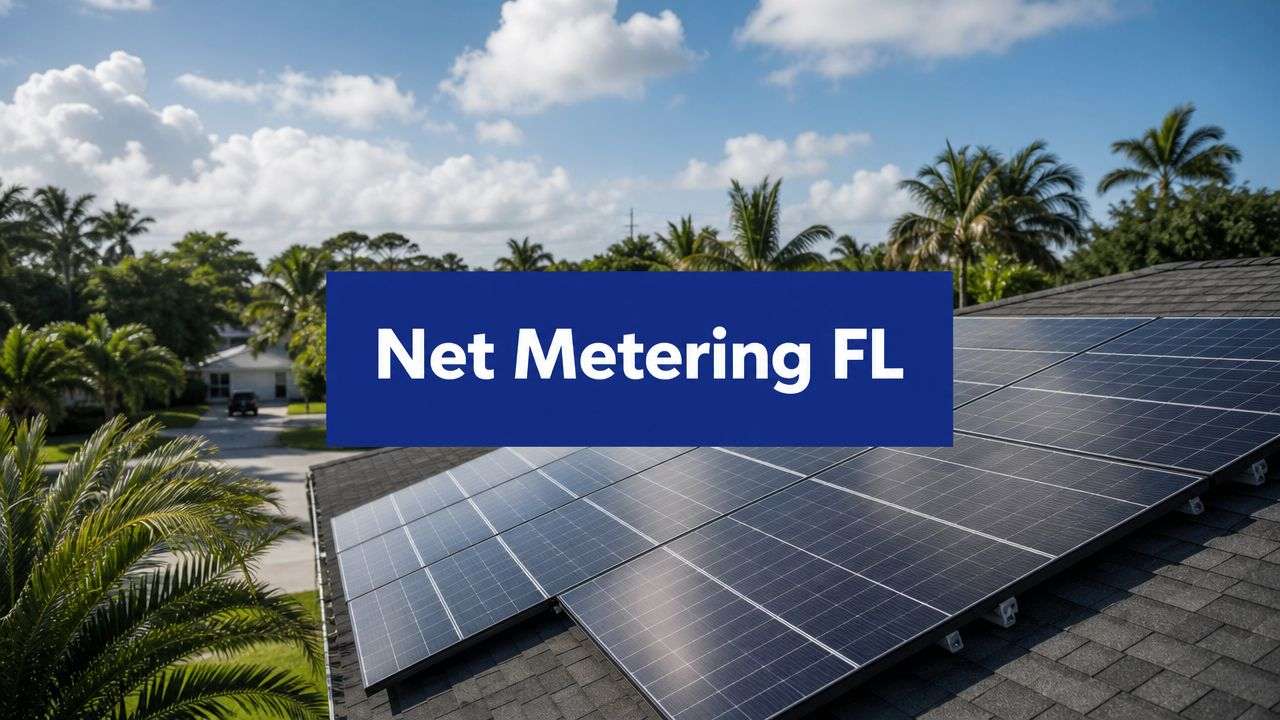
Then there's net metering. The practical point is simple: when your system produces excess power, utility bill credits can help improve project economics. But don't build a project around vague assumptions. You need to read the utility tariff, understand how credits appear on the bill, and model the system against your actual load profile.
The Biggest Shift for Many Households
The largest affordability change in Florida isn't a marketing gimmick. It's the state's Solar for All funding.
The EPA awarded Florida $156,120,000 for Solar for All, and the program is expected to help around 10,000 households. Subsidies can cover 80% to 100% of costs for low-income households and 60% to 80% for moderate-income households, according to Florida Solar for All program reporting.
That changes the conversation. For many households, the key question isn't "Can I use the old federal tax-credit logic?" It's "How do I combine grant support, state tax treatment, and smart financing without overcommitting?"
For a practical overview of state-level options, review this guide to the Florida solar incentive landscape.
How to Stack Incentives Without Making a Mess
Use a clean sequence:
- Confirm eligibility early: If your household may qualify for income-based support, start there. It can reshape the entire budget.
- Separate ownership from financing: Cash, loan, grant-supported ownership, and third-party structures don't behave the same way.
- Model bill credits carefully: Net metering helps, but its value depends on your usage pattern and utility billing structure.
- Review tax-credit rules with actual guidance: For a plain-English refresher, these expert insights on energy tax credits are a useful starting point before you talk with your tax professional.
If an incentive only appears in the sales conversation and never shows up clearly in the written financial model, treat that as a warning sign.
My recommendation is straightforward. Florida households should stop treating incentives as bonus savings and start treating them as a core design constraint. The best project isn't the one with the biggest array. It's the one that uses the available programs intelligently and still makes sense after you remove the sales optimism.
Building a Hurricane-Ready Solar and Storage System
If your goal is resilience, panels alone aren't enough. As a result, a lot of Florida buyers get burned.
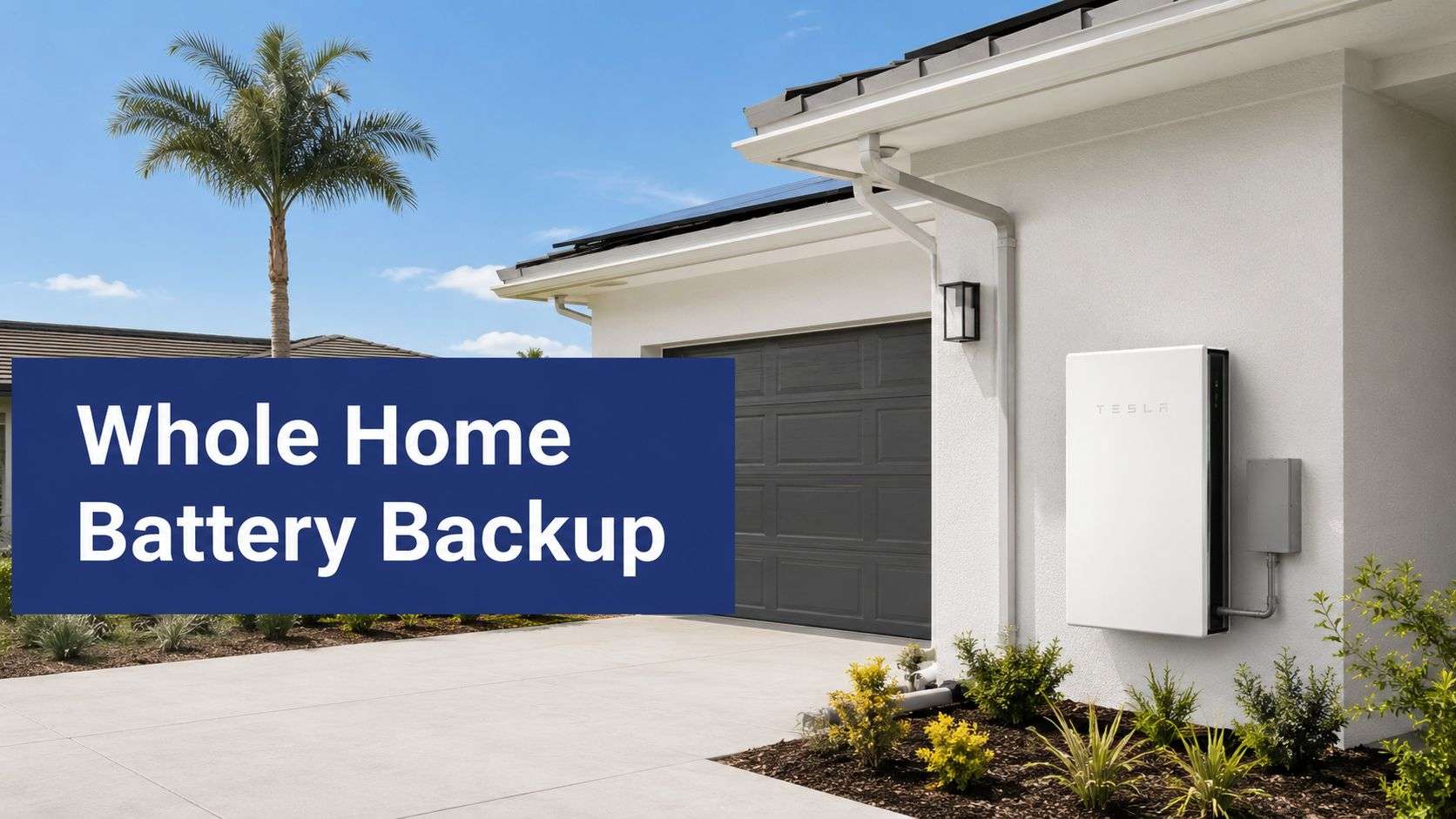
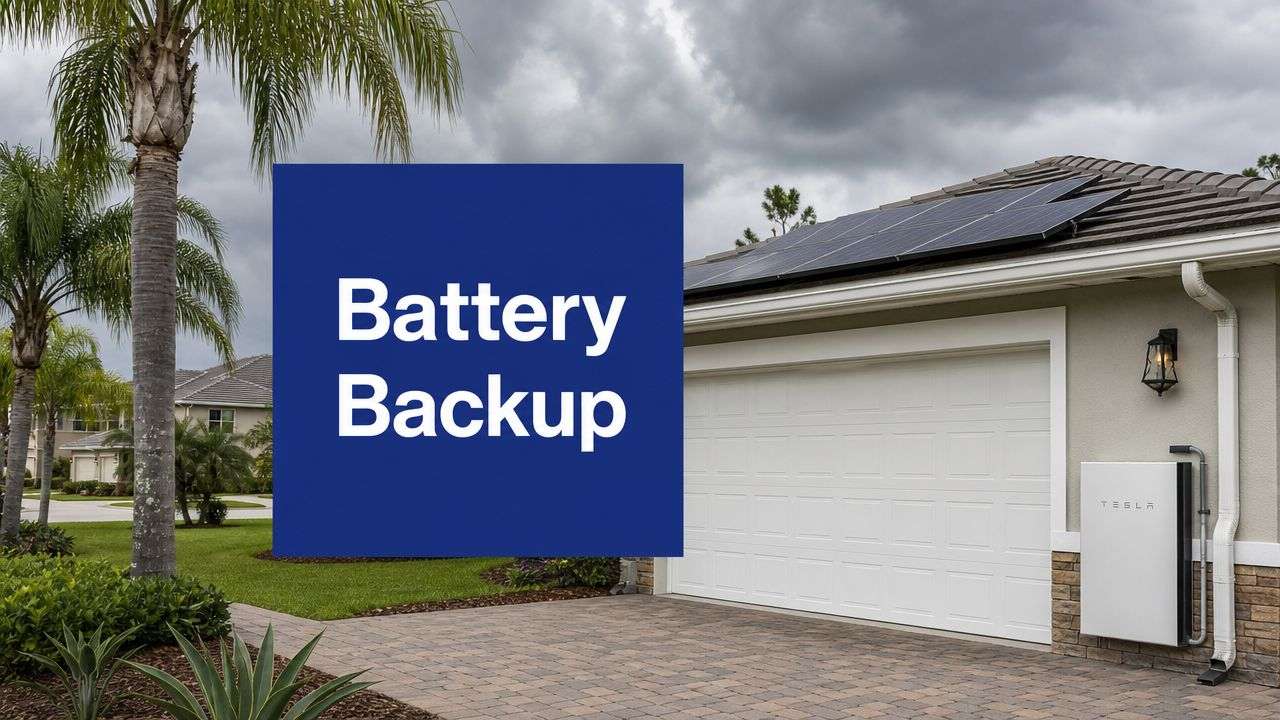
Many people assume solar panels in Florida will keep the lights on during an outage. That's false for a standard grid-tied system. Without a battery and proper islanding capability, the system typically shuts down when the grid goes down, as explained in Florida hurricane resilience reporting on solar and outages.
What Actually Keeps Power On
A resilience-oriented system needs more than rooftop modules. It usually requires a coordinated set of components:
- Solar array: Generates power when sunlight is available.
- Battery storage: Carries critical loads when production drops or the grid fails.
- Hybrid inverter with islanding capability: Lets the system operate safely apart from the grid.
- Protected loads panel: Prioritizes the circuits that matter most.
- Transfer and control equipment: Manages the handoff between grid power, solar production, and stored energy.

That protected loads panel is where most real resilience planning happens. You don't back up the whole building unless you have the budget and design to support it. You choose what must stay on. Refrigeration. Communications. Medical equipment. Internet. Select lighting. Maybe a well pump or limited cooling, depending on the site.
If you want a deeper look at hardened design considerations, review this guidance on hurricane-resistant solar planning in Florida.
Battery Sizing Should Follow Your Worst Day
Average daily usage is a weak basis for battery design. A real statistical analysis using solar-plus-load data found daily net energy could fall to -119.130 kWh, and the author recommended sizing storage around the worst observed deficit or 2 to 3 standard deviations below the mean, with 40 kWh suggested as a starting point in that example, based on Florida battery backup sizing analysis.
That doesn't mean your project needs that exact battery size. It means the design method matters.
Use this decision logic instead of rule-of-thumb sizing:
- List critical circuits first: Start with what must run, not what would be nice to run.
- Check inverter power limits: Some systems have enough battery energy but not enough output power for startup loads.
- Account for cloudy periods: Florida storms can stack low-solar days together.
- Plan for depth of discharge and usable capacity: Nameplate battery size isn't the same as practical backup energy.
Most failed backup expectations come from one mistake. The system was sold as "whole-home feel-good resilience" but designed like a bill-reduction package.
Storm Hardening Isn't Optional
Hardware selection matters, but installation quality matters just as much. Racking, attachment method, conduit routing, battery placement, and shutdown architecture all affect whether the system remains safe and serviceable after severe weather.
For owners and project teams dealing with Florida construction realities, this Guide for contractors working in Florida is useful context on the operating environment around storm recovery and field execution.
My advice is blunt. If hurricane resilience is one of your top two goals, don't buy panels first and ask backup questions later. Build the project as a storage-centered resilience system from day one. Otherwise, you're paying for production and hoping for backup.
Your Expert Checklist for Planning a Solar Project
A good solar project is usually won before the installer shows up. Most expensive mistakes happen in planning, not in production.
An independent review offers assistance. A Florida solar consultant can model feasibility, compare design paths, and stress-test proposals before you commit. That's different from a sales process that starts with equipment and works backward into justification.
Phase One and Feasibility
Start with the property and the load.
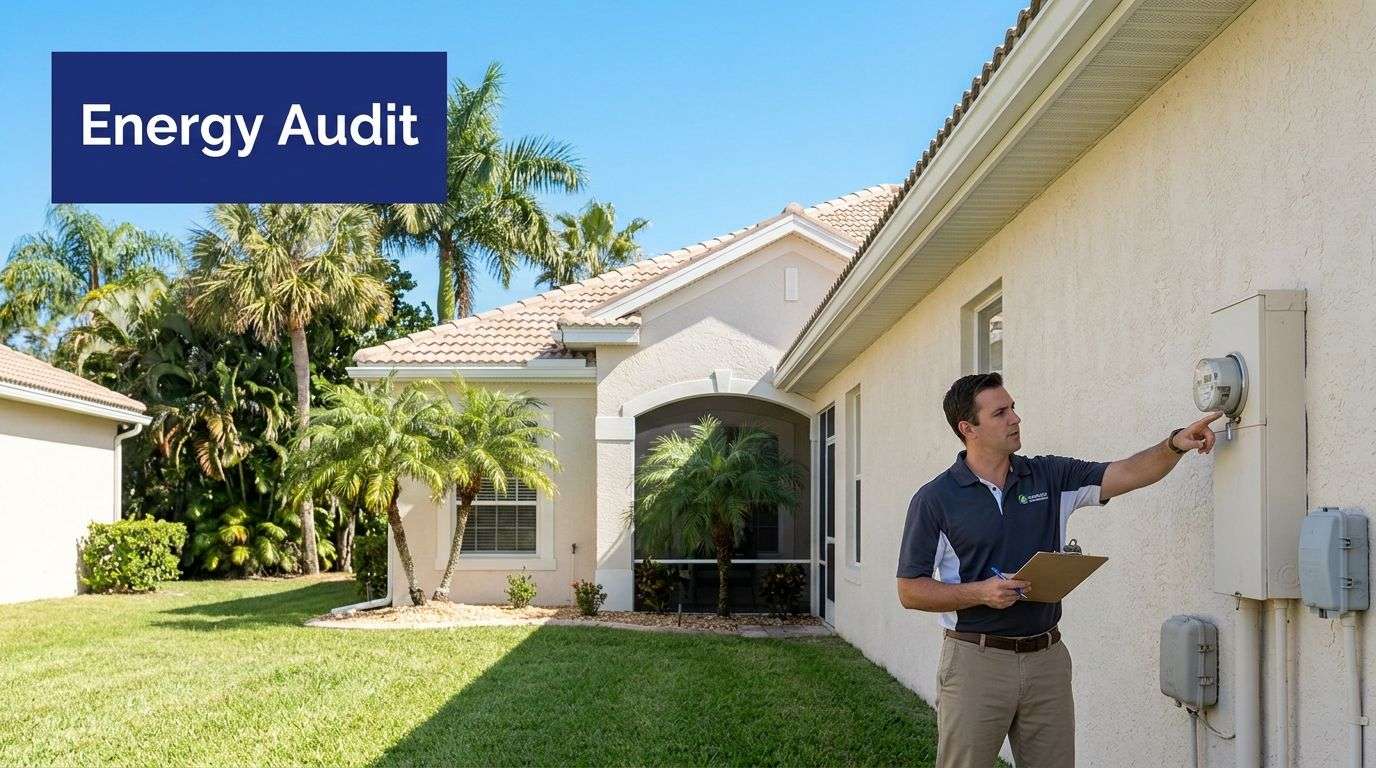
- Pull your utility history: Gather a full year of electric bills if possible. You need seasonal usage patterns, not one recent month.
- Check the roof: Age, condition, geometry, and shading should be evaluated before anyone discusses panel count.
- Define your objective: Bill reduction, backup power, long-term ownership value, and commercial demand management are not the same project.
- Screen the site for resilience constraints: Battery location, protected loads, and interconnection issues should be flagged early.
If you need a starting point for evaluating providers, this guide to choosing a Florida solar installer and project partner helps frame the right questions.
Phase Two and Partner Selection
Don't ask only for a quote. Ask for evidence that the proposal fits your property.
Use questions like these:
- What assumptions did you use for production modeling?
- Which roof planes are excluded, and why?
- Is the inverter setup battery-ready or battery-integrated?
- What critical loads can the backup design support?
- How will roof work or future reroofing affect the system?
- Who handles post-install service coordination?
At this stage, one option some Florida property owners use is Solar Energy Management LLC, which provides feasibility studies, ROI modeling, system design guidance, battery planning, and procurement support before installation. That kind of advisory role can help you compare proposals on engineering and financial merit rather than presentation quality alone.

Phase Three and Final Design Review
Before signing off, review the final package line by line.
- Layout and setbacks: Make sure the array plan matches the productive parts of the roof.
- Electrical scope: Confirm what is and isn't backed up.
- Monitoring: You should know how production and battery behavior will be tracked.
- Warranty chain: Clarify who supports panels, inverters, batteries, and workmanship.
- Project risk: If construction is substantial, review options for protecting your Florida project so damage or delay doesn't become your financial problem.
A strong proposal should survive scrutiny. If a provider gets evasive when you ask for assumptions, diagrams, or exclusions, walk away.
The buyers who do best with solar panels in Florida aren't the ones who move fastest. They're the ones who force clarity before the contract.
Next Steps for Homeowners and Commercial Stakeholders
A Florida property owner usually reaches the same fork in the road. One path leads to a fast solar quote built to close a sale. The other starts with an investment decision about cash flow, storm resilience, and long-term property value. Take the second path.
Florida has an established solar market, so the core question is not whether solar is viable here. The question is whether your specific building, utility bill pattern, and ownership horizon support a project that performs financially and operationally.
For homeowners, start with your own numbers. Pull 12 months of electric bills. Confirm the roof age, remaining life, and any known insurance or structural issues. Then choose your primary objective before you speak with installers: lower annual energy cost, outage protection, or a balanced mix of both. If you fail to set that priority, you will get a generic design that looks polished and underperforms where it matters to you.

Before you sign, require three documents:
- A site-specific production estimate tied to your roof, orientation, and shading
- A financial model that shows assumptions for utility inflation, incentives, payback, and ownership structure
- A backup plan that lists the exact loads or circuits the battery system will carry during an outage
Commercial owners and operators need a stricter screen. A warehouse, retail center, school, nonprofit facility, farm, or multi-tenant property has more variables and more ways to get the deal structure wrong. Start with feasibility, not a sales proposal. Review interval usage if available, roof and structural capacity, interconnection constraints, demand charges where relevant, and a cash-flow model based on how the site operates.
Leased properties need even more discipline. If the landlord pays for the system while tenants capture the savings, the economics break. The lease, rent structure, tenant meter arrangement, and hold period need to be aligned before a system size or financing option is chosen.
Nonprofits, municipalities, and mission-driven organizations should treat funding strategy as part of project design, not as an afterthought. The right structure may matter more than maximum system size.
My advice is simple. Treat solar panels in Florida as an energy asset that has to earn its place on your balance sheet and hold up during grid stress. If the project does not pencil out under realistic assumptions and does not match your resilience goals, pass on it. If it does, move decisively.
Frequently Asked Questions on Florida Solar
Do solar panels keep my home running during a power outage
Not by themselves. A standard grid-tied solar system usually shuts off when the grid fails. If you want backup power, you need battery storage and equipment that allows the system to operate independently from the grid during an outage.
Should I size a system to offset all of my electric use
Not automatically. The right size depends on your usage pattern, usable roof area, shading, financial goals, and whether you're adding storage. Full offset sounds attractive, but it isn't always the highest-return design.
Are solar panels in Florida a good fit for rental or future sale situations
They can be, but only if the ownership and financing structure matches your plans. If you may sell, rent, or refinance the property, review those scenarios before signing. Solar should increase flexibility, not create a closing problem later.
What should I ask before approving a battery system
Ask what loads are being backed up, how long the battery is expected to support them, what the inverter can deliver at one time, and how the system performs during low-solar weather. If the answer is vague, the design probably is too.
How do net metering credits affect the decision
They can improve the economics of a properly sized system, but they shouldn't be treated as a blank check for oversizing. The project still has to work against your actual consumption profile.
What's the biggest mistake Florida buyers make
They buy a panel package when they really need an energy strategy. That usually shows up in one of two ways. Either the system doesn't produce what the buyer expected because the roof wasn't evaluated carefully, or the buyer assumed solar meant backup power and learned too late that it didn't.
Is independent planning worth it before talking to installers
Yes. It helps you separate engineering facts from sales framing. A feasibility review, load analysis, and financial model can save you from signing the wrong contract for the right technology.
If you're evaluating solar panels in Florida and want an independent, strategy-first plan before you commit to an installer, Solar Energy Management LLC helps homeowners, businesses, nonprofits, and facility stakeholders assess feasibility, model ROI, plan battery storage, and design resilient solar solutions around real property conditions and financial goals.