The average solar power Florida cost is around $2.19 to $2.71 per watt before incentives, which puts many residential systems in the rough range of $27,000 to $37,000 upfront. But that sticker price doesn't tell the whole story once you factor in the federal tax credit, your current utility bill, and the long-term cost of staying tied to rising electric rates.
Most Florida buyers start in the same place. They open a summer power bill, see another painful total, and wonder whether solar is finally worth it. That's the right question, but it's often asked the wrong way.
Don't ask, “What do solar panels cost?” Ask, “What's the smartest way to de-risk a solar investment on my property?” That shift matters. Good solar decisions in Florida come from matching system size, tax strategy, financing, and resilience goals to your actual building and power usage. Bad decisions come from chasing the cheapest quote or the biggest promised savings.
The True Cost of Your Florida Power Bill
A Florida utility bill doesn't just reflect electricity use. It reflects exposure. If your home or building depends heavily on air conditioning, every hot month reminds you that you're buying a volatile necessity from the grid with no control over future pricing.
That's why I tell clients to stop treating the power bill like a routine household expense. It's a long-term liability. Solar changes that by letting you convert part of that liability into an owned energy asset.
EnergySage reports that the average Florida residential electricity rate is about 15.38 cents per kWh, with a typical monthly bill of about $168.12 on its Florida solar cost and electric bill data page. If your household or facility uses more power than average, your exposure is even higher.
Why This Matters More In Florida
Florida isn't a mild-load market. Cooling demand drives consumption, especially in larger homes, older buildings, and properties with poor insulation or long occupied hours. That means the value of solar isn't abstract. It's tied directly to a bill you already pay every month.
Here's the practical way to consider it:
- Your utility bill is recurring: It resets every month and gives you no ownership.
- A solar system is capital: It has an upfront cost, but it can offset a meaningful share of long-term utility spending.
- The comparison isn't solar versus doing nothing: It's solar versus decades of continued grid purchases.
Solar in Florida works best when you evaluate it like infrastructure, not like an appliance.
A Consultant's Framework
When someone asks me about solar power florida cost, I don't start with panels. I start with four filters:
- Load profile: How much power do you use, and when do you use it?
- Roof or site quality: Is the property physically suitable?
- Tax position: Can you fully use the available incentives?
- Risk tolerance: Are you optimizing for maximum return, lower monthly payments, or backup power?
That framework is what keeps buyers from overpaying, undersizing, or choosing the wrong financing structure.
Decoding The Price Per Watt In Florida
If you only learn one pricing concept, learn price per watt. It's the cleanest way to compare solar proposals because it standardizes system cost against system size.
In Florida, the benchmark range in 2026 is roughly $2.19 to $2.58 per watt installed, according to This Old House's Florida solar cost guide. The same source cites $15,480 for a 6 kW system at $2.58/W, while EnergySage's Florida average is $2.19/W and $32,278 for a 14.75 kW system before incentives. It also notes that after the 30% federal Residential Clean Energy Credit, that 14.75 kW example falls to about $22,595.

What Price Per Watt Actually Includes
A serious quote usually bundles much more than modules. The price per watt often reflects the full project stack:
- Solar panels: The visible hardware people focus on first.
- Inverter equipment: The part that converts solar production into usable electricity.
- Racking and mounting: The hardware that secures the array to the roof or structure.
- Electrical balance of system: Wiring, disconnects, and related electrical components.
- Labor and permitting: Design, plan prep, permit handling, and installation work.
That's why a quote can't be judged by panel brand alone. If you want a better understanding of equipment differences before you compare proposals, review this overview of solar panel technologies.
How To Use It Like A Professional
A higher total system cost does not automatically mean a worse deal. A larger system naturally costs more overall, but its price per watt may be perfectly competitive.
Use this rule:
- Compare $/W first
- Check system size second
- Review net cost after incentives third
- Then inspect warranty terms, production assumptions, and battery readiness
Practical rule: If two quotes propose different system sizes, don't compare total price alone. Compare cost per watt and expected fit for your actual load.
The buyers who get burned usually skip that step.
Sample Solar System Costs For Florida Homes And Businesses
A Florida owner gets a quote for $18,000 and another gets one for $34,000. Both numbers can be reasonable. The difference usually comes down to usage, roof constraints, and system size, not just markup. If you want to de-risk a solar investment, start by matching the project to the meter, not to a statewide average.
Market estimates from Forbes Home's Florida solar cost guide show a typical Florida system around 7.2 kW at roughly $19,512 before incentives, or about $2.71 per watt. That same source notes an estimated post-credit cost of $13,658 after the 30% federal tax credit for eligible buyers. Use that as a reference point, not a target. Your real number should be built from your annual consumption, your utility rate structure, and the physical limits of the site.

Residential Example With Moderate Usage
A moderate-use home often pencils out with a mid-sized system, especially if the owner wants to offset daytime air conditioning, appliances, and part of summer peak demand. In plain terms, that usually means avoiding the mistake of buying too little system and being disappointed later.
Forbes Home says that 7.2 kW Florida example can save about $130 per month over a 25-year period and may reach payback in about nine years for qualifying owners. Those numbers are useful because they show the right way to judge a proposal. Start with expected production and monthly bill offset, then check installed cost, then calculate net cost after incentives.
Larger Home With Heavy Cooling Load
Bigger homes need a stricter review. Pool pumps, long cooling hours, EV charging, and electric water heating can push usage high enough that a basic online calculator becomes misleading.
For owners sizing against annual usage, this guide to a 10,000 kWh solar system in Florida-style conditions is a practical benchmark. It helps you sanity-check whether a proposed array is in the right range before you sign anything.
My recommendation is simple. Pull 12 months of utility bills, separate fixed charges from energy charges, and compare the installer's production estimate to your actual annual consumption. That is how a consultant filters out oversized systems, undersized systems, and rosy savings claims.
What About Commercial Properties
Commercial solar should be judged even harder than residential solar. A business has more at stake, and the wrong design can drag out payback for years.
The right commercial review looks at interval usage, daytime load consistency, demand exposure, roof age, and how long the business expects to occupy the property. A warehouse with strong daytime demand is very different from an office that empties out early, and both are different from mixed-use space with weekend volatility. Treating those buildings the same is lazy analysis.
Operations matter after installation too. If production assumptions depend on a clean array, budget for maintenance from the start. Even a market-specific reference like solar panel cleaning costs in Phoenix is a useful reminder that upkeep has a real dollar value and should be part of the return model.
The safest solar investment is sized from meter data, tested against real site limits, and priced against expected savings, not sales language.
Maximizing Your Return With Florida Solar Incentives
Sticker price is the amateur number. Net cost is the number that matters.
The most important lever for Florida homeowners is the 30% federal Residential Clean Energy Credit. You see its impact clearly in the verified Florida examples above, where gross system cost drops materially after the credit is applied. For many buyers, that changes the project from “maybe later” to “financially sensible now.”

What Good Incentive Strategy Looks Like
A strong Florida solar decision usually combines several layers:
- Federal tax credit: This directly reduces eligible project cost for owners who qualify.
- State tax treatment: Florida's sales tax exemption and property tax exemption improve the economics qualitatively by lowering friction and protecting assessed value treatment.
- Commercial tax benefits: Businesses may also evaluate depreciation treatment and other ownership-based advantages with their tax advisors.
For a focused breakdown of Florida-specific policy mechanics, review this guide to the Florida solar incentive landscape.
Savings Need To Be Judged Over Time
PowerOutage.us estimates that a 5 kW Florida system costing roughly $11,060 after the 30% credit can have a 6-year payback and about $27,479 in 20-year savings on its Florida solar savings page. Verified data tied to ConsumerAffairs in the same source also estimates average 25-year utility-bill avoidance of about $51,910.
That's the right lens. You don't buy solar to win on day one. You buy it to improve the next two decades of energy economics.
For owners comparing long-term operating costs, maintenance planning matters too. Even though Arizona conditions are different, this breakdown of solar panel cleaning costs in Phoenix is a useful example of how to think about ongoing service expenses in a structured way rather than assuming maintenance is either free or overwhelming.
Incentives don't rescue a bad project. They improve a good one. If the roof, load, and ownership structure are wrong, tax credits won't fix that.
Financing Your System Lease Vs Buy In The Sunshine State
Financing choice can make or break your return. I'm blunt about this. If you can own the system and the property is a good fit, ownership usually creates the strongest long-term financial outcome.
That doesn't mean every buyer should pay cash. It means every buyer should understand what they give up when they don't own the asset.
Cash And Loan Options
Cash purchase is the cleanest path. You own the system, control the economics, and capture the available owner incentives. It's the option I prefer when the buyer has the capital and expects to stay in the property long enough to benefit from the savings curve.
Solar loan is often the practical middle ground. You still own the system, but you preserve liquidity and spread cost over time. For many Florida households and businesses, that balance works well when the monthly payment is structured intelligently.
If you're weighing those options, this overview of how to finance solar panels is a solid starting point.
Lease And PPA Tradeoffs
Leases and PPAs lower the upfront barrier, but they also reduce control. In most cases, the third party owns the system, captures the tax benefits, and sets the contract terms you'll live with for years.
That can still work for some buyers. It's just not my first recommendation when the goal is maximum lifetime value.
Use this decision filter:
- Choose cash if you want the strongest long-term return and simple ownership.
- Choose a loan if you want ownership without tying up all your cash.
- Consider a lease only if low upfront cost matters more than long-term upside.
- Consider a PPA if you want energy price relief without equipment ownership, and you've read every contract term carefully.
My Recommendation
For most Florida property owners, I recommend buy or finance, not lease, unless there's a specific cash-flow reason to do otherwise. The system is a productive asset. Giving away ownership usually means giving away the best part of the economics.
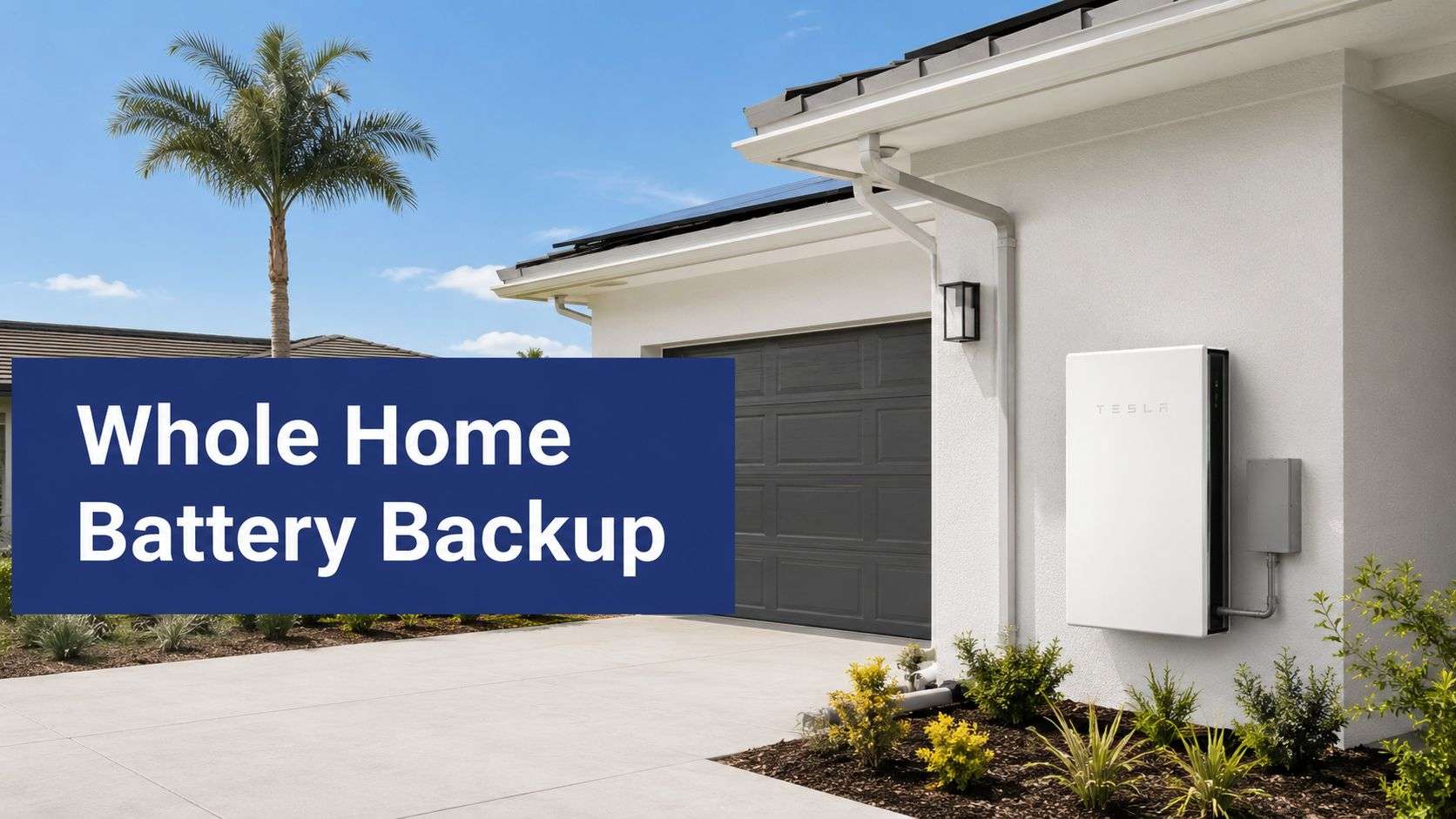
The Added Cost And Value Of Battery Storage
Solar saves money. Solar plus storage changes your resilience profile.
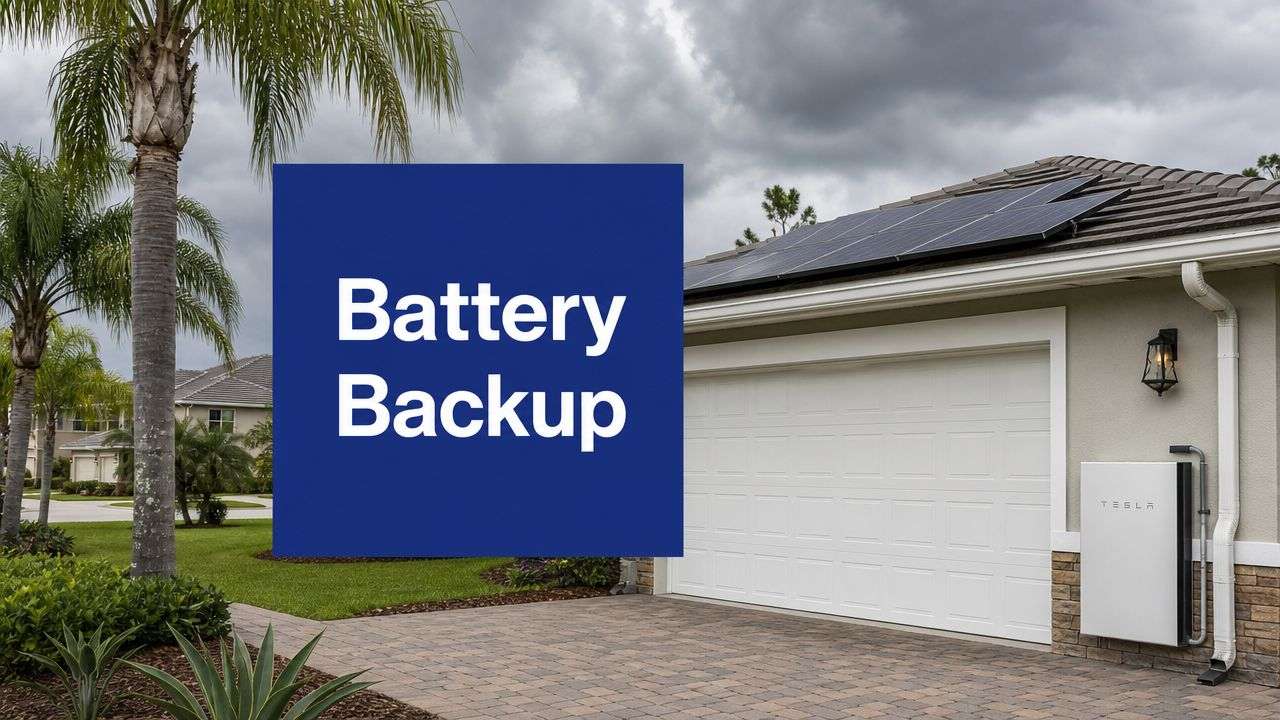
That distinction matters in Florida because grid outages aren't theoretical. Storms, grid disruptions, and utility instability change the way many owners think about energy. If backup power matters to you, battery storage deserves serious attention.

Why Storage Economics Are Getting Stronger
A verified industry report notes that Florida residential electricity rates reached 15.02 cents per kWh in December 2025, up from 14.19 cents per kWh one year earlier, representing roughly a 26% increase between 2020 and 2024, according to this Florida rate and solar savings report. The same report says a Florida Public Service Commission decision on November 20, 2025 approved a four-year rate settlement with Florida Power & Light that took effect January 1, 2026, with continued increases scheduled through 2029.
That's a strong argument for looking beyond simple panel payback. As utility prices rise, energy you can self-produce and store becomes more valuable.
What Batteries Actually Buy You
Battery storage can support several goals at once:
- Backup power: Keep critical loads running during outages.
- Load management: Shift stored power to periods when grid power is less desirable.
- Operational continuity: Protect refrigeration, communications, lighting, security, or other essential functions.
- Peace of mind: Reduce dependence on a grid you don't control.
If you're evaluating brands, capacity, and backup architecture, this page on battery storage systems including Tesla-based options gives a practical overview.
If your main concern is outage protection, don't judge a battery only by payback. Judge it by what happens when the grid fails and your building still needs to function.
My view is simple. In Florida, storage is no longer a luxury add-on for every buyer. For many properties, it's part of a serious risk-management strategy.
Your Next Step A Professional Feasibility Study
By now, the pattern should be clear. Solar power florida cost is never just one number. It's the result of system size, incentive eligibility, financing structure, site constraints, and your tolerance for energy risk.
That's why generic online calculators only get you so far. They can provide a rough benchmark, but they can't tell you whether your roof is worth using, whether your load profile supports a strong return, or whether storage belongs in the first phase or a later upgrade.
What A Real Evaluation Should Include
A proper feasibility study should look at the property from both engineering and financial angles:
- Utility bill analysis: Review actual consumption and seasonal swings.
- Site assessment: Check roof condition, shading, orientation, and usable area.
- System sizing logic: Match design to real usage instead of guesswork.
- Financial modeling: Compare ownership structures, incentives, and expected bill offset.
- Storage planning: Identify whether backup value justifies battery integration.
My Direct Advice
Don't start by asking installers for the cheapest quote. Start by making sure the project itself is right.
That's where an independent advisor can add real value. A consulting-first process helps you understand what to buy, what to ignore, and what assumptions need to be challenged before any contract is signed. One option in Florida is Solar Energy Management LLC, which provides feasibility studies, ROI modeling, system design guidance, and storage planning for property owners evaluating solar before procurement.
A de-risked solar project usually looks boring on paper. The numbers are clear. The scope is justified. The financing fits. The system size makes sense. That's exactly what you want.
If you want a Florida-specific solar plan before you talk to an installer, Solar Energy Management LLC can help you evaluate system size, incentives, financing, and battery strategy with a feasibility-first approach. That gives you a clearer path to lower utility costs, stronger long-term returns, and fewer expensive mistakes.