Florida homeowners usually start looking into solar for the same two reasons. The electric bill keeps climbing, and hurricane season keeps reminding them that grid power isn’t guaranteed when they need it most.
If you own a small house, that combination can work in your favor. A smaller home usually needs a smaller system, which can make solar easier to plan. But in Florida, the right plan isn’t just about fitting panels on a roof. It’s about matching the system to your utility use, your outage concerns, your roof, and your budget so the numbers still make sense after you add battery backup.
That’s where many generic articles fall short. They talk about panels, but not about how to balance payback, backup power, and real-world Florida conditions like heat, humidity, shade, storm exposure, and utility rules.
Going Solar In The Sunshine State
A small house in Florida sits in a very specific sweet spot for solar. You’re trying to control monthly power costs, but you’re also thinking about what happens when the grid goes down for a day, or longer. For many homeowners, solar power for small house planning isn’t about chasing a trend. It’s about making the home cheaper to run and more dependable during storm season.

Florida has real momentum behind residential solar. In 2022, Florida led non-California states with 670 megawatts of small-scale solar added, and the national median residential system size is 7.2 kilowatts, which for a typical Florida small house works out to about 15 to 19 panels of 400 watts each and enough output to offset 10,657 kWh of yearly use according to USAFacts solar production data.
That doesn’t mean every small house should install that exact setup. It means the idea is already practical at residential scale in Florida. The main question isn’t whether solar can work. The primary question is what version of solar works for your house.
What Florida Homeowners Usually Need
Most small-house owners I advise are trying to solve one of three problems:
- Lower the monthly bill: They want a grid-tied system that offsets a meaningful share of utility consumption.
- Keep essentials running: They want refrigeration, lighting, internet, fans, and maybe a few outlets available during outages.
- Do both well: They want savings in normal conditions and resilience when storms disrupt service.
Those goals lead to different system designs. A bill-reduction system and a storm-ready backup system may share the same roof, but they aren’t planned the same way.
Practical rule: In Florida, the right solar design starts with your outage priorities, not the panel count.
There’s also a broader reason many homeowners move now instead of waiting. Solar isn’t only about utility savings. It can also reduce dependence on conventional power generation and support a lower-impact home energy profile, which is part of the broader environmental benefits of solar energy.
Why Small Houses Deserve Their Own Plan
Small homes often have tighter roof space, lower daily usage, and more sensitivity to bad design choices. If an average-size house is oversized a bit, the owner may never notice. If a small house gets poor equipment matching, shading, or unrealistic battery expectations, the system can disappoint quickly.
That’s why consultant-level planning matters in Florida. The most successful projects aren’t the ones with the most hardware. They’re the ones where the homeowner knows exactly what the system is supposed to do before anyone submits an install proposal.
Is Your Florida Small House Ready For Solar?
Before talking equipment, run a hard feasibility check on the house itself. Some Florida homes are excellent solar candidates. Others need roof work, tree trimming, or a load-reduction plan first. A quick self-assessment saves time and keeps you from comparing proposals for a system that never had a fair chance to perform well.
Start With The Roof
Age matters. If your roof is already near replacement, solar should usually wait until that issue is addressed. Pulling panels off later to reroof is expensive and disruptive, so it’s smarter to align the project timeline up front.
Then look at roof shape and exposure. South-facing roof planes are typically the easiest to work with, but other orientations can still be viable depending on your goals. On many Florida homes, the bigger issue isn’t compass direction. It’s whether vents, hips, dormers, and small roof sections break up usable panel area.
A second concern is shading. Walk the property in the morning, midday, and late afternoon if you can. Look for:
- Tree canopy movement: Palms and mature oaks can cast shifting shade that changes through the day.
- Neighboring structures: A two-story house next door can affect a roof section more than people expect.
- Future growth: Trees that seem harmless now can become a performance problem later.
If your roof condition is uncertain, review both at the same time. A roof-and-solar coordination review helps in such cases, especially if you’re deciding whether to repair, replace, or proceed with the existing assembly. A focused look at solar and roof planning can help you avoid designing around a roof that isn’t ready.
Check The House Before You Size The System
A lot of small homes can improve the solar outcome by reducing waste first. If the house has old duct leaks, weak attic insulation, poor air sealing, or outdated lighting and appliances, you’re asking the solar system to carry avoidable load.
For homeowners who want a clear pre-solar checklist, this practical guide to energy savings is useful because it starts with the parts of the home that usually drive unnecessary consumption.
The cheapest kilowatt-hour to offset is the one your house never needed in the first place.
Pull A Full Year Of Utility Bills
Use your last 12 months of electric bills and look for patterns instead of staring at one high summer statement. Small-house solar planning works best when you know what’s consistent and what’s seasonal.
Make notes on these points:
Highest-use months
In Florida, air conditioning often drives the spikes. That affects both savings expectations and backup planning.Base load
This is the power the home uses even when you aren’t doing much. Refrigeration, standby loads, internet equipment, and lighting all show up here.Lifestyle changes
If someone started working from home, added an EV charger, or upgraded appliances, older usage may not reflect what’s coming.Critical loads during outages
Decide what needs to stay on. Many homeowners say “whole house backup” at first, then realize their true storm plan is much narrower and more affordable.
By the end of this review, you should know two things. First, whether the property is physically suitable for solar. Second, whether your current energy use is efficient enough to justify system design now, or whether the house needs improvements before the numbers pencil out.
Sizing Your Solar System And Battery Storage
Sizing is where a lot of Florida projects go off course. Homeowners often assume the system should match their bill history exactly, then add a battery and call it done. That approach misses how solar performs in real conditions.

The core formula for small-house planning is straightforward: Required Solar Capacity = (Battery Recharge Energy + Daily Energy Use) × 1.3 / Peak Sun Hours. That 1.3 multiplier matters because wiring losses, inverter efficiency, and panel orientation can cut output by up to 30%, and Florida peak sun hours typically range from 4.5 to 5.5 according to this tiny-house solar sizing guide.
Why The Multiplier Matters In Florida
Think of nameplate wattage as the label on the box, not the power you’ll always get in service. Heat, wiring resistance, inverter conversion, partial shade, and roof layout all chip away at ideal output.
That’s especially important on a small house. A modest sizing error has a bigger impact when the total system is compact. If someone sizes too close to theoretical production, the system may look fine on paper and still underperform when weather shifts, winter sun hours shorten, or storm-season cloud cover lingers.
Here’s the practical distinction:
- Bill-offset sizing focuses on annual utility use and how much of that consumption you want solar to cover.
- Backup sizing adds battery recharge needs and asks what the array must do after an outage, not just on a normal utility day.
Those aren’t the same design problem.
How To Think About Battery Storage
Battery storage should start with use case, not with brand or marketing claims. In Florida, I usually ask homeowners one question first: what must remain powered if the grid is down tonight?
That answer shapes battery planning far more than total house square footage. For a small house, battery storage is often most effective when it protects selected circuits instead of trying to mimic full-house service. Refrigeration, lighting, communications, fan power, garage access, and medical equipment usually matter more than every convenience load.
A battery becomes expensive very quickly when you ask it to support habits instead of priorities.
If your solar goal is primarily utility savings, your array and storage can be modest. If your goal is to restore the home after a storm and carry critical loads through repeated cloudy days, the design has to be more conservative.
Match The System To The Goal
A useful way to frame solar power for small house design is to choose one of these paths:
Savings-first system
Best for homeowners focused on monthly bill reduction. Battery capacity may be limited or deferred.Resilience-first system
Best for outage-prone areas or households with essential power needs. The battery and critical load plan lead the design.Balanced system
Best when you want both. This usually requires tighter modeling so the project doesn’t become oversized financially.
If you want a broader reference point for annual energy offset planning, a guide to 10,000 kWh solar system sizing helps frame how consumption translates into array design, even if your small house ends up below that usage level.
Choosing The Right Solar Components
Once the system size is clear, component choice starts to matter more than many homeowners expect. Two proposals can show similar estimated production and still perform very differently over time because the hardware mix isn’t the same.
Panels For Tight Roof Space
For most Florida small houses, monocrystalline panels are the practical choice. Roof area is limited, so efficiency matters. You want more production from fewer modules, especially if vents, ridges, setbacks, or roof geometry shrink the usable footprint.
This is one place where cheaper isn’t always cheaper. A lower-efficiency panel may save money up front, but it can force compromises on layout and total output. On a small roof, lost space is hard to recover.
Good panel selection should account for:
- Available roof area: Higher-efficiency modules help when space is constrained.
- Heat performance: Florida roofs run hot, so panel behavior in high temperatures matters.
- Storm durability: Attachment method and module quality both matter in a hurricane-prone environment.
Inverters And Why Roof Complexity Matters
Inverter selection should follow roof conditions. If the roof is simple and unshaded, a string inverter can work well. If the roof has multiple planes, intermittent shade, or odd module groupings, microinverters usually give the homeowner more flexibility and cleaner performance at the panel level.
That’s why I often prefer microinverters for smaller Florida homes with chopped-up roof lines. They can reduce the penalty from partial shading and make troubleshooting easier because performance is easier to isolate.
A simple comparison helps:
| Component Choice | Usually Works Best When | Main Trade-Off |
|---|---|---|
| String Inverter | Roof is straightforward and shade is minimal | Less flexible if one roof section underperforms |
| Microinverters | Roof has multiple planes or shifting shade | Higher equipment complexity |
Batteries Built For Florida Conditions
For storage, LiFePO4 batteries are the right fit for most small-house resilience designs in Florida. They’re well suited to hot climates, have strong safety characteristics, and align well with the kind of repeated cycling homeowners expect when they want backup power, not just a bill-reduction accessory.
This matters more after storms. A backup battery has to remain unobtrusive, stay ready, and perform predictably when utility service fails. Homeowners rarely care about battery chemistry until the first multi-day outage. Then they care a lot.
One more point often missed in generic buying guides: the battery should integrate cleanly with the inverter strategy and the critical-load design. A battery added later without a clear load plan often becomes an expensive add-on that doesn’t deliver the resilience the homeowner thought they bought.
For people who want independent design review before comparing install bids, Solar Energy Management LLC provides Florida feasibility studies, ROI modeling, battery storage planning, and system design guidance so homeowners can evaluate equipment choices against actual house conditions rather than brochure claims.
Florida Solar Finances Payback And Incentives
The financial case for solar in a Florida small house is usually stronger when you stop treating it like a generic home upgrade. It isn’t just a panel purchase. It’s a long-term energy asset with tax treatment, utility implications, and resilience value.

A useful planning benchmark comes from Florida-focused modeling summarized by RatedPower. Small homes often use 2 to 5 kW systems, and after Hurricane Ian, resilient designs with LiFePO4 batteries added 20% to 30% to project cost. Even so, with the 30% federal ITC and Florida property tax exemptions, systems with major utilities like Duke Energy and FPL still average 10 to 15 years for payback according to this solar finance and resilience overview.
What Moves The Payback In Either Direction
On a small house, payback usually improves when the system offsets expensive daytime consumption and the roof is uncomplicated. It usually stretches out when homeowners add battery backup, choose more resilient architecture, or have limited solar exposure.
That doesn’t mean storage is a bad investment. It means you should judge it appropriately. A battery may weaken simple bill-payback math while still making the overall project more valuable to your household because it provides continuity during outages.
Here are the levers that matter most:
System purpose
A savings-first system is usually easier to justify financially than a resilience-first system.Roof efficiency
A clean, unshaded roof lets the array do more work with less hardware.Battery scope
A battery sized for essentials is very different from a battery meant to support broad household use.Utility relationship
Net metering treatment and bill structure affect how much value exported solar actually delivers.
Incentives Need To Be Modeled, Not Just Mentioned
The 30% federal investment tax credit is powerful, but it only helps if it fits your tax situation and timing. Florida’s property tax treatment also matters because it affects how the added system value is handled. These aren’t side notes. They’re core parts of the investment model.
A clean financial review should answer questions like:
- What does the project look like with solar only?
- How does the timeline change when battery storage is added?
- How much of the value comes from direct bill offset versus resilience?
- Does the owner plan to stay in the house long enough to realize the return?
Homeowners often get into trouble when they accept a single “savings” number without seeing the assumptions behind it. If a proposal doesn’t separate energy offset from backup value, it’s hard to know what you’re buying.
A good financial model shows where the return comes from. It doesn’t hide the battery inside a headline savings estimate.
Why Small Houses Need Customized ROI
Small houses are not scaled-down versions of large-house economics. A compact home can have lower energy use but still need a meaningful battery if the owner wants dependable backup during storm outages. That creates a different return profile.
The right way to evaluate the project is to separate the stack of benefits:
- bill reduction in normal operation
- tax treatment and Florida exemptions
- avoided disruption during outages
- long-term energy price stability
For homeowners comparing options, a detailed look at Florida solar incentive planning helps clarify how those benefits fit together before you commit to a specific equipment package or financing path.
Designing For Resilience And Backup Power
Florida homeowners often ask for backup power after they’ve already decided on solar. In practice, resilience should be part of the design from the beginning. If you wait until the end, the battery can become a costly add-on instead of a coordinated backup system.

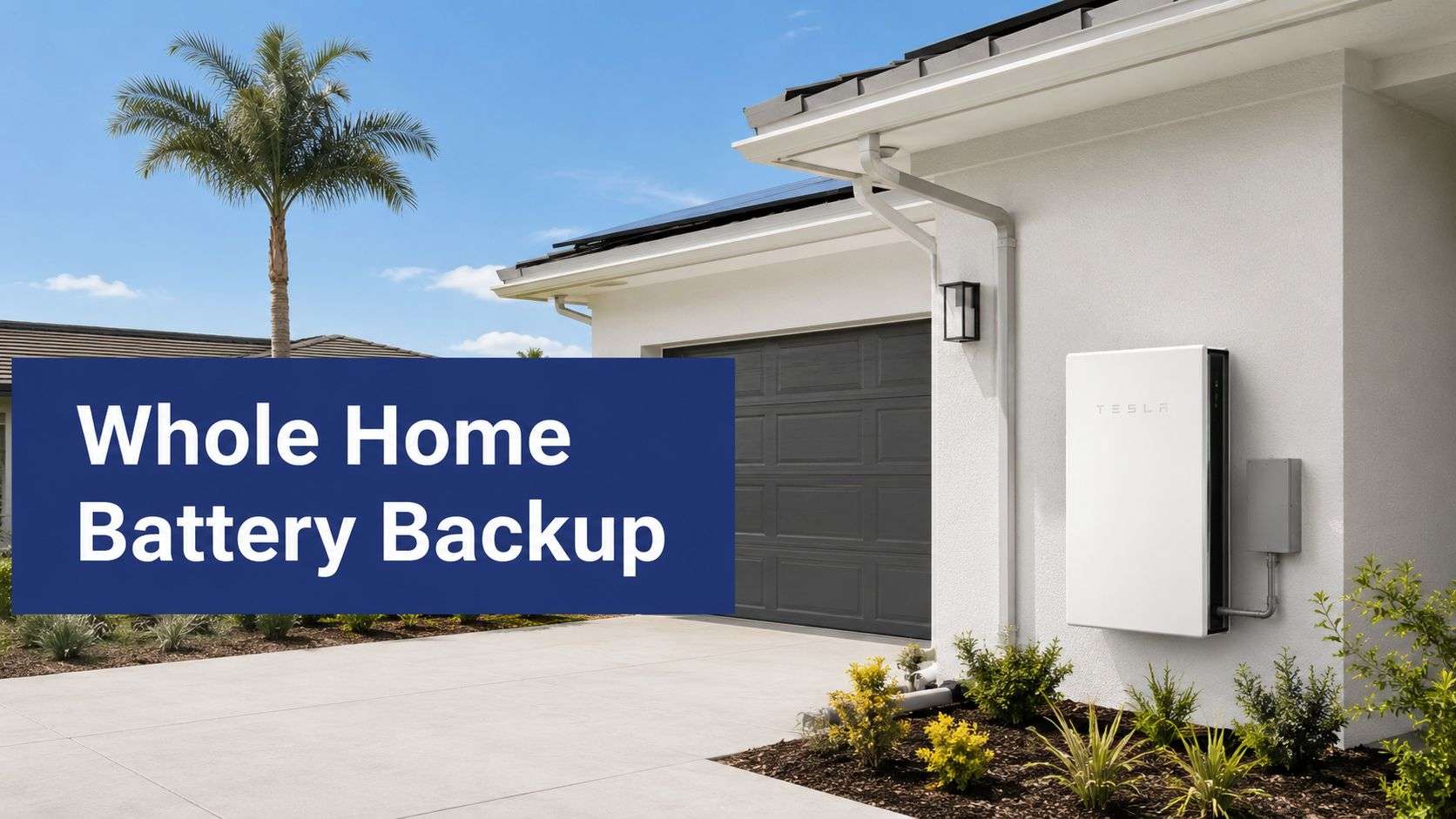
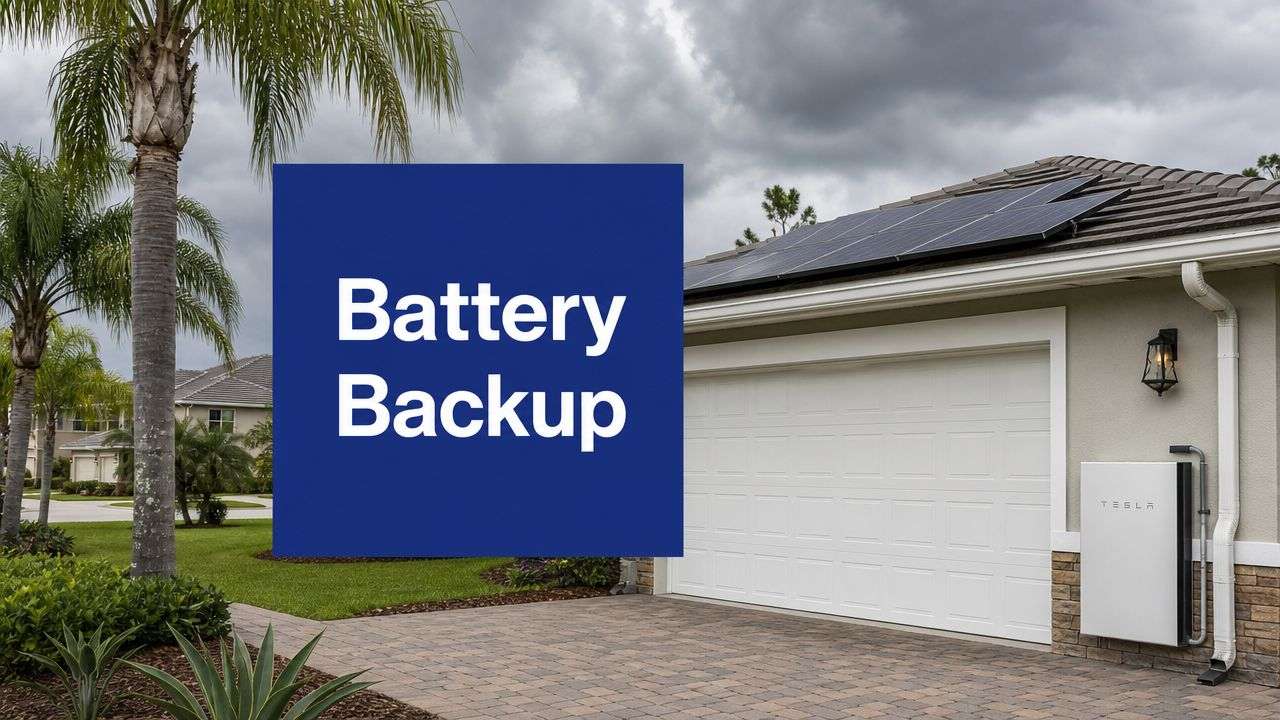
For small homes, resilience usually means keeping essential loads running, not energizing everything. A refrigerator and lights commonly fall into that category, and those essentials may consume about 1 to 3 kWh per day. A properly designed backup setup uses a dedicated charge controller and a compact LiFePO4 battery so those loads remain available during blackouts, which has been a frequent concern for Florida residents after the 2024 storm season according to this small-home backup power guide.
The Critical Load Subpanel Is The Real Backup Plan
The smartest resilience designs usually center on a critical load subpanel. That means selected circuits are isolated and prioritized so the battery supports what matters most instead of getting drained by everything connected to the house.
Typical critical loads in a Florida small house include:
- Refrigeration: Food safety disappears quickly during a long outage.
- Lighting: A few efficient circuits go a long way.
- Internet and charging: Communication matters during storms.
- Fans or medical loads: These often become the highest priority in real events.
This approach does two things. It stretches battery runtime, and it makes homeowner expectations realistic. Whole-house backup sounds good until someone prices it and sees what it takes to support large HVAC loads for extended outages.
Design For Several Bad Days, Not One Good Day
A lot of backup plans look fine for an overnight outage. Florida resilience planning should consider what happens after a major storm, when cloud cover, debris, and utility restoration delays all work against you.
That’s why I push homeowners to define their outage target plainly. Do you want to get through evening inconvenience, or do you want a system that can support essentials through a longer grid interruption?
The homes that ride out outages best aren’t always the ones with the biggest batteries. They’re the ones with the clearest load priorities.
The best resilience designs are disciplined. They avoid trying to power every appliance, they protect the loads that matter, and they assume solar production may not be perfect every day after a storm.
What Usually Works Best
For a Florida small house, the most dependable resilience strategy is usually:
- a well-defined essential-load list
- a dedicated backup electrical path
- LiFePO4 storage matched to those essentials
- homeowner habits that support conservation during outage periods
That may sound less glamorous than “whole-home energy independence,” but it’s usually far more achievable and far more useful when a real storm hits.
Your Next Steps Permitting And Finding A Partner
Florida solar projects move faster and with fewer surprises when the homeowner arrives prepared. By the time you talk with an installer or consultant, you should already know your house, your usage, and your priorities well enough to reject a generic proposal.
Permitting and utility interconnection are part of that process. Local review, electrical design coordination, structural considerations, and utility approval all affect schedule and scope. On a small house, those steps still matter just as much as they do on a larger property, because a compact project can still fail if the paperwork and design assumptions aren’t aligned.
Bring These Items To Your First Serious Conversation
A productive planning meeting usually starts with a short package of homeowner information:
Your last 12 months of utility bills
This gives a real consumption baseline instead of guesswork.Roof notes and photos
Include roof age, known repair history, and any obvious shade points.A simple outage plan
Write down what must stay on during a blackout and what can wait.Your budget boundaries
Don’t just say you want “the best price.” State whether you want savings-first, resilience-first, or a balanced design.Any existing proposals
If contractors have already submitted quotes, bring them all. Side-by-side review often exposes missing assumptions fast.
How To Evaluate The Partner
You don’t need someone who only knows how to sell equipment. You need someone who can explain trade-offs clearly. That means they should be able to discuss roof constraints, estimated production, battery scope, utility interaction, and payback assumptions in plain language.
A good advisor should also help you pressure-test bids. If you’re comparing local options, a review of the broader range of solar companies in Tampa Florida can help you frame questions before choosing who handles the project.
The most important thing to remember is simple. A Florida small house can be an excellent solar candidate, but the project works best when it’s designed around your actual life. Not a national average, not a sales script, and not a one-size-fits-all package.
If you want an independent review of whether solar power for small house planning makes sense for your Florida property, Solar Energy Management LLC can help you evaluate feasibility, model ROI, define backup priorities, and review contractor proposals before you commit.