Florida property owners usually start in the same place. The electric bill keeps climbing, the summer cooling load feels relentless, and every storm season raises the same question about backup power. By the time property owners start asking about solar, they are not just shopping for panels. They are trying to reduce long-term utility exposure, protect operations during outages, and avoid making an expensive design mistake.
That is why solar power system design in Florida should be treated as a planning exercise first and an equipment purchase second. The panels, inverters, batteries, and permits matter. But the bigger financial outcome is decided earlier, when someone defines the load, models the site, weighs resilience goals, and sets the performance assumptions that will drive the investment.
A good design process doesn't begin with a quote. It begins with the right questions.
Your Starting Point The Essential Site and Load Assessment
In Florida, bad assumptions show up fast. A roof that looks wide open from the street may have late-afternoon shading from oaks or palms. A home with moderate annual usage may still have sharp summer peaks because of air conditioning. A small commercial building may look simple on paper but carry critical refrigeration, server, or ventilation loads that change the design completely.
The first pass is always about two realities. Where the system can go and what the system must do.

What A Florida Site Review Needs To Capture
A proper site assessment is more than checking whether the roof faces south. In Florida, designers need to study roof planes, usable area, shading patterns, drainage paths, service equipment location, and the physical realities of maintenance access. Trees matter more than many buyers expect because mature landscaping is common and shade shifts throughout the year.
Start with these items:
- Sun access across the day: The roof or ground area needs more than a quick visual review. Shade from trees, nearby structures, parapets, and mechanical equipment changes production and can create mismatched performance across the array.
- Roof condition and remaining life: If the roof is already nearing replacement, solar should wait or be coordinated with reroofing. Removing and reinstalling a system later changes project economics.
- Structural and wind considerations: Florida design has to respect severe weather exposure. Mounting approach, attachment spacing, and equipment placement all need to fit the building and local code environment.
- Local restrictions: HOA rules, municipal requirements, and utility-specific interconnection details can affect layout decisions before equipment is ever selected.
If your property has any meaningful tree cover, a dedicated solar panel shading analysis is worth doing early. It is far cheaper to discover a production constraint in the planning phase than after contracts are signed.
Practical rule: If the site data is weak, every savings projection built on top of it is weak too.
Why Utility Bills Matter More Than Panel Wattage
The second half of design is load assessment. That means collecting 12 months of utility bills and reading them like an operating profile, not just a running total. Florida properties often have big seasonal swings. Cooling load can dominate the economics, and that matters for both system sizing and storage strategy.
The core sizing logic used in industry guidance is System Size (kW) = Annual Consumption (kWh) ÷ Specific Yield (kWh/kW/year), which ties your actual demand to local solar resource conditions instead of panel nameplate alone, as described by the U.S. Department of Energy's photovoltaic system design guidance.
That formula sounds technical, but the lesson is simple. Two Florida properties with the same electric bill total may still need different designs because their roofs, shading, service configuration, and usage timing are different.
The Questions That Change The Design
Annual usage is only the start. The better questions are operational:
- When do you use the most electricity? Midday office load, overnight multifamily load, and evening residential load create different design priorities.
- What is changing soon? EV charging, pool equipment, tenant turnover, electrification, and building additions all affect sizing.
- Which loads are essential? Refrigeration, communications, medical equipment, and security systems often shape storage planning later.
- Are you optimizing for savings, backup, or both? That answer affects orientation, inverter choice, and battery sizing from the beginning.
A lot of disappointing projects trace back to skipping this step. People focus on the panel brand because it feels tangible. Matching the system to the property's actual operating pattern provides the most significant advantage.
Right-Sizing Your System From Kilowatts to Savings
Once the load is clear, the next decision is not “How many panels fit?” It is “What system size produces the best financial result under this roof, this usage profile, and this utility structure?” That is a different question, and it usually leads to a better answer.

Converting Energy Demand Into System Capacity
Panel count comes last. System capacity comes first.
A right-sized design starts with annual consumption and local yield assumptions, then tests whether the roof area, electrical service, and ownership goals support that target. If a Florida homeowner wants to offset a large cooling-driven bill, the array may need to cover more than the base household load. If a commercial owner only cares about the most predictable daytime usage, a smaller array may pencil better.
For clients who want a clear framework before they review proposals, this guide on how to size a solar system is useful because it keeps the conversation centered on load and output, not just equipment count.
The DC And AC Balance Most People Miss
The most misunderstood part of solar power system design is the relationship between the array and the inverter. Panels produce DC power. Buildings use AC power. The inverter is the translation point, and its size changes both output behavior and project economics.
A simple way to think about it is this. The array is the water supply. The inverter is the pipe. If the supply is slightly larger than the pipe, you gather more water over the full day even if a little overflows during the strongest moments.
That is why DC/AC ratios between 1.1 and 1.3 are common, meaning the solar array is typically sized 10% to 30% larger than inverter AC capacity to improve annual energy harvest while accepting some clipping during peak irradiance periods, as summarized in this solar PV market reference.
Why Florida Often Rewards Sensible Oversizing
In practice, a perfectly matched DC and AC size is often not the strongest financial design. A modestly oversized array can improve annual harvest because the inverter spends more hours operating closer to its useful range. Some midday production may be clipped, but the full-year result can still be better.
That matters in Florida for a few reasons:
- Morning and late-day production matter: Those hours can be valuable for matching real building load, especially where cooling starts early and continues late.
- Cloud movement changes output shape: Production is rarely a smooth textbook curve.
- Heat changes real-world performance: Nameplate power does not equal field performance in a hot environment.
Clipping isn't automatically a design flaw. Sometimes it is the result of an intentional trade-off that improves annual economics.
What Usually Doesn't Work
A few sizing approaches regularly underperform:
- Buying to the biggest panel wattage only: High nameplate numbers do not fix shading, poor orientation, or mismatched inverter design.
- Sizing only to last month's bill: Florida loads move seasonally. One bill tells you almost nothing useful by itself.
- Ignoring future load additions: EV charging and electrification can turn a “perfectly sized” system into an undersized one very quickly.
- Chasing full offset without testing value: More solar is not always more profitable, especially if export conditions, roof geometry, or resilience goals point in another direction.
The point of sizing is not to maximize panel count. It is to choose the combination of array, inverter, and expected production profile that gives the owner the best long-term outcome.
Choosing Solar Equipment for Florida's Climate
Florida is a demanding place for solar equipment. Heat pushes module performance down. Salt air attacks exposed hardware near the coast. Storm risk changes mounting and component selection. The right equipment choice is less about who has the flashiest spec sheet and more about who can hold up under local conditions without creating maintenance headaches.
Panels Need To Be Judged In Real Conditions
A lot of buyers compare modules as if rated wattage tells the whole story. It doesn't. In Florida, module behavior in high ambient temperature matters because rooftop operating conditions can be harsh for long stretches.
The practical question is not just “How powerful is this panel on paper?” It is “How well does this panel hold useful performance in heat, dirt, and partial shade conditions common to this property?” The design side of the industry has long recognized that system output depends on real-world energy yield, not just module nameplate. That is why serious planning uses location-specific yield assumptions and loss modeling instead of panel wattage alone.
When clients want a broader technical primer on panel types and performance differences, I often point them to a focused overview of solar panel technology. It helps separate marketing language from engineering choices.
Inverter Selection Changes The Whole System Behavior
Inverters deserve more attention than they usually get. They are not interchangeable.
Here is the practical breakdown most Florida owners should use:
- String inverters: Often a clean fit when roof planes are simple, shade is limited, and the goal is efficient central conversion with fewer rooftop electronics.
- Microinverters: Useful when the roof has multiple orientations, intermittent shading, or smaller sections that behave differently across the day.
- Hybrid inverters: Worth a close look when storage, backup planning, or later battery integration is part of the project.
None of these is universally “best.” The right choice depends on roof geometry, backup goals, equipment access, and how much design flexibility the project needs.
Mounting Hardware Is Not A Commodity In Florida
Racking gets ignored until it fails an engineering review or creates corrosion problems years later. In Florida, attachment details, flashing approach, uplift resistance, and material compatibility matter from day one.
For coastal and near-coastal properties, salt exposure changes the conversation. Hardware, fasteners, and enclosure durability should be reviewed with that environment in mind. For inland projects, storm exposure and roof type still drive mounting design.
A sound equipment package should answer these questions clearly:
| Equipment Area | What To Verify In Florida |
|---|---|
| Modules | Heat tolerance, warranty terms, frame durability, expected performance under local operating conditions |
| Inverters | Compatibility with roof layout, monitoring needs, and any storage or backup plan |
| Racking | Wind-appropriate engineering, roof compatibility, corrosion resistance, serviceability |
| Balance of system | Disconnects, combiner locations, conduit paths, and placement that supports maintenance and code compliance |
What Experienced Buyers Filter Out Early
The fastest way to improve procurement is to remove weak selection criteria. These usually distract from the actual decision:
- Lowest price without design context: Cheap hardware on a compromised design is still a costly investment.
- Single-spec comparisons: A stronger efficiency number means little if the product is a poor fit for the site.
- Underspecified mounting plans: If the proposal is vague about attachments and wind engineering, that should raise concern.
- Battery-ready claims without real compatibility review: Some systems are easy to expand later. Others are “battery-ready” only in sales language.
Equipment should be chosen as part of a system architecture, not as separate shopping items. The strongest Florida designs treat panels, inverters, racking, and electrical layout as one coordinated package.
Designing for Resilience with Battery Storage
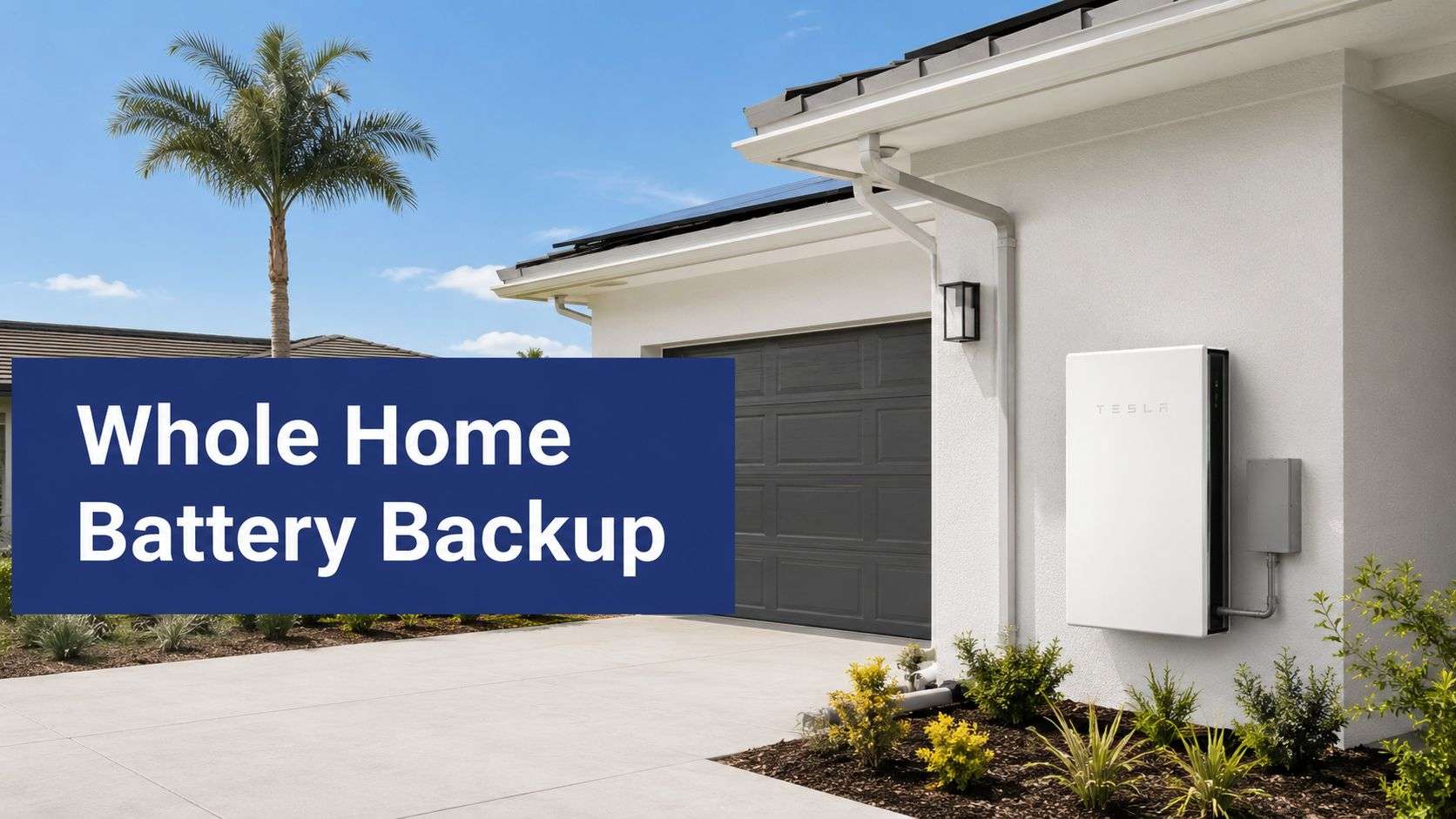
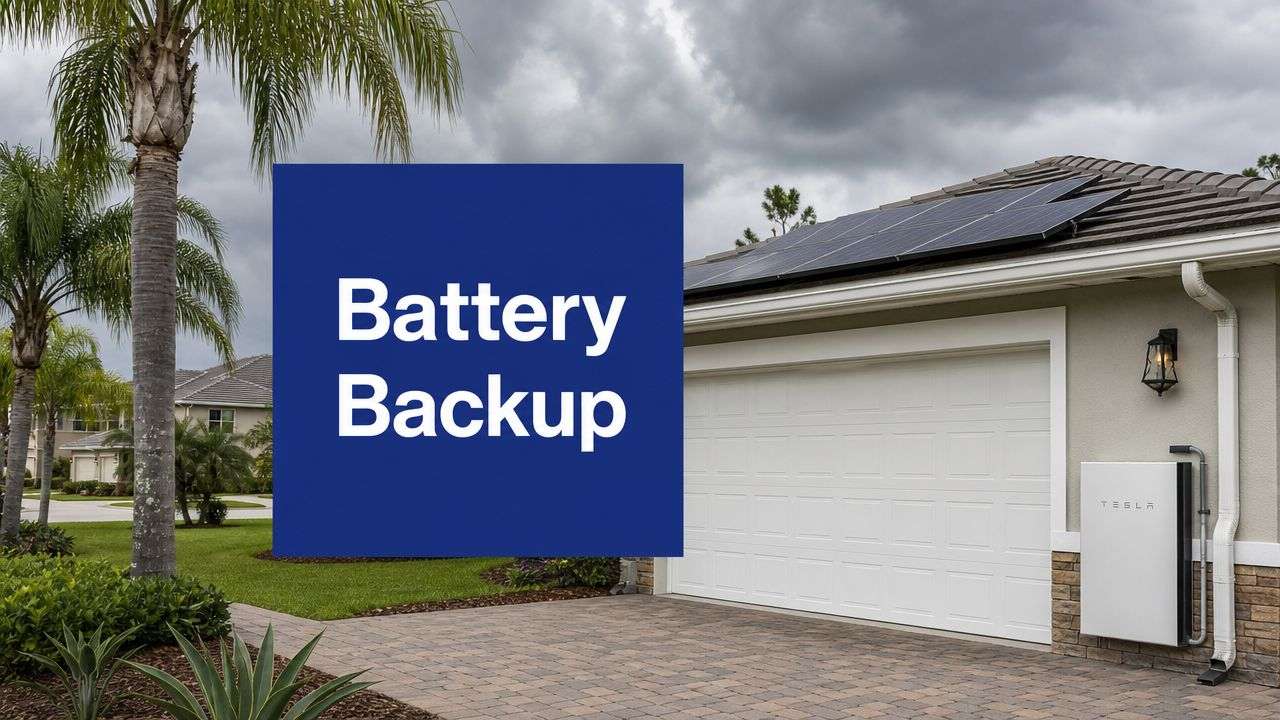
In Florida, storage is not an accessory. For many properties, it is the part of the project that changes solar from a bill-reduction tool into an operating continuity tool. That distinction matters. A battery-backed design can protect refrigeration, communications, lighting, pumps, security, and selected HVAC loads during utility outages. But only if the system was planned around those priorities in advance.

Start With Critical Loads Not Battery Size
A common mistake is asking, “How many batteries do I need?” before defining what must stay on. That reverses the design process.
Start by listing the circuits that matter most during an outage. For a home, that might mean refrigeration, internet, lights, a few outlets, medical equipment, and selected cooling. For a business, it may include POS systems, network gear, freezers, access control, or a server closet. Once those loads are separated from everything else, the design becomes much more useful.
A backup planning resource like solar battery backup for power outages can help owners think in circuits and operating priorities rather than in generic battery marketing terms.
Inverter Capacity Matters As Much As Battery Capacity
People often focus on stored energy and overlook power delivery. A battery can hold enough energy on paper and still fail to start the equipment you care about if the inverter is undersized.
A common battery-backed sizing rule is to choose an inverter with a capacity 25–30% above your normal connected load, and one that can handle a surge of at least 3x the nameplate rating for motor-driven appliances like compressors to ensure reliability during start-up, according to this solar energy system design guide.
That point matters in Florida because many critical loads include motors. Refrigerators, pumps, condensers, and air-handling equipment do not start gently. If the inverter cannot absorb that surge, the battery system may look strong in a proposal and feel unreliable in a storm.
Battery design is really load design. If you haven't prioritized the loads, you haven't designed the storage.
The Orientation Question Changes With Storage
Once batteries enter the picture, the “best” array layout may change. A design aimed strictly at annual production can behave differently than a design aimed at earlier battery recharge, smoother daytime production, or stronger critical-load support during storm-related outages.
Some Florida properties benefit from array orientations that spread production rather than concentrating everything around midday. That can help storage systems recharge earlier and reduce periods when the array is producing more than the battery or load can use efficiently.
Three Storage Strategies Owners Should Separate
Different resilience goals produce very different systems:
Bill savings with limited backup
This setup usually protects a smaller critical-load panel. It can work well when the owner wants some outage coverage without designing around whole-building operation.Resilience-first partial backup
This is often the strongest balance for Florida homes and small businesses. The system is designed around the most valuable circuits and realistic outage behavior.Operational continuity or microgrid planning
Commercial sites, multifamily facilities, and mission-driven properties sometimes need a more strategic approach with staged loads, generator coordination, and controls logic.
If a project is headed toward that third category, independent planning matters even more. Firms such as Solar Energy Management LLC provide feasibility studies, storage planning, and microgrid strategy before procurement, which is useful when the owner needs a defined scope before approaching EPC partners.
What To Avoid In Battery Planning
These decisions usually create trouble later:
- Assuming the battery will run the whole house or whole facility by default
- Ignoring motor surge and startup behavior
- Designing backup around annual energy instead of outage priorities
- Treating generator and battery planning as separate conversations
- Skipping load shedding strategy for longer outages
The most successful Florida storage systems are honest about trade-offs. They do not promise unlimited backup. They deliver the right backup.
Navigating Layout Interconnection and Permitting
By the time a project reaches layout, many owners think the hard decisions are finished. They are not. Roof geometry, fire access, equipment spacing, conduit routing, utility requirements, and local permit interpretation can still change production, schedule, and cost.
Layout Is A Performance Decision
Panel layout is often treated like a drafting task. In reality, it is a performance and serviceability decision.
A clean layout should account for usable roof zones, setbacks, obstructions, future maintenance access, and electrical routing that does not create avoidable complexity. On commercial roofs, the path to rooftop units and drains matters. On homes, vent stacks, valleys, hips, and compact roof sections can force better or worse choices.
A dense layout is not always a smart one. Sometimes a slightly smaller but cleaner array creates a better long-term installation.
South Facing Is Not Always The Right Answer In Florida
Many people still assume the ideal layout is a textbook south-facing array at a standard tilt. That is too simplistic once backup goals and actual usage patterns enter the discussion.
For battery-backed and off-grid systems, a textbook south-facing at latitude tilt layout can be suboptimal once resilience and load timing are considered. The design question shifts from maximizing annual kWh to optimizing for earlier battery recharge or critical-load coverage, as discussed in this analysis of tilt, orientation, and inverter clipping trade-offs.
That matters in Florida because a split east/west layout can sometimes support a smoother production curve. For the right property, that may align better with morning recharge needs, afternoon cooling load, or storage operation.
The best layout is the one that supports the owner's actual objective. That may be savings, backup, or a balance of both.
Interconnection And Permitting Require Real Coordination
The utility and permit side is where rushed projects lose time. Florida is not one permitting environment. Requirements vary by jurisdiction and utility territory, and the design set needs to reflect that reality before submittal.
A practical review should address:
- Electrical service compatibility: Main panel condition, breaker space, service rating, and any need for upgrades
- Utility interconnection package: Single-line diagram, equipment data, production assumptions, and utility-specific forms
- Jurisdictional permit standards: Structural review, wind design documentation, site plan expectations, and fire access rules
- Scope alignment before bidding: Making sure the design intent matches what installers will price and build
For owners, the financial reason to care is straightforward. Every redesign, permit correction, or interconnection mismatch increases soft cost and pushes savings farther out. A well-prepared design package reduces that friction before procurement begins.
Modeling Financial Returns and Florida Incentives
Most solar proposals in Florida lean hard on hardware and stay light on finance. That is backwards. Solar is a long-term asset, and the quality of the investment case depends on the quality of the design assumptions underneath it.
A weak financial model can make a mediocre system look attractive. A disciplined model does the opposite. It exposes risk early, shows where the design is sensitive, and helps the owner decide whether the project belongs in the capital budget at all.

What A Useful Florida Solar Model Should Include
A serious model starts with production assumptions derived from the site, layout, and loss factors. It then maps those outputs against utility bill structure, ownership goals, financing terms if any, and resilience value where relevant.
Sound financial modeling depends on high-quality inputs. Using conservative loss stacks and accurate, site-specific weather data in the preliminary design phase can materially reduce overproduction risk and improve ROI forecasting for major projects, as explained in this discussion of preliminary solar design and financial forecasting.
In practice, that means the financial forecast should not be built from optimistic assumptions about perfect sun, perfect orientation, or zero operational friction. Florida projects need realistic weather inputs, realistic loss assumptions, and realistic expectations for how the system will operate.
Which Metrics Matter To Owners
Different owners look at different return thresholds, but the same core metrics tend to matter:
- Simple payback: How long it takes savings to recover the upfront cost
- Net present value: Whether future savings are worth more than keeping the capital deployed elsewhere
- Internal rate of return: How the project performs compared with other investment options
- Cash flow timing: Whether the system supports the owner's budget and financing structure
- Resilience value: Whether backup capability avoids spoilage, downtime, lost productivity, or operational disruption
Residential clients often start with payback because it is intuitive. Commercial and institutional owners usually need a broader capital-allocation view. The important part is not choosing one favorite metric. It is making sure all of them are built from defensible inputs.
Florida Incentives Need To Be Modeled Carefully
Florida owners also need to evaluate the available incentive options with the same discipline. Incentives can improve returns, but they should never be treated as a substitute for good design. If the project only works under aggressive assumptions, the answer may be to redesign it rather than force it through.
For a current overview of state-specific opportunities and considerations, this guide to Florida solar rebates and incentives is a practical starting point. Owners should review how incentives interact with tax position, ownership structure, and utility billing treatment before they assume value in a spreadsheet.
Why Preconstruction Cost Discipline Matters
One thing I often see in larger commercial planning is a disconnect between production modeling and electrical cost estimating. The system may look strong from an energy perspective while the balance-of-system scope, service upgrades, or distribution work have not been scoped tightly enough.
That is where structured estimating tools become useful. Teams comparing procurement scenarios or validating electrical scope can benefit from platforms such as Exayard electrical estimating software, especially when the goal is to tie design intent to real installation cost rather than rely on broad allowances.
A solar project is not financially sound because the savings case looks good in isolation. It is sound when production, incentives, electrical scope, and operating assumptions all agree with each other.
The Real Goal Of Financial Modeling
The goal is not to make the project look compelling. The goal is to know whether it is compelling.
That difference is what separates strategic solar planning from quote shopping. In Florida, where cooling loads are high, outage risk is real, and utility structures matter, the owner who models carefully has a major advantage. They can test alternate layouts, storage options, and procurement paths before signing anything. That is how solar becomes a controlled investment decision instead of a hopeful purchase.
From Design to Reality Your Next Steps
The throughline in all of this is simple. The quality of the solar result depends on the quality of the planning that happens before installation pricing starts. Site constraints affect production. Load timing affects sizing. Equipment choices affect durability. Storage strategy affects resilience. Financial assumptions affect whether the project should move forward at all.
That is why the smartest next step is usually not collecting the most installer quotes. It is building a design basis first.
For homeowners, facility managers, and developers in Florida, that means defining the load, reviewing the site, setting resilience priorities, and creating a scope that installers can bid consistently. Once that work is done, EPC proposals become easier to compare because everyone is pricing against the same objectives instead of selling different visions of the same roof.
For organizations thinking beyond a single project, broader planning resources can also help frame the bigger picture. This 2026 guide for renewable energy scaling is useful for understanding how renewable projects fit into longer-term business growth and operational planning.
Independent consulting adds value here because it aligns the project around the owner's interests before procurement pressure enters the room. That is how you de-risk solar power system design in Florida. You plan first, then buy.
If you're evaluating solar for a home, business, multifamily property, or resilience-driven facility in Florida, Solar Energy Management LLC can help you assess the site, model ROI, define storage strategy, and prepare a clear design basis before you engage an EPC. That gives you a stronger scope, better bid comparisons, and a far more predictable investment outcome.