Your electric bill arrives. Hurricane season is on your mind. You’ve probably heard solar can lower operating costs, add backup power, and make a property less exposed to utility price swings. All of that can be true in Florida. It can also go wrong fast if the system is oversized, undersized, poorly modeled, or designed around a sales target instead of your actual load profile.
That’s where a consultant’s view matters.
When people search for solar power systems florida, they usually aren’t just shopping for panels. They’re trying to answer a harder question. What system makes financial sense for this building, on this roof, under this utility, with this storm risk, and with these resilience goals? The right answer starts before you pick an installer.
Why Florida Is Embracing Solar Power Now
Florida’s solar growth isn’t theoretical anymore. It’s visible in utility-scale development, residential adoption, and how often owners now ask for batteries as part of the conversation instead of as an afterthought.
In the first half of 2023, Florida led all U.S. states in new solar installations, adding 2,499 megawatts of capacity, a record pace for the state, according to this Florida solar installation report. That matters because it confirms something property owners are already seeing on the ground. Solar in Florida has moved from niche upgrade to mainstream energy strategy.
What’s Driving Interest
Most homeowners and business owners come in with one of these concerns:
- Bill pressure: Utility costs feel less predictable, and owners want more control over long-term energy spend.
- Outage risk: Grid dependence feels different after major storms and extended outages.
- Property planning: Owners are thinking beyond a simple payback and asking how solar fits renovation, reroofing, expansion, EV charging, or backup power goals.
Florida helps that shift because the state has what system planners need most. Strong sun resource, a large installed base, and enough market activity that equipment and design choices are no longer experimental.
Why Timing Matters
A lot of bad solar decisions happen when people treat the purchase like buying an appliance. It’s closer to planning a small on-site power asset. The roof, the utility tariff, the interconnection rules, the backup loads, and the financing structure all affect the result.
Solar works best in Florida when the system is designed around your load and risk tolerance, not around a generic package size.
For homeowners, that usually means deciding how much of the electric bill to offset and whether outage backup is a must-have. For businesses, the bigger question is often operational. Which loads matter most, what utility savings model fits the site, and whether storage should serve resilience, demand management, or both.
Understanding Solar and Battery Storage Systems
A solar system is easier to understand when you stop thinking about equipment and start thinking about job roles. The panels generate power, the inverter makes that power usable, and the battery stores energy for later.

The Three Core Components
Solar panels capture sunlight and produce direct current electricity. In Florida, panel selection should reflect heat, humidity, roof layout, and storm exposure, not just nameplate wattage.
Inverters convert that electricity into the alternating current your home or building uses. The system's architecture then becomes a critical factor. String inverter, microinverter, and hybrid inverter approaches each make sense in different conditions.
Batteries hold energy for later use. In a grid-tied Florida property, they’re usually there for backup, load management, or a combination of both. They aren’t mandatory for solar savings, but they often are the deciding factor if resilience matters.
How Power Actually Flows
On a normal sunny day, the array produces electricity first. The building uses what it needs in real time. If production exceeds usage, excess energy can flow outward under the applicable utility arrangement. If a battery is installed, some of that energy may charge the battery before export, depending on system settings and priorities.
At night or during outages, the battery can support selected loads if the system is designed for backup operation. That last part is critical. Not every battery-backed system is configured to carry the same circuits.
A practical example is a home that wants refrigeration, lighting, internet, and a few outlets backed up, but not central air for the entire house. That’s a very different design from a commercial site trying to maintain critical office systems, access control, or refrigeration.
What Owners Often Miss
The mistake I see most is assuming every battery setup creates whole-property independence. It usually doesn’t unless the design, panelboard strategy, and load management plan were built for that goal from the start.
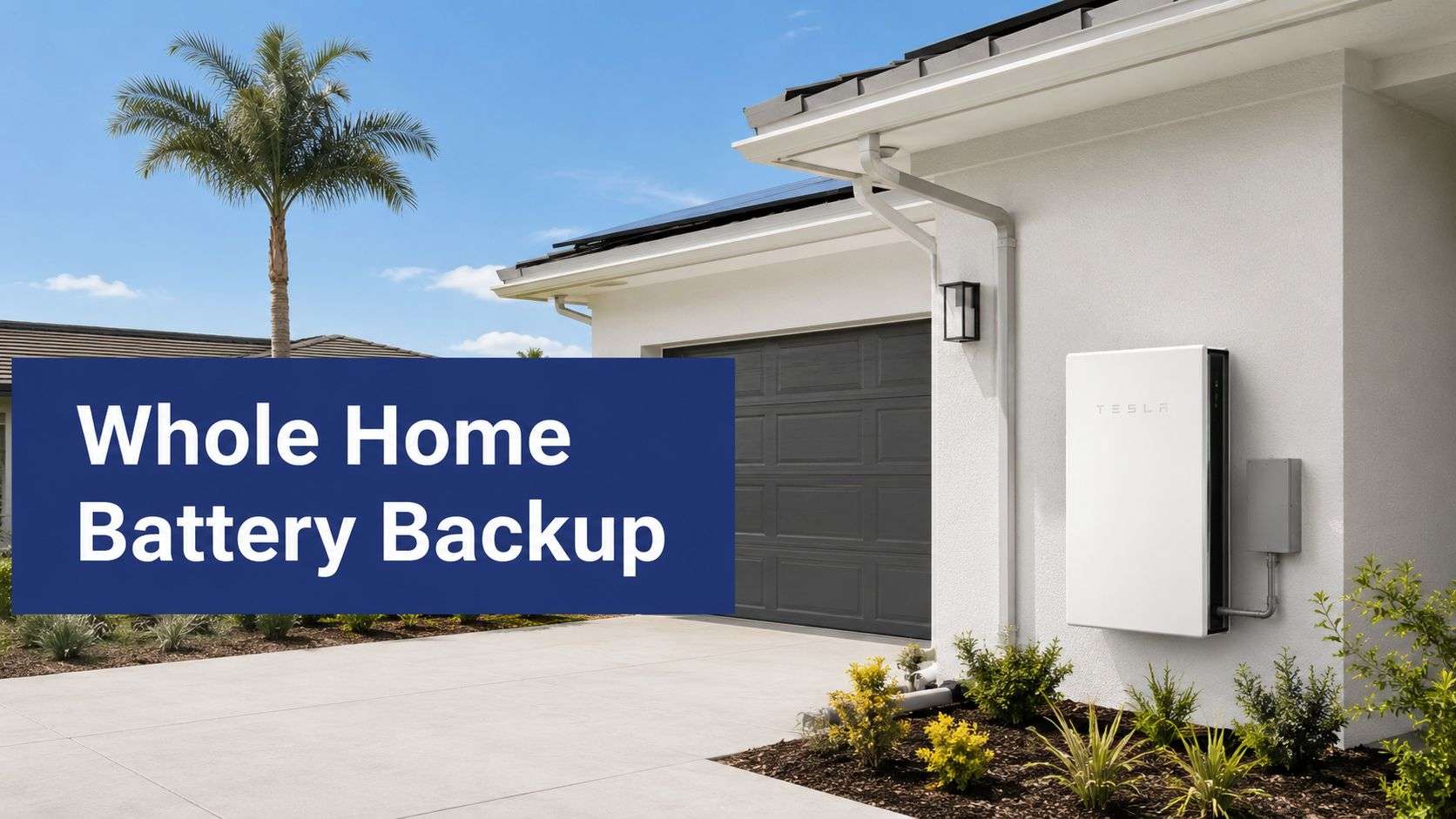
If you’re comparing storage options, it helps to review a real backup architecture such as this Tesla Powerwall 2 installation overview, because the hardware is only part of the answer. The usable value comes from how the battery is integrated with your loads and switching strategy.
A battery doesn’t fix a bad solar design. It only stores energy within the limits of the system around it.
Florida Solar Incentives and Financial Models
A good solar decision in Florida starts with incentives, but it shouldn’t end there. Incentives lower the barrier to entry. Financial modeling tells you whether the project still makes sense after you account for production, utility structure, backup goals, and ownership strategy.

The Incentives That Change the Conversation
One of the biggest developments for underserved households is the Florida Solar for All program. Awarded in April 2024, the program provides $156.1 million and is structured to cover 80 to 100 percent of solar installation costs for low-income households and 60 to 80 percent for moderate-income households, targeting about 10,000 single-family homes, with installations starting in late 2024, according to this Florida Solar for All program summary.
That program changes project feasibility for households that previously had no realistic path to ownership. It also creates a planning challenge. Owners still need proper feasibility analysis, load review, and system design so they don’t leave value on the table or end up with a system that doesn’t match the property.
For the broader market, buyers also often evaluate the federal tax credit, Florida’s tax treatment of solar, local financing options, and how utility bill offset works over time. For many owners, the better question isn’t “What incentive exists?” It’s “How do these incentives change my cash flow over the life of the system?”
For a fuller state-level overview, this Florida solar incentive guide is useful as a starting reference.
How Consultants Model the Real Return
Sales proposals often focus on a simple payback story. That’s too narrow.
A proper feasibility model usually looks at several layers at once:
- Production assumptions: How much energy the system is likely to generate on this roof or site.
- Self-consumption versus export: Whether the building uses most of that power as it’s produced or sends a larger share outward.
- Battery role: Whether storage is there for backup only or also to improve operating economics.
- Ownership structure: Cash purchase, financing, and the business implications of buy versus lease.
Business owners especially should look at financing in the context of equipment strategy, not just monthly payment size. If you’re weighing ownership against leasing, Noreast Capital's guide for businesses gives a helpful framework for thinking through control, balance-sheet impact, and long-term asset value.
What Works and What Doesn’t
What works is a model built from actual interval usage, actual roof constraints, and actual utility rules. What doesn’t work is dropping a generic system size into a template and assuming the outcome will be close enough.
Practical rule: If a proposal can’t clearly show how it handles your load profile, export assumptions, and backup priorities, it’s not a financial model. It’s a sales estimate.
For commercial properties, this matters even more. A warehouse, school, office, church, and multifamily building can all have similar annual usage and still need very different system designs because their load shapes are different.
Sizing Your System for Florida's Climate
System sizing in Florida should start with one simple question. How much electricity does the property use over time? After that, the climate data starts to matter.
Florida has a strong solar resource, but strong sunlight doesn’t eliminate the need for disciplined modeling. In Florida, solar systems produce about 1,400 to 1,700 kWh per kW of capacity annually, and accurate performance modeling should account for factors such as 80% humidity, potential shading, and a 15% inverter loss, as outlined by the University of Florida solar research page.

Start With Usage, Not Roof Area
A lot of owners begin by asking how many panels fit on the roof. That’s backward. Fit matters, but usage drives the target.
Pull past electric bills and look for patterns:
- Base load: What does the property consume even in mild weather?
- Seasonal swings: How much do cooling loads change the picture?
- Planned changes: Pool equipment, EV charging, electrification, new tenants, or business expansion can all change future sizing.
For residential projects, a common planning mistake is sizing strictly to last year’s bill while ignoring future electrification. For businesses, the bigger error is looking only at annual totals instead of daytime load shape.
Florida-Specific Variables That Change Output
Florida’s climate gives you excellent production potential, but it also introduces penalties that can’t be ignored.
- Humidity and heat: Modules still produce well, but thermal and moisture conditions affect real-world performance.
- Shading: Trees, vents, parapets, and neighboring structures can materially reduce output.
- Roof orientation and tilt: A roof may hold plenty of panels but still be a weaker production surface than expected.
- Storm exposure: Racking choices and layout spacing can affect both resilience and usable roof area.
If you want a practical benchmark for household planning, this 10,000 kWh solar system guide helps frame how annual electricity use translates into system sizing logic.
Why Oversizing Can Hurt
Bigger isn’t automatically better. In some Florida projects, oversizing creates weaker economics because the building can’t use enough of the production when it’s generated. That’s especially true when proposal design ignores export compensation realities or seasonal occupancy.
A right-sized system usually does three things well:
- It matches a realistic share of annual consumption.
- It reflects the property’s best roof or site surfaces.
- It leaves room for future battery integration or load growth if that’s part of the plan.
Shading and humidity don’t make solar a bad fit in Florida. They make lazy modeling a bad fit.
For commercial roofs, I also look closely at usable square footage versus gross square footage. Mechanical equipment, setbacks, access pathways, and structural constraints can matter as much as sunlight.
Navigating Florida Permitting and Interconnection
A solar project isn’t real until it clears local permitting and utility interconnection. Strong projects can still get delayed during these processes due to weak paperwork, vague line diagrams, or a design that wasn’t matched to the right utility pathway.
The process usually involves local building review, electrical review, engineering documentation, utility application, installation, inspection, and final permission to operate. The exact sequence can vary by jurisdiction and utility, but the planning logic doesn’t. You want the system designed to pass both code review and utility review before installation begins.
The Net Metering Tiers That Shape Design
Florida’s utility framework classifies systems into three net metering tiers. The Florida Public Service Commission defines Tier 1 as systems up to 10 kW, Tier 2 as 10 to 100 kW, and Tier 3 as 100 kW to 2 MW, and those tiers affect interconnection requirements and exported energy compensation, as described in this breakdown of Florida solar system types and net metering tiers.
That classification matters because it affects more than paperwork. It influences how far you can reasonably scale the project, what approvals are required, and how the economics behave if the system exports substantial energy.
For owners served by Duke, it helps to understand utility-specific procedures early. This Duke Energy net metering guide is a useful reference point when you’re evaluating design assumptions against the utility’s process.
Where Projects Get Stuck
The most common avoidable problems tend to be practical, not technical.
- Wrong system tier: A proposal may look attractive until the owner realizes the design crosses into a different interconnection pathway.
- Incomplete plans: Missing documentation can slow permit review even when the hardware is straightforward.
- Poor service equipment review: Main panel limitations, backfeed constraints, or transformer issues can force redesigns.
- Backup confusion: Owners think they’re buying outage protection, but the submitted design doesn’t include the necessary critical-load strategy.
A consultant’s job here isn’t to file random forms. It’s to catch design and process issues before they turn into cost, delay, or reduced performance.
Building for Resilience and Hurricane Protection
In Florida, resilience isn’t a luxury feature. It’s often the reason a project moves forward.
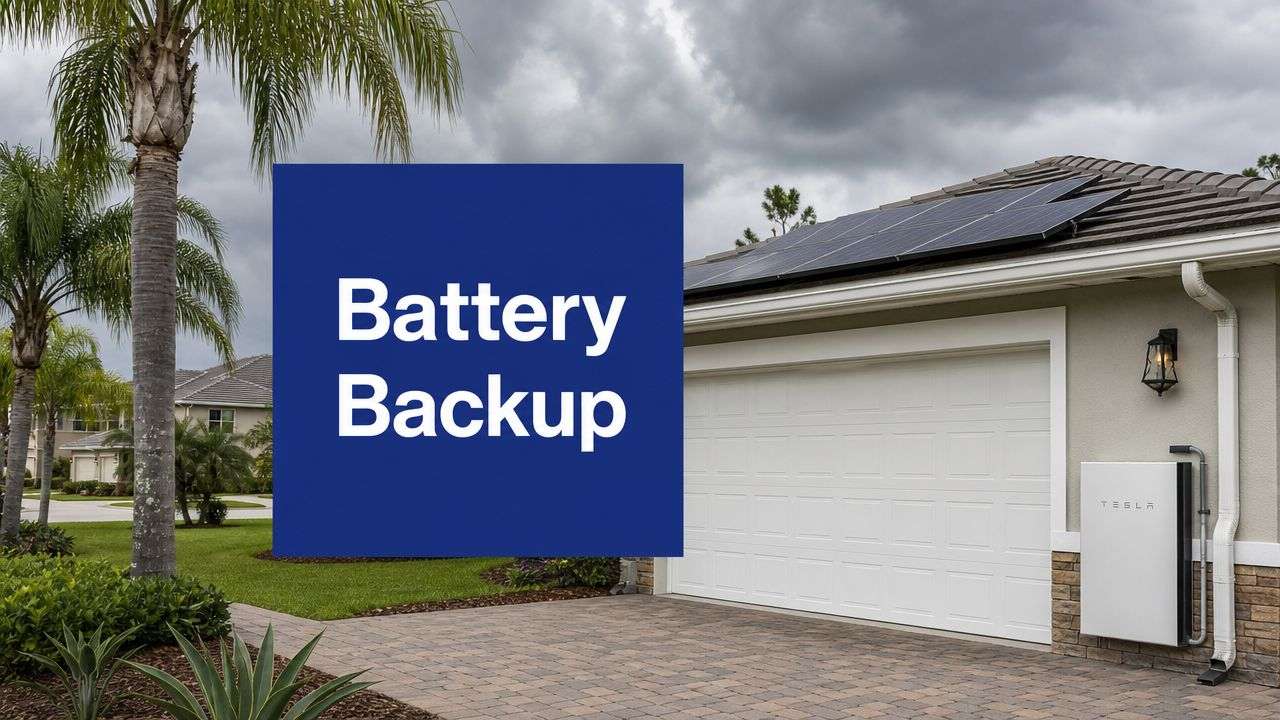
People don’t usually start caring about backup power because they love equipment. They care because food spoils, internet drops, medical devices need power, businesses lose operating time, and storm recovery can stretch longer than expected. Solar by itself can lower bills. Solar paired with storage can help keep critical loads running when the grid is down.

The Most Practical Resilience Setup
For most Florida properties, the smartest resilience design is grid-tied solar with battery backup, not full off-grid. Fully off-grid solar is legal in parts of Florida, but a typical home setup can cost $80,000 to $85,000, while grid-tied systems with battery backup are the more common and cost-effective path for outage resilience, according to this Florida off-grid solar overview.
That tracks with what works in practice. Most owners don’t need total grid separation. They need a system that keeps essential functions going during outages while still delivering normal utility savings the rest of the year.
What to Back Up First
Backup design should be selective. If you try to support everything, cost rises and performance expectations often become unrealistic.
A better approach is to prioritize loads such as:
- Essential residential circuits: Refrigeration, lighting, communications, garage access, and selected receptacles.
- Business continuity loads: Network equipment, point-of-sale systems, security, office circuits, and refrigeration where applicable.
- Critical infrastructure: Medical equipment, pumps, access control, or tenant safety systems.
That design work matters more than battery branding. The battery is only useful if the backed-up panel, load schedule, and transfer strategy match the owner’s actual priorities.
Storm resilience comes from disciplined load selection, not from assuming one battery will run everything.
What Doesn’t Work Well in Florida
A few approaches consistently create disappointment:
- Whole-home expectations without whole-home design
- Battery add-ons with no critical-load planning
- Off-grid ambitions without aggressive efficiency upgrades
- Roof-first decisions that ignore storm exposure and service equipment limitations
For commercial and multifamily owners, resilience planning often works better when you define tiers of operation. What must stay on immediately, what can cycle, and what can remain offline until the grid returns.
That’s how you turn solar from a bill-reduction tool into a continuity asset.
Choosing Your Expert An Independent Consultant vs An EPC
By the time most owners talk to solar providers, they’ve already noticed a pattern. One proposal says bigger is better. Another says batteries are optional. A third promises quick savings but doesn’t explain assumptions. The confusion usually comes from role mismatch.
An EPC is there to engineer, procure, and construct a system. That’s valuable. But an EPC is also trying to sell and install a project. An independent consultant serves a different role. The consultant should evaluate feasibility, model performance, define scope, and protect the owner’s interests before procurement is locked in.
The Difference in Practical Terms
Here’s how the two paths usually differ.
Working directly with an EPC
- You may get a faster proposal.
- You may get a bundled path from design through installation.
- You also have to judge whether the recommended system is optimized for your property or efficient for that company to sell.
Working with an independent consultant first
- You start with load analysis, design criteria, resilience goals, and financial modeling.
- You can compare installer bids against a defined scope instead of comparing sales presentations.
- You reduce the risk of buying a system that looks good on paper but performs poorly against your actual objectives.
For owners comparing procurement paths, this overview of solar companies in Florida can help frame the market and the differences in provider type.
Where Independent Advice Pays Off
The best use cases for a consultant usually involve complexity:
- Battery storage decisions: How much backup is really needed, and for which circuits?
- Commercial tariff analysis: Whether the value is driven more by self-consumption, resilience, or future load planning.
- Reroof or redevelopment timing: Whether solar should wait, phase, or integrate with another capital project.
- Bid review: Whether pricing, assumptions, and equipment selections are aligned across competing proposals.
Solar Energy Management LLC is one example of a Florida-based consultancy that handles feasibility studies, ROI modeling, battery planning, and system design guidance before owners commit to implementation. That kind of scope is different from installation sales. It’s meant to make the eventual procurement cleaner and less risky.
If you don’t define the project before installers price it, you’re not comparing bids. You’re comparing competing assumptions.
The right choice depends on the property and the owner. If your project is simple and your goals are narrow, an EPC-led process may be enough. If the project involves resilience, financing structure, multiple stakeholders, or a meaningful capital commitment, independent analysis usually saves money by preventing expensive design mistakes.
If you’re evaluating solar power systems florida and want an independent view before signing with an installer, Solar Energy Management LLC helps Florida homeowners, businesses, and organizations model ROI, size systems correctly, plan battery backup, and define a procurement-ready scope based on real usage and resilience goals.