
TL;DR:
- Following a solar savings checklist helps Florida homeowners maximize financial benefits and system efficiency. Properly sizing systems, claiming tax exemptions, and adding storage improve long-term savings and resilience against outages. Independent analysis ensures homeowners avoid costly mistakes and optimize their solar investment.
A solar savings checklist for Florida homeowners is a practical set of verified steps that ensures you capture every available financial benefit from a residential solar installation. Florida homeowners who follow this checklist can expect savings over 25 years between $30,000 and $45,000, with a payback period of 9–12 years. The state offers property tax exemptions, sales tax exemptions, and full retail net metering credits that most homeowners never fully use. Solar Energy Management has spent over 20 years helping Florida homeowners close that gap.
1. Solar savings checklist for Florida homeowners: start with your energy baseline
Your annual electricity consumption is the foundation of every savings calculation. Pull 12 months of utility bills and calculate your average monthly kilowatt-hour usage. Florida homes run air conditioning for most of the year, which pushes average consumption well above the national norm. That number determines the right system size, the right net metering strategy, and the realistic payback period for your specific home.
Without this baseline, any quote you receive is a guess. Installers who skip this step are selling systems, not solutions.
2. Verify your roof’s condition before committing to solar
Roof condition is a financial checkpoint that most homeowners overlook until it is too late. Replacing a roof before solar installation is cost-effective when less than 10 years of useful life remain. Removing and reinstalling a solar array for a mid-life roof replacement adds thousands of dollars in labor costs that wipe out months of savings. Have a licensed roofing contractor assess your roof before signing any solar contract.
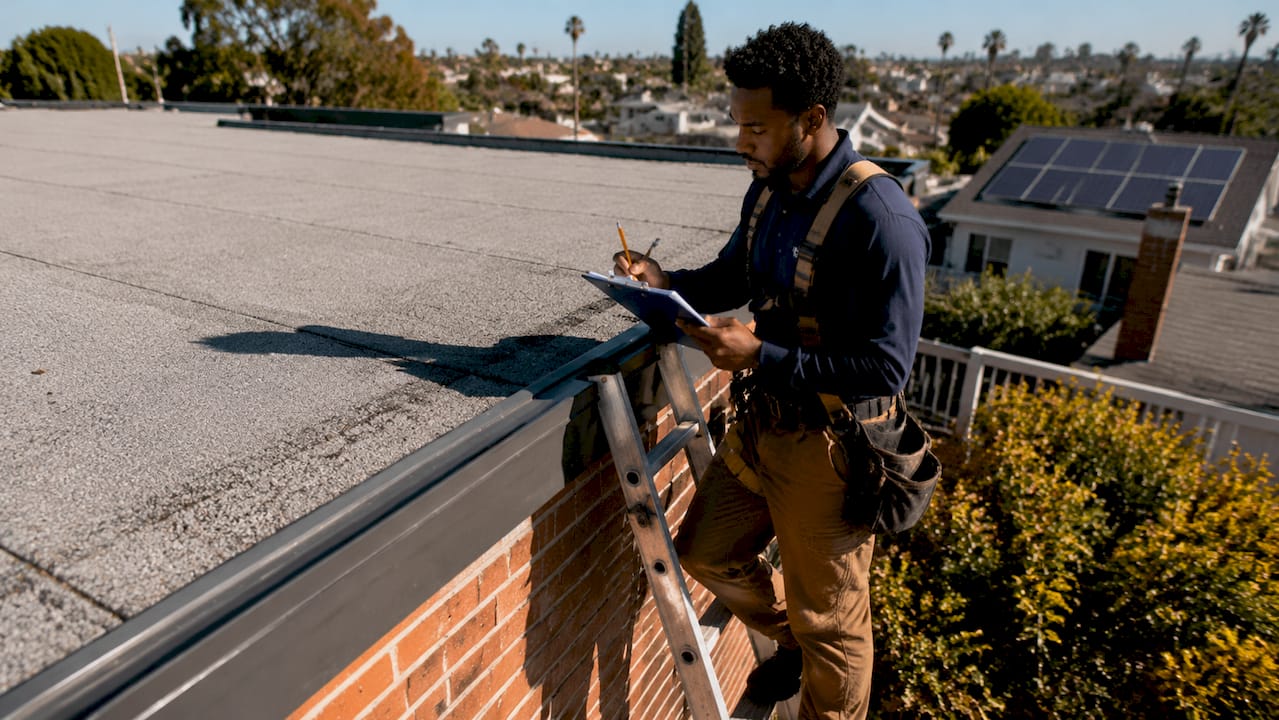
South-facing roof sections with minimal shading produce the highest output in Florida’s latitude. A roof orientation assessment takes less than an hour and directly affects your 25-year production estimate.
3. Get at least three quotes from licensed Florida contractors
Comparing multiple quotes from licensed Florida contractors is the single most effective way to protect yourself from inflated pricing and overstated savings claims. Florida requires solar installers to hold an Electrical Contractor (EC) or Certified Electrical Contractor (CEC) state license. Verify that license before any conversation about pricing.
- Request at least three detailed quotes with itemized equipment costs
- Ask each installer for a 25-year savings projection based on your actual utility rate
- Confirm that permitting and utility interconnection services are included in the contract
- Reject any quote that uses generic savings estimates not tied to your consumption data
Pro Tip: Ask each installer to model two scenarios: one with battery storage and one without. The cost difference is often smaller than homeowners expect, and the resilience benefit in Florida is significant.
4. Size your system to match your annual consumption
Right-sizing a solar system to offset 90–100% of annual usage is the most reliable way to maximize net metering returns. Oversizing creates excess generation that utilities credit at avoided-cost rates rather than full retail rates. That difference can meaningfully reduce your actual return on investment.
- Target 90–110% of your annual kilowatt-hour usage as your system output goal
- Typical Florida residential systems fall in the 6–12 kW range
- Oversized systems generate credits that pay out at lower avoided-cost rates at annual true-up
- A solar ROI calculator can model the exact financial impact of different system sizes for your home
Florida’s heat also affects panel output. Request production data that accounts for high ambient temperatures and ask for panels with strong temperature coefficients, meaning panels that lose less output as temperatures rise.
Pro Tip: Request a production guarantee in writing from your installer. Florida’s solar irradiance is high, but shading from trees and roof pitch variations can reduce actual output by 10–20% versus modeled estimates.
5. Leverage Florida’s tax exemptions to reduce upfront costs
Florida offers two state-level incentives that directly reduce what you pay. Florida’s 100% property tax exemption means the added value a solar system brings to your home is not included in your annual property tax assessment. For a system that adds $25,000 in home value, that exemption saves hundreds of dollars per year for the life of the system.
The second incentive is a 6% state sales tax exemption on solar equipment. On a $22,000 system, that exemption saves approximately $1,320 at purchase. Florida’s sales and property tax exemptions together yield $1,200 to $1,800 in upfront savings and thousands more over the system’s life.
| Incentive | Benefit | Notes |
|---|---|---|
| Property tax exemption | 100% of added home value excluded | Applies for the life of the system |
| Sales tax exemption | 6% off equipment purchase price | Applied at point of sale |
| Federal ITC | Expired December 31, 2025 | No longer available in 2026 |
| State income tax credit | Not available | Florida has no state income tax |
The federal 30% Investment Tax Credit expired on December 31, 2025. Homeowners who installed before that date may still claim it on their 2025 tax return, but it does not apply to new installations in 2026. Florida’s state exemptions remain fully intact.
6. Understand how net metering works with your utility
Net metering in Florida credits excess solar generation at the full retail electricity rate under investor-owned utilities including Florida Power & Light, Duke Energy Florida, and Tampa Electric. That full retail credit is what makes solar financially attractive in the state.
- Residential systems up to 2 MW qualify, with most homes installing 6–12 kW systems
- Excess credits roll over monthly and are settled at annual true-up
- Credits beyond your annual consumption are paid out at avoided-cost rates, which are lower than retail
- Policy changes to net metering remain a real risk; conservative sizing protects your returns
Net metering credit rates are granted at full retail for exports up to your annual consumption. Any surplus beyond that is settled at a lower avoided-cost rate. This is why matching system size to consumption is not just a technical decision. It is a financial one.
7. Add battery storage for resilience and peak savings
Battery storage is no longer optional for Florida homeowners who want full energy independence. Battery storage is essential in Florida for both cost savings and power resilience during hurricanes and grid outages. A grid-tied solar system without batteries goes dark during a power outage, even when the sun is shining.
- Battery systems provide backup power for critical loads during grid outages
- Peak-shaving capabilities reduce demand charges where applicable under your utility’s rate structure
- Systems with 3 kWh or more of usable storage capacity may qualify for additional incentives
- Battery storage options for Florida homes range from single-unit backup systems to whole-home configurations
Pro Tip: Size your battery to cover your critical loads, not your entire home. Air conditioning, refrigeration, and medical equipment are the priority. A well-sized battery covering those loads costs significantly less than a whole-home system and still provides meaningful hurricane protection.
Battery storage for resilience is increasingly viewed as a core component of Florida solar planning, not an add-on. The combination of solar plus storage shortens effective payback periods when you account for avoided generator costs and the value of uninterrupted power.
8. Explore solar panel financing options before signing
Financing structure affects your total cost of solar more than most homeowners realize. A cash purchase delivers the highest long-term return because you own the system outright and capture all savings from day one. A solar loan preserves that ownership while spreading the upfront cost over time.
Solar panel financing options in Florida include direct purchase, secured solar loans, and property-assessed clean energy (PACE) financing. PACE financing attaches repayment to your property tax bill, which can complicate home sales. Understand the terms before signing. Power purchase agreements (PPAs) and leases are available but transfer most financial benefits to the third-party owner, not you.
The average Florida installation cost is approximately $2.20 per watt. A 10 kW system costs about $22,000 before incentives. After the 6% sales tax exemption, that drops to roughly $20,680. Your financing choice determines how quickly you recover that investment.
Key Takeaways
Florida homeowners who size their systems correctly, claim all available state tax exemptions, and add battery storage consistently achieve the strongest solar returns in the state.
| Point | Details |
|---|---|
| Baseline your consumption first | Use 12 months of utility bills to set the right system size before requesting quotes. |
| Claim both state tax exemptions | Florida’s property and sales tax exemptions reduce upfront and long-term costs significantly. |
| Size to match annual usage | Oversizing triggers lower avoided-cost credit rates at annual true-up, reducing your ROI. |
| Add battery storage | Battery systems provide hurricane backup and extend the financial value of your solar investment. |
| Verify installer credentials | Only accept quotes from EC or CEC licensed Florida contractors with detailed savings projections. |
What 20 years in Florida solar has taught us
The homeowners who get the best results from solar are not the ones who find the lowest price. They are the ones who ask the hardest questions before signing anything.
The most common mistake we see at Solar Energy Management is homeowners accepting a single quote with a generic savings estimate. That estimate is almost always based on average consumption, average utility rates, and average production assumptions. None of those averages apply to your specific home, your specific roof, or your specific utility rate structure.
The second mistake is ignoring the roof. We have seen homeowners install a $25,000 solar system on a roof that needed replacement within five years. The removal and reinstallation cost erased two full years of savings. A roof inspection before installation is not optional. It is part of the checklist.
Battery storage is the item most homeowners add after the fact, and that is always more expensive than including it in the original design. Florida’s hurricane season is not a hypothetical risk. It is an annual certainty. A solar system without storage is a system that goes dark exactly when you need it most.
The policy environment around net metering will continue to evolve. Conservative system sizing and high-quality equipment protect your investment against rate structure changes that no one can predict. Prioritize efficiency and durability over the lowest panel price.
— Solar Energy Management
How Solar Energy Management helps you capture every dollar of savings
Florida homeowners who want a complete picture of their solar savings potential need more than a quote. They need an independent analysis that accounts for their actual consumption, their utility’s rate structure, and the full range of available incentives.
Solar Energy Management provides independent consulting, financial modeling, and system design guidance for Florida homeowners. The team helps you evaluate battery storage solutions suited to your home’s critical loads and hurricane risk profile. For homeowners who want expert guidance before committing to any installer, solar energy consulting from Solar Energy Management delivers the customized savings analysis and system design review that protects your investment from day one. Contact Solar Energy Management to request a consultation.
FAQ
What is the average solar payback period in Florida?
Florida homeowners typically see a solar payback period of 9–12 years, with total savings over 25 years ranging from $30,000 to $45,000 depending on electricity rates and system performance.
Does Florida offer a state solar tax credit in 2026?
Florida does not have a state income tax credit for solar. The federal 30% Investment Tax Credit expired December 31, 2025. Florida’s property tax exemption and 6% sales tax exemption on equipment remain available in 2026.
How does net metering work in Florida?
Florida’s investor-owned utilities credit excess solar generation at the full retail electricity rate. Credits roll over monthly, and any surplus beyond your annual consumption is settled at a lower avoided-cost rate at the annual true-up.
Is battery storage worth adding to a Florida solar system?
Battery storage provides backup power during grid outages and hurricanes, making it a practical necessity in Florida. Systems with 3 kWh or more of usable capacity may also qualify for additional incentives and reduce peak demand charges.
What license should a Florida solar installer hold?
Florida solar installers must hold an Electrical Contractor (EC) or Certified Electrical Contractor (CEC) state license. Verify this credential before accepting any quote or signing any contract.
Recommended
- Residential Solar Energy Florida A 2026 Homeowners Guide – Commercial + Residential Solar Power Florida
- Is Home Solar Worth It in Florida? a 2026 Financial Guide – Commercial + Residential Solar Power Florida
- Solar Panels in Florida: 2026 Costs & Benefits – Commercial + Residential Solar Power Florida


