
TL;DR:
- A solar consultant provides independent guidance on technical, financial, and regulatory aspects of solar projects. Their early involvement improves project returns, reduces risks, and helps shape procurement and design decisions. Engaging a consultant before contacting installers is essential for maximizing project success at any scale.
A solar consultant business is defined as an independent advisory firm that provides technical, financial, and regulatory guidance to homeowners and businesses pursuing solar energy projects. Unlike installers, solar consultants sell no equipment and hold no stake in which products you buy. That vendor neutrality is the foundation of their value. Solar Energy Management has worked with Florida clients for over 20 years, and the pattern is consistent: projects guided by qualified solar consulting services from the start deliver better returns, fewer surprises, and faster permitting. This guide explains exactly what solar consultants do, why their role matters, and how to use them effectively across residential, commercial, lease, and development contexts.

What is the role of solar consultant business services?
A solar consultant business covers six core service areas, each addressing a distinct risk in the project lifecycle.
- Site assessment and shading analysis. Partial shading can reduce system output by 25–40%, making a professional shading analysis one of the highest-value tasks a consultant performs. Without it, you may install a correctly sized system that chronically underperforms.
- Load profiling and utility bill analysis. Consultants typically review 6–12 months of utility data to size a system accurately. Undersizing leaves money on the table; oversizing wastes capital on panels that never pay back.
- Financial modeling and incentive optimization. A qualified advisor builds a full pro forma covering the federal 30% Investment Tax Credit, net metering credits, and depreciation schedules for commercial clients. This is where most self-managed projects leave significant savings uncaptured.
- Procurement advisory and competitive bidding. Consultants run structured RFP processes that produce comparable, competitive bids aligned with your project specs. That process alone can reduce procurement costs meaningfully.
- Regulatory navigation and permitting. Florida’s interconnection rules, utility tariff structures, and local permitting requirements change regularly. A consultant tracks those changes and keeps your project compliant.
- Project management and quality assurance. Independent engineering inspections during construction reduce defects and post-installation performance issues. The consultant acts as your technical representative on site.
Pro Tip: Hire your solar consultant before you contact any installer. Consultants who enter after bids are received have far less ability to shape the procurement process in your favor.
How do solar consultants improve financial outcomes and reduce project risk?
The financial case for hiring a solar advisor is direct. Renewable energy projects with expert independent consulting achieve 15–30% better ROI and 40% fewer implementation delays. Those are not marginal improvements. A 20% ROI gain on a $200,000 commercial installation equals $40,000 in additional return over the system’s life.
“Independent solar consultants act as the client’s advocate, preventing overpayment and ensuring technical accuracy throughout the project. Their role is not to sell a system but to make sure the system you buy is the right one, installed correctly, and priced fairly.”
The risk reduction side is equally concrete. Consultants bring cross-project benchmarks that prevent clients from repeating common sizing and procurement mistakes seen across similar projects. An oversized system on a small commercial building, for example, may never achieve payback within the loan term. A consultant catches that mismatch in the feasibility phase, not after the panels are on the roof.
| Risk area | Without a consultant | With a consultant |
|---|---|---|
| System sizing | Based on installer estimate | Verified against 6–12 months of load data |
| Shading losses | Often undetected pre-installation | Quantified and mitigated in design |
| Procurement cost | Single installer quote | Competitive RFP with comparable bids |
| Incentive capture | Partial or missed | Full ITC, depreciation, and rebate modeling |
| Regulatory delays | Common, costly | Minimized through proactive permitting |
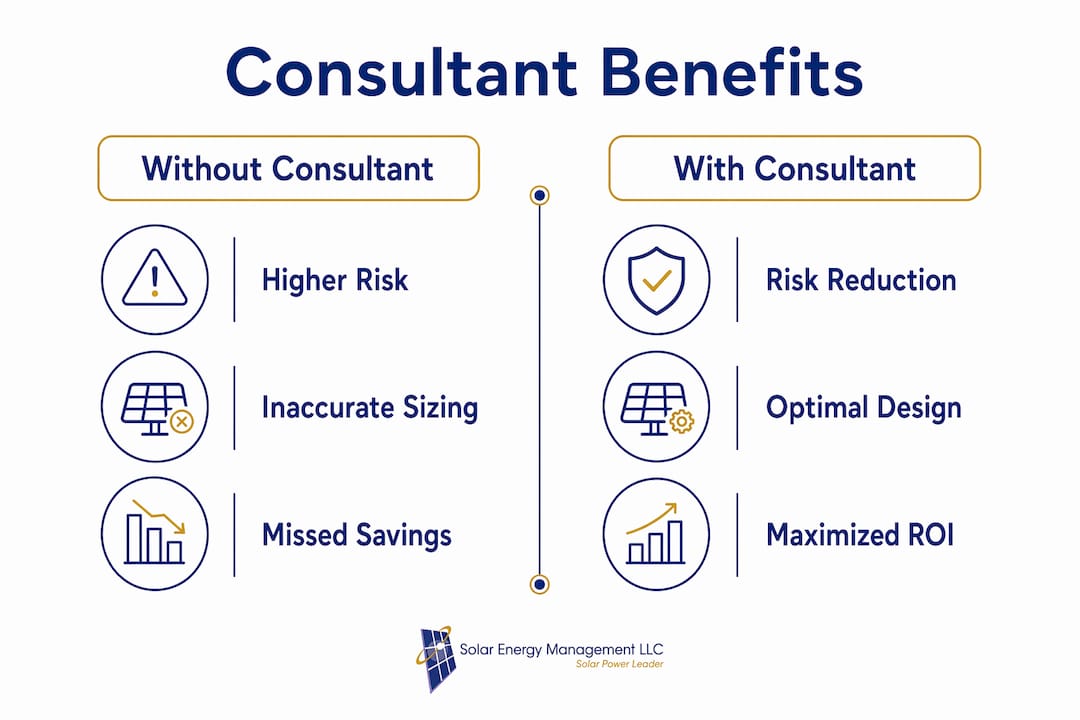
Regulatory and incentive environments change rapidly, and consultants add value by keeping projects compliant and optimized amid shifting rules. Florida’s net metering policy, for instance, has undergone significant revisions in recent years. A consultant who tracks those changes protects your projected returns from being eroded by policy shifts you did not anticipate.
Pro Tip: Ask any consultant you interview to show you a financial model from a completed project. The quality of that model tells you more about their capability than any credential.
What is the role of solar consultants in lease negotiations and property management?
The role of solar consultants for property managers is distinct from their role in owner-occupied projects. When a building is leased, the financial and legal structure of a solar installation becomes significantly more complex. Consultants who specialize in this area address a specific set of questions that standard installers are not equipped to answer.
- Lease structure review. A consultant evaluates whether the existing lease allows for capital improvements, who owns the system at lease end, and how energy savings are allocated between landlord and tenant. A poorly structured solar lease arrangement can create disputes that outlast the installation itself.
- Viability assessment across multiple sites. Property managers overseeing portfolios of five or more buildings need a consistent methodology for ranking solar candidates. Consultants apply standardized load profiling and roof condition criteria to prioritize sites by payback period and risk.
- Tenant impact analysis. In net-metered commercial buildings, the allocation of solar credits between common areas and tenant spaces requires careful modeling. Consultants build that allocation model before the system is designed, not after.
- Financing structure guidance. Power Purchase Agreements, operating leases, and direct ownership each carry different tax and accounting implications for property owners. An independent advisor explains those tradeoffs without steering you toward the option that benefits a financing partner.
The role of solar in lease negotiations extends beyond energy savings. A well-structured solar installation can increase net operating income, improve a building’s energy rating, and strengthen lease renewal terms. Consultants who understand both the technical and financial dimensions of leased properties protect property managers from agreements that look favorable on paper but underperform in practice.
How do solar consultants contribute to development projects?
Solar consultants contribute to development projects at every stage from initial feasibility through long-term performance monitoring. Their involvement in the planning phase is where the most value is created and the most risk is avoided.
- Feasibility analysis. The consultant evaluates the site’s solar resource, roof or ground area, structural capacity, shading profile, and utility interconnection requirements. This analysis determines whether a project is worth pursuing before any capital is committed.
- Technical design review. Once a preliminary design exists, the consultant reviews panel layout, inverter selection, string configuration, and battery storage integration for technical accuracy. Errors caught at this stage cost nothing to fix. Errors caught after installation are expensive.
- Competitive RFP management. The consultant writes the technical specification, issues it to qualified installers, and evaluates responses against consistent criteria. This process produces bids that are genuinely comparable, which is rare when owners solicit quotes independently.
- Construction oversight. During installation, the consultant verifies that work matches the approved design, that equipment matches specifications, and that safety and code requirements are met. Independent quality assurance during construction is the single most effective way to prevent post-installation defects.
- Commissioning and performance verification. At system startup, the consultant confirms that output matches modeled projections and that monitoring systems are correctly configured. This creates a documented performance baseline for warranty claims.
- Long-term monitoring and warranty management. Consultants who remain engaged post-commissioning track production data, identify underperformance early, and manage warranty claims on the client’s behalf.
For development projects specifically, the solar panel return on investment depends heavily on decisions made in the first 10% of the project timeline. Consultants who enter at the feasibility stage shape those decisions. Consultants who enter at procurement can only manage what has already been decided.
Pro Tip: For development projects over $500,000, require the consultant to provide an independent energy yield assessment using a recognized modeling tool. This document becomes a critical asset for project financing.
Key Takeaways
A solar consultant business delivers the most value when engaged before any installer contact, because independent technical and financial guidance at the feasibility stage determines the quality of every decision that follows.
| Point | Details |
|---|---|
| Engage consultants early | Hire before contacting installers to shape procurement and avoid costly design errors. |
| Shading analysis is non-negotiable | Undetected shading can reduce output by 25–40%, directly cutting your financial return. |
| Independent advice protects your budget | Vendor-neutral consultants run competitive RFPs that produce fair, comparable bids. |
| Lease and property contexts need specialists | Solar lease structures require legal, financial, and technical review beyond standard installation advice. |
| Development projects need full-cycle oversight | Consultant involvement from feasibility through commissioning reduces defects and protects ROI. |
What Solar Energy Management has learned about consultant timing
After more than 20 years working on Florida solar projects, the most consistent finding is this: the clients who struggle are almost never the ones who hired the wrong installer. They are the ones who hired a consultant too late, or not at all.
The misconception I encounter most often is that solar consulting services are a luxury for large commercial projects. That framing is wrong. A homeowner installing a $35,000 residential system faces the same core risks as a business owner installing a $350,000 commercial system. Shading analysis, load profiling, and incentive modeling matter at both scales. The dollar amounts differ; the decision framework does not.
Florida’s regulatory environment makes this even more pressing. Net metering rules, interconnection timelines, and utility tariff structures in this state have shifted more than once in recent years. Clients who relied on installer-provided financial projections built on outdated assumptions have seen their expected payback periods extend significantly. An independent solar consultant tracks those regulatory changes as a core part of the job. An installer tracks them only when they affect the sale.
The other pattern worth naming is the role of solar consultant expertise in development projects. Developers who treat solar as an afterthought, added during value engineering to cut costs, consistently produce systems that underperform. Developers who bring a consultant in at the site planning stage produce systems that meet financial targets and hold up under warranty review. The difference is not the technology. It is the sequence of decisions.
— Solar Energy Management
Solar Energy Management’s consulting services for homes and businesses
Solar Energy Management brings over 20 years of Florida-specific experience to every project, from single-family residential installations to multi-site commercial portfolios.

The firm’s energy solutions for homes and businesses cover the full consulting lifecycle: site assessment, load profiling, financial modeling, procurement oversight, and construction quality assurance. For clients evaluating battery storage alongside solar, Solar Energy Management provides integrated battery storage planning that accounts for Florida’s grid conditions and utility tariff structures. Every engagement is independent. Solar Energy Management sells no equipment and holds no installer relationships, which means every recommendation reflects your financial interests alone. Contact Solar Energy Management to schedule a consultation and get a clear picture of what your project should cost and what it should return.
FAQ
What does a solar consultant business actually do?
A solar consultant business provides independent technical, financial, and regulatory guidance for solar projects. Services include site assessment, load profiling, financial modeling, procurement oversight, and construction quality assurance.
How do solar consultants improve ROI on solar projects?
Renewable energy projects with expert independent consulting achieve 15–30% better ROI and 40% fewer implementation delays. Consultants capture this value through accurate sizing, competitive procurement, and full incentive utilization.
Why do property managers need a solar consultant?
Property managers overseeing leased buildings need consultants to evaluate solar lease structures, allocate energy credits between landlord and tenant, and rank multiple sites by financial viability. Standard installers do not provide this analysis.
How do I select a solar consultant for my project?
Select a consultant who is vendor-neutral, carries no installer affiliations, and can show completed financial models from comparable projects. Verify that they cover permitting, interconnection, and post-installation performance monitoring, not just system design.
When should I hire a solar consultant for a development project?
Hire a solar consultant at the feasibility stage, before any design or procurement work begins. Consultant involvement in the first 10% of the project timeline shapes every financial and technical decision that follows.
Recommended
- Solar Energy Consultants Near Me in 2026 – Commercial + Residential Solar Power Florida
- Solar Panel Tech in Florida: A Consultant’s Guide For 2026 – Commercial + Residential Solar Power Florida
- Independent Solar Consultant: Expert Solar Guidance – Commercial + Residential Solar Power Florida
- Top Solar Power Contractors Florida: Your 2026 Guide – Commercial + Residential Solar Power Florida


