
TL;DR:
- Solar energy enhances property net operating income by increasing revenue streams and reducing operating costs. It also raises property value through cap rate compression and attracts tenants with lower energy expenses. Proper financial structuring and timely installation maximize these benefits and improve exit valuations.
Solar energy is defined as a direct driver of property net operating income (NOI) through two parallel mechanisms: adding new revenue streams and cutting operating expenses. Both effects compound at exit, since every dollar of NOI improvement translates into amplified asset value at prevailing cap rates. The ways solar improves property NOI span rooftop lease income, utility cost reduction, federal tax incentives, and tenant retention advantages. Institutional investors now actively capitalize solar income streams when underwriting acquisitions, making solar a valuation tool as much as an energy tool. Solar Energy Management has spent over 20 years helping Florida property owners model exactly these outcomes.
1. How rooftop solar leases create a new NOI income stream
Front-of-the-meter (FTM) solar leasing is the most direct way to add contracted income to a property without touching tenant rent rolls. Under this model, a property owner leases rooftop or ground space to a third-party solar developer. The developer installs, owns, and maintains the array. The owner receives a fixed lease payment for the term of the agreement, typically 20–25 years.
This income stream is structurally separate from tenant occupancy. A vacant building still generates solar lease revenue. That independence makes the income highly attractive to institutional buyers who apply a separate discounted cash flow analysis to it during appraisal, often resulting in a higher asset valuation than if the savings were bundled into base rent.
The financial impact is measurable. Contracted rooftop solar leases produced a 3.7%–4.4% uplift in property value across two documented case studies, adding $1.7M to a $39M asset and $2.4M to a $65M asset respectively. Those are not marginal gains. They reflect what happens when stable, long-duration income gets capitalized at institutional yields.
- Industrial and warehouse properties with large, unshaded roof areas are the best candidates.
- Rooftop lease income does not require the owner to invest capital or manage operations.
- Lease terms are typically indexed to inflation, protecting real income over time.
- Appraisers treat this income as stabilized revenue, supporting yield compression at exit.
Pro Tip: Before signing a rooftop lease, confirm the developer carries full liability insurance and that the lease includes a roof restoration clause at term end. These two provisions protect asset condition without adding cost to the owner.
2. Reducing utility costs to directly boost NOI
Behind-the-meter (BTM) solar systems generate electricity that offsets what a property purchases from the grid. That offset reduces operating expenses dollar for dollar. Since NOI equals gross income minus operating expenses, every dollar saved on electricity is a dollar added to NOI.
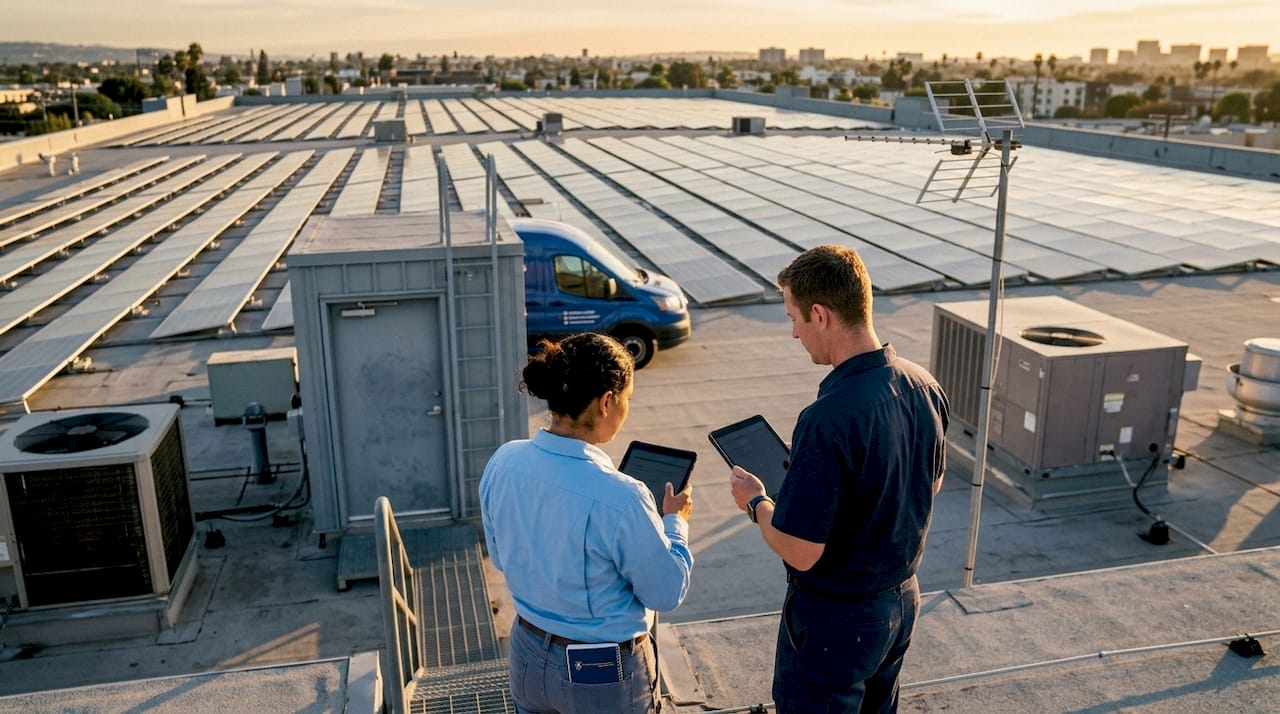
The math scales quickly. Every $50,000 in annual energy savings can add $1,000,000 to property value at a 5% exit yield. That figure assumes no change in gross income at all. The entire value creation comes purely from expense reduction.
Commercial solar system costs average $1.50–$2.20 per Watt peak as of mid-2026. At those cost levels and with the 30% federal Investment Tax Credit (ITC) applied, tax-adjusted paybacks fall in the 4–9 year range. The property continues generating savings for 25–30 years after payback. That is a long tail of pure NOI improvement.
The commercial solar installation cost is the starting point for any financial model. Owners who skip this step often undersize systems and leave savings on the table.
3. Peak demand charge reduction with solar-plus-battery systems
Utility bills for commercial properties contain two distinct charges: consumption charges and demand charges. Demand charges are calculated on the highest 15-minute power draw in a billing period. They can represent 30%–50% of a total commercial electricity bill. Solar alone does not eliminate demand charges because peak demand often occurs in the evening or on cloudy days.
Solar-plus-battery systems solve this problem. The battery stores solar generation during the day and discharges during peak demand windows, flattening the load profile. A 100 kW battery system can cut $12,000–$30,000 annually in demand charges alone. That range depends on local utility tariff structure and the property’s load profile.
Battery storage paired with solar often improves payback by 1–2 years in commercial properties with significant demand charges. That acceleration matters because faster payback means the NOI improvement compounds sooner. Owners evaluating this option should review the battery storage for solar options available in Florida before sizing a system.
Pro Tip: Request a 12-month interval data report from your utility before sizing a battery system. This load profile analysis identifies your actual peak demand windows and prevents oversizing, which is the most common and costly mistake in commercial battery projects.
4. Federal tax incentives that amplify solar’s NOI impact
The 30% federal ITC reduces the net cost of a solar installation by 30% in the year it is placed in service. Direct ownership captures this credit immediately. The depreciable basis for Modified Accelerated Cost Recovery System (MACRS) depreciation is then reduced by 50% of the ITC claimed, a calculation that requires careful modeling but still produces substantial tax benefit. Owners who understand this structure can review the full solar energy tax credits framework before committing to a structure.
Commercial solar installations achieve unlevered IRRs of 12%–20% when the ITC and MACRS depreciation are fully applied. That return profile is competitive with most value-add real estate strategies. Tax appetite is the key driver in choosing between direct ownership and a Power Purchase Agreement (PPA). Owners with strong taxable income benefit most from direct ownership. Those without sufficient tax appetite often find PPAs more practical.
PPAs typically offer energy rates 10%–30% below local utility rates with no upfront capital requirement. The tradeoff is that the developer, not the owner, captures the ITC and depreciation. Understanding a solar power purchase agreement in detail before signing prevents costly structural mismatches.
- Direct ownership: captures ITC, MACRS depreciation, and full long-term savings.
- PPA: zero capital outlay, predictable discounted energy rates, no tax benefit to owner.
- Tax equity partnerships: allow owners with limited tax appetite to monetize credits indirectly.
- Lease structures: similar to PPAs but with fixed payments rather than per-kilowatt-hour rates.
5. How solar improves tenant retention and lease re-gearing
Solar reduces tenant energy costs in buildings where owners pass through utility savings. In triple-net lease properties, solar lowers common area maintenance charges by reducing utility costs, making the property more competitive and attractive to tenants. Lower occupancy costs increase the likelihood that tenants renew rather than relocate.
Lease re-gearing is the underused opportunity here. Owners who install solar before a lease renewal negotiation hold a concrete financial benefit to offer tenants. In exchange for a documented reduction in energy costs, owners can negotiate rent escalations, extended terms, or both. Lease re-gear strategies that include solar stabilize tenant operating expenses and reduce vacancy risk simultaneously.
“Solar income is increasingly seen as stabilized revenue by institutional buyers, supporting yield compression and capital value uplift. The business case for solar has evolved into a valuation case where solar income streams are actively capitalized at acquisition.”
The multifamily solar feasibility process applies the same logic to residential portfolios. Tenants who pay lower energy bills stay longer. Lower vacancy rates protect NOI from the top line, while solar savings protect it from the expense side. Both effects move the same direction.
Sustainable building certifications like LEED and ENERGY STAR also become more accessible with solar installations. Certified buildings command measurable rent premiums and attract credit-quality tenants who prioritize operational cost certainty. That combination of higher rents and lower vacancy directly strengthens NOI.
6. How solar affects cap rate and property valuation at exit
Cap rate compression is the mechanism that converts NOI improvement into asset value. At a 5% cap rate, $100,000 of additional annual NOI adds $2,000,000 to property value. Solar creates NOI improvement through both expense reduction and added income, so both effects flow through to valuation.
Solar as a value-add strategy yields IRRs of 20%–30% in cases where paybacks fall under four years. Those returns reflect the combined effect of tax incentives, expense savings, and income capitalization. Institutional buyers increasingly underwrite solar income as a distinct line item, which means sellers can present it separately in offering memoranda to support higher asking prices.
The solar panel return on investment calculator is a practical starting point for modeling these exit scenarios. Owners who run this analysis before listing often discover that solar adds more value than a full interior renovation at a fraction of the cost.
Properties in Florida benefit from above-average solar irradiance, which increases annual generation and therefore annual savings. That geographic advantage makes the Florida market particularly well-suited to solar as a value-add play, which is exactly why Solar Energy Management focuses its practice here.
Key Takeaways
Solar energy improves property NOI through multiple simultaneous mechanisms, and each one compounds at exit through cap rate capitalization.
| Point | Details |
|---|---|
| Rooftop lease income | FTM solar leases add 3.7%–4.4% to property value as stable, capitalized income. |
| Expense reduction multiplier | Every $50,000 in annual energy savings adds $1,000,000 to value at a 5% cap rate. |
| Tax credit acceleration | The 30% ITC and MACRS depreciation produce unlevered IRRs of 12%–20% for direct owners. |
| Battery storage advantage | A 100 kW battery cuts $12,000–$30,000 annually in demand charges, improving payback by 1–2 years. |
| Tenant retention value | Solar-enabled lease re-gears reduce vacancy risk and support rent escalations simultaneously. |
What 20 years of solar consulting has taught us about NOI
Most property owners approach solar as an energy decision. The owners who extract the most value treat it as a financial structuring decision first. The energy savings are real, but the tax position, the lease structure, and the timing of installation relative to lease renewals determine whether a project delivers a 12% IRR or a 25% IRR.
The most common mistake I see is owners installing solar without first auditing their tax appetite. A property owner with significant passive losses and limited taxable income will not benefit from the ITC in the year it is claimed. That owner should seriously evaluate a PPA or a tax equity structure instead of direct ownership. Getting this wrong does not eliminate the savings, but it delays the financial benefit by years.
Battery storage is the second area where owners consistently underinvest. Demand charges are the hidden cost that solar alone cannot address. Properties with high peak demand, such as cold storage facilities, data centers, and large retail anchors, often find that the battery pays back faster than the solar array itself. The combined system changes the financial profile of the entire project.
The valuation conversation is shifting faster than most owners realize. Institutional buyers in 2026 are asking for solar income to be presented as a separate line item in rent rolls. Owners who have not structured their solar income this way are leaving negotiating leverage on the table at exit. The time to structure it correctly is before installation, not before listing.
— Solar Energy Management
Solar Energy Management: built for property NOI analysis
Solar Energy Management works directly with Florida property owners and investors who need more than a solar quote. The firm provides tailored energy solutions that include financial modeling, feasibility studies, tax credit analysis, and lease structuring guidance. Every engagement starts with a load profile analysis and a clear-eyed assessment of which ownership structure maximizes your specific tax position.

Whether you are evaluating a rooftop lease, a direct ownership installation, or a PPA for a commercial portfolio, Solar Energy Management builds the financial case before any equipment is specified. The firm’s commercial solar financing expertise covers the full range of structures available in the Florida market. Property owners who want to understand exactly how solar affects their cap rate and exit value can request a consultation directly through the Solar Energy Management website.
FAQ
How does solar directly increase property NOI?
Solar increases NOI by reducing operating expenses through lower utility bills and by adding rooftop lease income as a new revenue line. Both effects improve the NOI figure used to calculate property value at exit.
What is the difference between a PPA and direct ownership for NOI purposes?
Direct ownership captures the 30% ITC and MACRS depreciation, producing higher long-term returns for owners with tax appetite. A PPA provides discounted energy rates with no upfront capital but transfers the tax benefits to the developer.
How does solar affect cap rate and property value?
Solar improves NOI, and higher NOI produces higher asset value at any given cap rate. At a 5% cap rate, $50,000 in annual solar savings adds $1,000,000 to property value.
Can solar help with tenant retention in commercial properties?
Solar lowers tenant energy costs and common area maintenance charges, increasing the likelihood of lease renewal. Owners can also use documented energy savings as a negotiating tool to secure rent escalations during lease re-gears.
How long does it take for commercial solar to pay back in Florida?
Tax-adjusted paybacks for commercial solar fall in the 4–9 year range with the 30% ITC applied. Adding battery storage can shorten payback by 1–2 years in properties with high demand charges.


