
TL;DR:
- A Solar Energy Zone is a federal land area pre-screened for utility-scale solar development to reduce environmental conflicts. These zones offer faster permitting, lower land-use conflicts, and access to competitive leasing, aiding project finance. However, project approval still requires environmental review and stakeholder engagement, with political and infrastructural risks remaining.
A Solar Energy Zone (SEZ) is defined by the U.S. Bureau of Land Management as a tract of federal public land designated to support utility-scale solar production while minimizing conflicts with sensitive habitats and cultural resources. The Western Solar Plan, administered by the Department of Interior, established the SEZ framework to give developers a clear, pre-vetted path to large-scale solar development on public land. As of 2026, approximately 285,000 acres have been designated as priority SEZ land, forming part of nearly 31 million acres available for solar consideration across 11 western states. Understanding what is a solar energy zone matters because these designations directly shape where utility-scale solar gets built, how fast it gets permitted, and what financial returns developers can realistically expect.
What is a solar energy zone and how are they identified?
SEZ identification is not a simple administrative decision. The BLM conducts programmatic environmental impact studies before designating any zone, screening each candidate area for conflicts with wildlife corridors, cultural heritage sites, and competing land uses. This front-loaded analysis is what separates an SEZ from ordinary federal land open to solar applications.
The updated 2024 Western Solar Plan codified several hard exclusion criteria that disqualify land from SEZ status:
- Slopes exceeding 10% grade, which raise construction costs and reduce panel efficiency
- Protected cultural or wildlife sites under federal designation
- Lands more than 15 miles from existing or planned transmission corridors of 69 kV or higher
- Pristine, undisturbed ecosystems where new development would create disproportionate environmental harm
The transmission proximity rule is particularly consequential. Sites beyond 15 miles of major transmission infrastructure face significantly higher interconnection costs and longer approval timelines. That single criterion eliminates vast stretches of otherwise sunny federal land from consideration.
The 2024 update also expanded the program’s geographic reach from 6 to 11 western states, covering nearly 31 million acres for solar consideration. The BLM has approved 19 Solar Energy Zones across California, Nevada, Arizona, Colorado, Utah, and New Mexico. Several of these zones sit on previously disturbed lands, a deliberate choice that limits new environmental footprint while still capturing high-quality solar resources. The 2012 Western Solar Plan set the original framework, and the 2024 revision updated site selection criteria to reflect advances in solar technology and evolving environmental priorities.

What benefits do solar energy zones provide for developers?
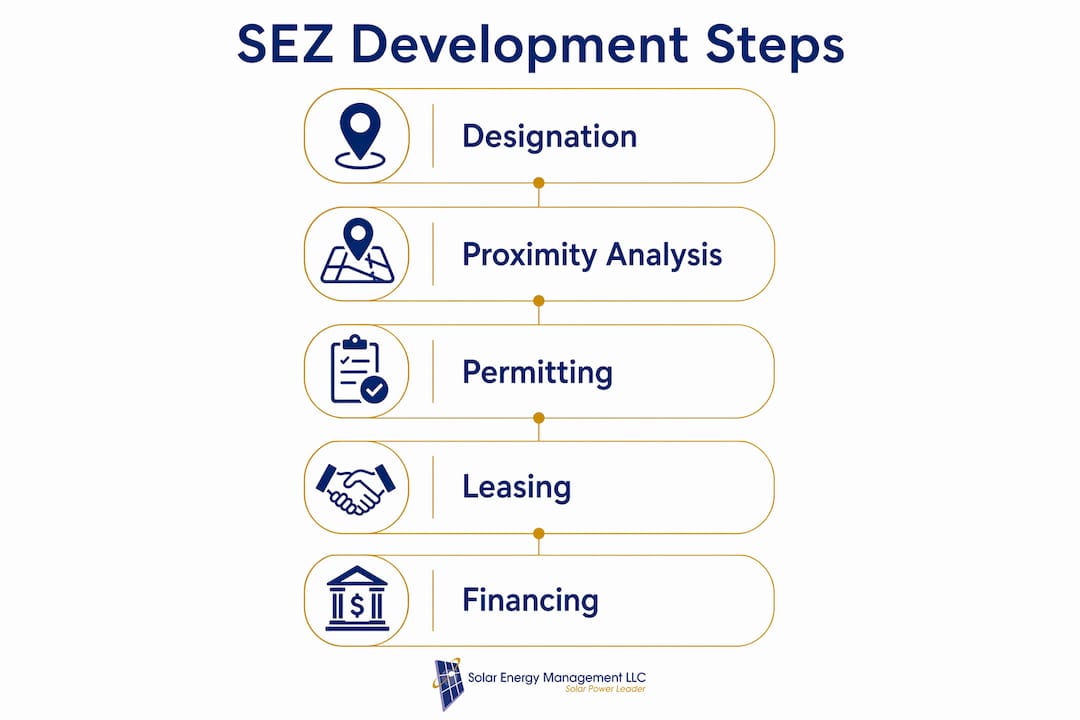
SEZs deliver three concrete advantages: faster permitting, reduced land-use conflict, and access to competitive leasing. Each one directly affects project economics and timeline certainty, which are the two variables that determine whether a utility-scale solar project gets financed.
Pro Tip: If you are evaluating a solar development opportunity on federal land, check whether the target parcel falls within a designated SEZ before committing to site control. The permitting timeline difference between SEZ and non-SEZ federal land can span several years.
The BLM’s competitive leasing process within SEZs demonstrates real market confidence in these designations. A 2025 auction at the Amargosa Valley SEZ generated over $105 million in bids. That figure reflects developer willingness to pay a premium for land where the regulatory path is clearer and the environmental baseline work is already done.
The benefits of solar energy zones extend beyond individual developers:
- Streamlined permitting: Pre-designation environmental analysis reduces the scope of site-specific review, compressing timelines.
- Reduced resource conflicts: BLM prioritization means fewer competing claims from grazing, mining, or recreation interests.
- Financial incentives: Competitive leasing creates transparent pricing and supports project financing by reducing regulatory risk.
- State and federal goal alignment: SEZs directly support Executive Orders on clean energy and state renewable portfolio standards.
- Community economic impact: Utility-scale projects within SEZs generate construction jobs, lease revenues, and long-term tax contributions to rural counties.
Solar financing options become more accessible when a project sits within an SEZ, because lenders and equity investors treat pre-vetted federal land as a lower-risk asset. The combination of streamlined permitting and competitive leasing creates a foundation that supports the commercial 30% investment tax credit and other financial structures that make large projects viable.
What challenges and limitations come with solar energy zones?
SEZ designation does not guarantee project approval. Every proposed utility-scale solar project must still complete site-specific environmental reviews under the National Environmental Policy Act (NEPA), involving multi-year permitting and stakeholder engagement. Developers who treat SEZ status as a green light routinely encounter costly delays.
“While SEZs make permitting more efficient, every proposed utility-scale solar project must undergo exhaustive environmental review, underscoring the importance of early and ongoing collaboration with regulators and communities.”
The practical challenges developers face within SEZs fall into several categories:
- NEPA compliance: Site-specific environmental impact assessments remain mandatory regardless of pre-designation work. These reviews examine local wildlife, hydrology, and cultural resources at a project-specific level.
- Multi-year timelines: Even with BLM prioritization, utility-scale projects routinely require three to seven years from application to construction authorization.
- Transmission interconnection: Proximity to a transmission corridor does not guarantee available capacity. Interconnection queue positions and grid upgrade requirements add cost and time.
- Political and administrative risk: Political changes introduce uncertainty in SEZ program continuity. A new administration can pause leasing, revise boundaries, or deprioritize zones that took years to designate.
- Stakeholder engagement complexity: Tribal nations, conservation groups, local governments, and grazing permittees all hold legitimate interests in federal land. Managing those relationships requires dedicated resources and early outreach.
- Iterative proposal revision: The iterative nature of SEZ permitting often requires developers to revise project designs based on technical, environmental, and community feedback across multiple review cycles.
The gap between SEZ designation and project completion is where most development risk lives. Treating the designation as a starting point rather than a finish line is the correct mental model for any organization entering this space.
How do solar energy zones fit into broader renewable energy planning?
SEZs are one tool within a larger set of renewable energy zone strategies that governments use to direct clean energy investment toward suitable land. The DOE’s broader siting framework for large-scale renewable projects treats SEZs as a federal-land-specific application of a concept that also appears in state-level renewable energy zones and international green energy zone programs.
The table below compares SEZs with related planning designations:
| Planning Designation | Governing Authority | Primary Purpose | Key Distinction |
|---|---|---|---|
| Solar Energy Zone (SEZ) | U.S. Bureau of Land Management | Utility-scale solar on federal land | Pre-vetted via programmatic EIS |
| State Renewable Energy Zone | State energy agencies | Broad renewable development | Varies by state; may include wind and storage |
| Green Energy Zone | Local or regional governments | Economic development via clean energy | Focuses on investment attraction and job creation |
| Designated Leasing Area (DLA) | BLM | Solar and wind on federal land | Broader than SEZ; less pre-screening |
SEZs connect directly to national climate commitments. Executive Orders directing federal agencies to support clean energy deployment treat BLM-managed western lands as a primary resource. The expansion from 6 to 11 states in the 2024 Western Solar Plan reflects that policy direction becoming operational. Green energy zones at the state and local level often mirror SEZ logic by pre-screening land, reducing permitting friction, and signaling to investors that a jurisdiction is open for renewable business. Rural communities near SEZs benefit from this investment signal through lease payments, property tax revenues, and construction employment that would not otherwise reach those areas.
Key Takeaways
Solar Energy Zones are the most direct federal mechanism for directing utility-scale solar development to pre-vetted public land, but they require rigorous environmental review and stakeholder engagement to move from designation to construction.
| Point | Details |
|---|---|
| SEZ definition | The BLM designates SEZs as federal land pre-screened for utility-scale solar with minimized environmental conflict. |
| Scale of the program | Nearly 31 million acres across 11 western states are available for solar consideration, with 285,000 acres in priority SEZ status. |
| Key selection criteria | Lands must be within 15 miles of 69 kV transmission lines and free of protected cultural or wildlife designations. |
| Benefits for developers | Competitive leasing, streamlined permitting, and pre-designation environmental work reduce financial and regulatory risk. |
| Persistent challenges | NEPA reviews, multi-year timelines, and political risk remain even after SEZ designation. |
The reality of SEZs that most coverage misses
Working with clients who are evaluating large-scale solar opportunities, I have seen a consistent pattern: organizations overestimate what SEZ designation actually delivers. The designation is a signal, not a guarantee. It tells you that the BLM has done preliminary homework on a parcel. It does not tell you that your specific project will sail through review.
The political risk dimension deserves more attention than it typically receives. The 2024 Western Solar Plan was finalized in the final weeks of an outgoing administration. That timing matters. Federal land policy is not permanent, and developers who build 10-year financial models on the assumption of stable SEZ boundaries are taking on risk they may not have priced correctly.
The opportunity I find genuinely compelling is the focus on previously disturbed lands within SEZ boundaries. Building on land that has already been altered reduces environmental opposition, shortens NEPA review scope, and often signals better infrastructure proximity. When Solar Energy Management evaluates solar development scenarios for clients, previously disturbed sites within or adjacent to SEZ boundaries consistently show the strongest feasibility profiles.
Proactive stakeholder engagement is not a compliance checkbox. It is the variable that most directly determines whether a project survives the iterative revision cycles that NEPA and community review generate. Organizations that invest in tribal consultation, conservation group dialogue, and local government relationships early in the process consistently reach construction authorization faster than those that treat engagement as a late-stage obligation.
— Solar Energy Management
How Solar Energy Management can support your solar planning
Solar development decisions carry real financial weight, whether you are evaluating a utility-scale opportunity or planning a commercial installation. Solar Energy Management brings over 20 years of independent consulting experience to help you assess feasibility, model financial returns, and navigate the regulatory considerations that determine project viability.
Our team provides comprehensive energy solutions for both residential and commercial clients, including financial modeling, feasibility studies, and system design guidance tailored to your specific situation. We also help clients plan battery storage systems that complement solar installations and support energy resilience. If you are ready to evaluate your solar options with an advisor who understands the full picture, contact Solar Energy Management for a consultation.
FAQ
What is a solar energy zone in simple terms?
A Solar Energy Zone is a tract of federal public land that the BLM has pre-screened and designated as suitable for utility-scale solar development. The designation streamlines permitting by completing environmental baseline work before any developer applies.
How many solar energy zones exist in the United States?
The BLM has approved 19 Solar Energy Zones across six western states, including California, Nevada, Arizona, Colorado, Utah, and New Mexico, with potential for future additions under the expanded 2024 Western Solar Plan.
Does an SEZ designation mean a solar project is automatically approved?
No. SEZ designation does not exempt a project from NEPA review or site-specific environmental assessment. Every proposed utility-scale solar project must still complete its own environmental impact study and stakeholder engagement process.
Why does transmission proximity matter for solar energy zones?
Lands within 15 miles of 69 kV or higher transmission lines receive priority designation because interconnection costs and delays increase significantly beyond that distance. Transmission proximity is one of the most decisive factors in project financial viability.
How do solar energy zones support renewable energy goals?
SEZs align federal land management with national clean energy targets by directing utility-scale solar investment to pre-vetted, suitable land. The 2024 expansion to 11 states and nearly 31 million acres of consideration reflects the federal commitment to scaling solar power development responsibly.
Recommended
- Future Energy Solutions Florida: 2026 Guide – Commercial + Residential Solar Power Florida
- Residential Solar Energy Florida A 2026 Homeowners Guide – Commercial + Residential Solar Power Florida
- Florida Solar System Design: Expert Guide 2026 – Commercial + Residential Solar Power Florida
- Solar Panel Tech in Florida: A Consultant’s Guide For 2026 – Commercial + Residential Solar Power Florida


