
A sustainability audit is a systematic review of an organization’s environmental, social, and governance (ESG) performance, measured against recognized standards to identify inefficiencies, compliance gaps, and opportunities for improvement. Think of it as the architectural blueprint review before construction: you would not build a high-rise without verifying every structural plan, and you should not run a business without verifying how your operations hold up against ESG benchmarks. Frameworks like GRI Standards and ISO 14001 define the criteria most audits use, giving the process a consistent, defensible structure.
What is a sustainability audit and why does it matter?
A sustainability audit systematically reviews a company’s environmental performance and social impact against ESG standards, with the explicit goal of uncovering inefficiencies, assessing regulatory compliance, and assuring stakeholders that sustainability commitments are real. The three core pillars are Environmental, Social, and Governance, and some frameworks add Economic factors as a fourth dimension.
The purpose goes well beyond checking a compliance box. Organizations use audit findings to:
- Identify energy waste and resource inefficiencies, excess emissions, and resource inefficiencies
- Verify alignment with regulations and voluntary standards like GRI and ISO 14001
- Demonstrate accountability to investors, regulators, and the public
- Set measurable baselines for year-over-year performance tracking
- Reduce reputational and financial risk tied to ESG shortfalls
For businesses in energy-intensive sectors, a sustainability audit often surfaces the clearest path to reducing operating costs through targeted efficiency improvements.
How to prepare and plan for a sustainability audit

Preparation determines whether an audit produces real change or just paperwork. Before any data is collected, you need a defined scope that ties directly to your business goals, whether that means focusing on carbon emissions, supply chain labor practices, or board-level governance accountability.
Key preparation steps include:
- Define scope and objectives: Decide which ESG pillars the audit will cover and align them with current business priorities.
- Select relevant metrics and standards: Choose frameworks such as GRI, ISO 14001, or SASB that match your industry and reporting obligations.
- Identify stakeholders: Involve department heads, operations managers, legal counsel, and, where applicable, external auditors from the start.
- Allocate resources: Assign dedicated personnel, budget for third-party verification if needed, and confirm data access rights.
- Establish a timeline: Set clear milestones for data collection, on-site inspection, analysis, and final reporting.
- Collect baseline documentation: Gather historical utility bills, labor records, and prior sustainability reports to establish performance benchmarks, as noted by Wolters Kluwer.
A poorly scoped audit wastes resources and produces findings too vague to act on. Specificity at the planning stage is what separates a useful audit from a compliance formality.
Data collection and on-site inspection in sustainability audits
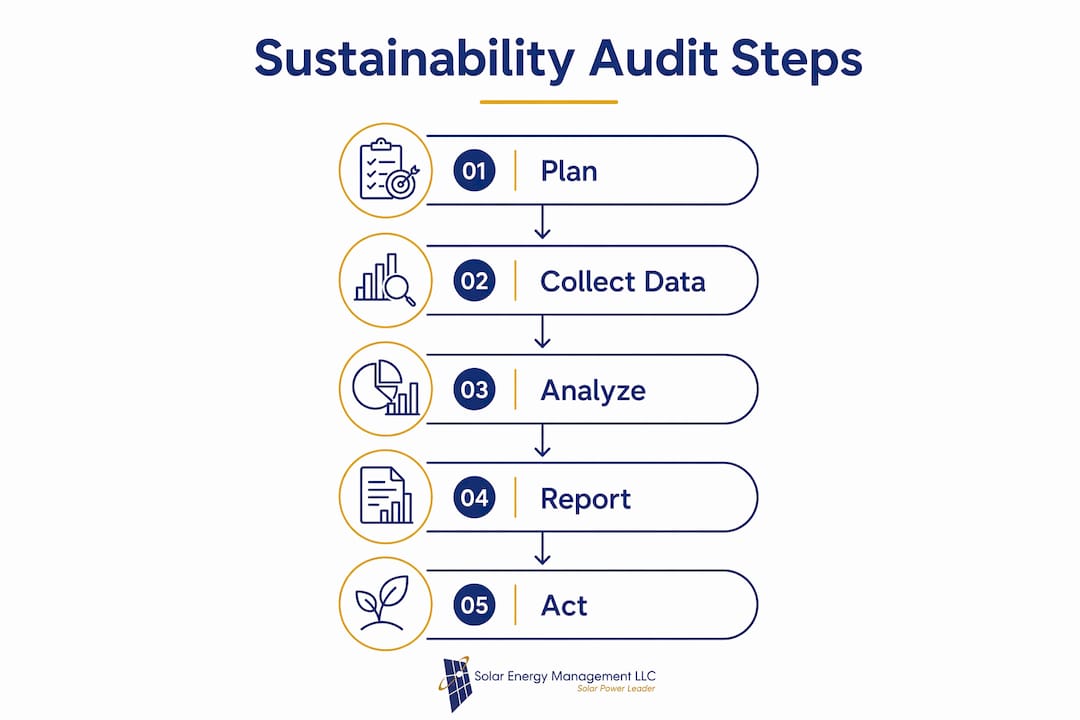
With scope defined, the audit moves into active data gathering. Quantitative sources typically include utility bills, fuel consumption logs, waste disposal records, water usage data, and payroll or labor practice documentation. Qualitative sources include employee interviews, supplier questionnaires, and governance policy reviews.
On-site inspections verify what records alone cannot confirm. An auditor walking a facility can spot unreported waste streams, observe actual safety practices, and assess whether documented procedures match real operations. This direct observation layer is where many compliance gaps first surface.
- Energy use: Meter readings, load profiles, and equipment efficiency ratings
- Waste and emissions: Disposal manifests, stack emissions data, and recycling rates
- Social practices: Workforce health and safety records, diversity metrics, and community impact data
- Governance documentation: Board policies, ethics codes, and internal control frameworks
Pro Tip: Integrate real-time monitoring systems, such as smart meters or IoT-connected sensors, into your facilities before the audit cycle begins. Continuous data capture eliminates the estimation errors that come from reconstructing consumption figures after the fact, and it gives auditors a far more defensible dataset.
For businesses already conducting a commercial energy audit, much of this data infrastructure is already in place, making the sustainability audit process significantly faster.

Analysis, reporting, and identifying gaps in sustainability audits
Raw data only becomes useful once it is benchmarked against ESG standards and compared to prior audit cycles. The analysis phase involves mapping actual performance against GRI indicators, ISO 14001 requirements, or sector-specific benchmarks, then identifying where the organization falls short.
Gap identification focuses on three categories: operational inefficiencies (energy waste, excess material consumption), compliance shortfalls (regulatory violations or near-misses), and governance weaknesses (inadequate disclosure, missing controls). Each gap gets prioritized by severity and feasibility of correction.
The audit report translates findings into a structured document that includes:
- An executive summary with key findings and risk ratings
- Detailed evidence for each identified gap
- Benchmarking comparisons against prior periods or industry peers
- Specific, prioritized recommendations for corrective action
- A stakeholder review section for management response and sign-off
Transparency in reporting is not optional. Research on 550 firms found that internal audits enhance environmental performance and compliance, while external audits boost profitability and investor trust. Objective, well-documented reporting is what makes either outcome possible.
How to build an action plan from audit findings
An audit report without a follow-through plan is just documentation. The action plan converts findings into SMART goals: Specific, Measurable, Achievable, Relevant, and Time-bound objectives that assign clear ownership and deadlines.
Effective action planning follows this sequence:
- Prioritize by impact and feasibility: Address high-severity, low-cost corrections first to build momentum and demonstrate early wins.
- Assign clear ownership: Each action item needs a named responsible party, not just a department.
- Set deadlines: Short-term actions for quick wins; medium-term for capital improvements.
- Budget resources: Identify whether corrections require capital expenditure, process changes, or training investments.
- Build in progress checkpoints: Monthly or quarterly reviews keep implementation on track and surface obstacles early.
For energy-related findings, an energy audit for businesses can translate audit recommendations into a concrete efficiency roadmap with measurable financial targets.
Why recurring audits drive continuous improvement
Most organizations make the mistake of treating a sustainability audit as a one-time event. The firms that see lasting improvement treat it as a recurring cycle, with each audit building on the data and benchmarks established by the last. Wolters Kluwer describes this as the difference between genuine operational culture change and superficial greenwashing.
Continuous improvement through recurring audits requires:
- Persistent data systems: KPI dashboards that track energy use, emissions, and social metrics year over year
- Governance integration: Embedding audit functions as a third-line defense within corporate governance, providing independent assurance to the board
- Adaptive scope: Updating audit criteria as regulations evolve and business operations change
- Stakeholder reporting cadence: Regular disclosure builds trust with investors, regulators, and communities over time
EY notes that shifting U.S. regulatory requirements are making sustainability reporting increasingly mandatory, meaning organizations that have already embedded recurring audit cycles are far better positioned to meet emerging disclosure standards without costly remediation.
Business benefits and strategic importance of sustainability audits
Sustainability audits deliver measurable financial and operational returns, not just compliance assurance. PwC identifies sustainability audits as strategic initiatives that reduce energy waste and improve supply chain efficiency, yielding concrete ROI. The business case covers several dimensions:
- Cost reduction: Identifying energy waste and process inefficiencies directly lowers operating expenses. A Florida energy efficiency audit often reveals savings opportunities that pay back audit costs within the first year.
- Investor confidence: External audits signal organizational transparency and maturity, factors that attract ESG-focused capital.
- Regulatory risk management: Proactive auditing reduces exposure to penalties as U.S. disclosure requirements tighten.
- Reputation and market positioning: Companies that demonstrate verified ESG performance attract environmentally conscious customers and partners.
- Governance accountability: Embedding audits within corporate governance provides independent assurance critical to long-term growth and market credibility.
Sustainability and profitability are not competing priorities. The audit process is the mechanism that aligns them.
What types of sustainability audits should you know about?
Sustainability audits divide into three primary types, each targeting a different ESG dimension.
Environmental audits assess energy consumption, carbon emissions, water usage, waste management, and biodiversity impact. These are the most common entry point, particularly for manufacturing, energy, and real estate businesses. Reviewing environmental benefits of operational changes often starts here.
Social audits examine labor practices, workforce safety, diversity and inclusion metrics, supply chain human rights compliance, and community impact. They are especially relevant for companies with complex supplier networks or significant public-facing operations.
Governance audits review board composition, executive accountability, ethics policies, anti-corruption controls, and internal reporting structures. These audits matter most to institutional investors and regulators evaluating organizational integrity.
Some frameworks, including certain GRI Standards applications, incorporate a fourth dimension covering economic sustainability, examining how financial decisions affect long-term community and environmental health. Each audit type can be conducted independently or combined into a full ESG review, depending on organizational priorities and stakeholder demands.
Key components and criteria evaluated in a sustainability audit
Regardless of type, every sustainability audit evaluates a consistent set of core components.
| Component | What gets evaluated |
|---|---|
| Energy consumption | Utility data, load profiles, efficiency ratings, renewable energy use |
| Emissions and carbon footprint | Scope 1 and 2 greenhouse gas data against regulatory thresholds |
| Waste management | Disposal records, recycling rates, hazardous material handling |
| Water usage | Consumption volumes, discharge quality, water stress exposure |
| Labor and social practices | Safety records, wages, diversity metrics, supplier conduct |
| Governance and ethics | Board policies, internal controls, disclosure practices, anti-corruption measures |
| Regulatory compliance | Alignment with EPA requirements, OSHA standards, and applicable state regulations |
| Stakeholder engagement | Community relations, investor communication, and grievance mechanisms |
The criteria used to evaluate each component come from the chosen framework. GRI Standards provide the broadest coverage across all ESG dimensions. ISO 14001 focuses specifically on environmental management systems. SASB standards are industry-specific, making them particularly useful for sector-level benchmarking. Choosing the right framework at the planning stage determines how comparable your results will be to peers and how credible they appear to external stakeholders.
Ready to put audit findings into action? Solar Energy Management helps Florida businesses translate sustainability and energy audit results into concrete efficiency improvements and solar solutions. Explore your energy solutions options or start with a Florida energy efficiency audit to build your baseline.

Key Takeaways
A sustainability audit is most valuable when treated as a recurring, data-driven process rather than a one-time compliance check, with findings translated into SMART action plans tied to measurable ESG benchmarks.
| Point | Details |
|---|---|
| Core definition | A sustainability audit reviews ESG performance against standards like GRI and ISO 14001 to identify gaps. |
| Research on 550 firms | Internal audits improve environmental compliance; external audits boost profitability and investor trust. |
| Three audit types | Environmental, Social, and Governance audits each target a distinct ESG dimension and can be combined. |
| Recurring cycles matter | Embedding audits in corporate governance as a third-line defense drives lasting operational culture change. |
| U.S. regulatory pressure | EY identifies tightening U.S. disclosure requirements as a key reason to build proactive audit cycles now. |
FAQ
What are sustainability audits?
A sustainability audit is a systematic evaluation of an organization’s environmental, social, and governance (ESG) practices against recognized standards such as GRI or ISO 14001, designed to identify inefficiencies, compliance gaps, and improvement opportunities.
What are the three essential areas of a sustainability audit?
The three core areas are Environmental (energy, emissions, waste, water), Social (labor practices, safety, diversity), and Governance (board accountability, ethics policies, internal controls). Some frameworks add Economic sustainability as a fourth dimension.
What are the four types of sustainability?
Sustainability is commonly divided into Environmental, Social, Governance, and Economic dimensions. In audit practice, these map directly to the ESG pillars plus economic impact assessments that evaluate how financial decisions affect long-term community and environmental health.
How often should a sustainability audit be conducted?
Most organizations conduct formal sustainability audits annually, though high-impact industries or those facing regulatory scrutiny often run internal reviews quarterly and reserve full external audits for annual or biennial cycles.
What standards guide a sustainability audit?
The most widely used frameworks in the U.S. are GRI Standards for broad ESG coverage, ISO 14001 for environmental management systems, and SASB standards for industry-specific benchmarking. Choosing the right framework depends on your sector, stakeholder expectations, and reporting obligations.
Recommended
- Commercial Energy Audit: A Florida Business Guide – Commercial + Residential Solar Power Florida
- A Guide to Your Florida Energy Efficiency Audit – Commercial + Residential Solar Power Florida
- Energy Audit for Businesses Your Florida Strategy Guide – Commercial + Residential Solar Power Florida
- Solar Feasibility Study Explained: Your 2026 Guide – Commercial + Residential Solar Power Florida


