
TL;DR:
- Solar energy offset measures how much of your annual electricity consumption your solar system produces. It is calculated by dividing annual solar production by total annual usage and multiplying by 100. The ideal offset target varies based on utility policies and system sizing considerations, affecting savings and energy independence.
Solar energy offset is defined as the percentage of your total annual electricity consumption that your solar system produces. The offset formula is straightforward: divide annual solar production in kilowatt-hours by annual home electricity usage in kilowatt-hours, then multiply by 100. A result of 80% means your panels generate energy equal to 80% of what you use each year. Understanding this metric is the foundation of every sound solar investment decision, whether you are a homeowner in Tampa or a commercial property manager in Orlando. Solar Energy Management uses this metric as the starting point for every feasibility study and system design it delivers to Florida clients.
What is solar energy offset and how is it calculated?

Solar offset, the industry’s standard term for this metric, tells you exactly how much of your electricity demand your panels can match over a full year. The calculation does not measure real-time performance. It compares total annual production against total annual consumption, which smooths out seasonal swings and gives you a reliable planning number.
Here is what different offset levels mean in practice:
- 100% offset: Your panels produce as much energy as you consume annually. You still draw from the grid at night and export surplus during the day.
- 80–90% offset: A common target for cost-effective residential systems. You cover most of your bill while avoiding oversizing.
- Over 100% offset: Your system produces more than you use. Excess energy exports to the grid, but compensation rates vary widely by utility.
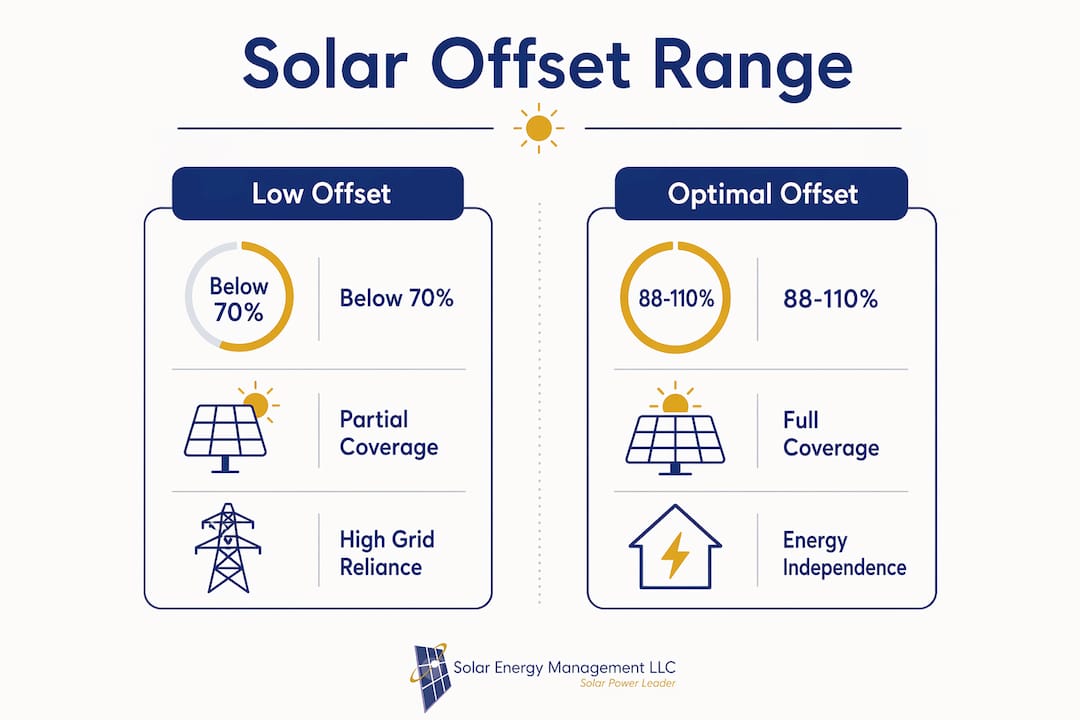
- Below 70% offset: Your panels make a meaningful dent in your bill, but grid dependence remains high.
Average offset targets range from 88–110% depending on location and local utility policies. That range reflects the reality that the “right” number is not universal. It depends on your roof space, your utility’s compensation rules, and your financial goals.
| Offset Level | What It Means | Typical Use Case |
|---|---|---|
| Below 70% | Partial coverage, high grid reliance | Limited roof space or budget |
| 70–85% | Strong savings, cost-effective sizing | Net billing utility areas |
| 88–100% | Near-full coverage, balanced ROI | Full retail net metering areas |
| Over 100% | Surplus generation, export credits | Large roofs, EV charging planned |
The formula works best when you use 12 months of actual utility bills to establish your baseline. One year of data captures seasonal peaks, like Florida’s summer air conditioning load, that a single month would miss entirely.
What does solar offset mean for financial savings and energy independence?
A 100% solar offset does not mean a zero electric bill. Fixed utility fees of $10–$30 per month remain on your bill regardless of how much your panels produce. These are mandatory connection charges that cover grid maintenance, and no solar system eliminates them.
Net metering is the mechanism that makes offset financially meaningful. When your panels produce more than you use at a given moment, excess electricity flows to the grid. Your utility credits that export against future consumption. The credit rate determines how much financial value you recover from surplus production.
Key points about net metering and offset value:
- Full retail net metering credits your exports at the same rate you pay for grid electricity, typically around $0.15/kWh.
- Net billing credits exports at wholesale or avoided cost rates, often $0.02–$0.08/kWh, which significantly reduces the financial return on excess production.
- True-up billing settles your account annually. Mismatches between production and consumption can produce unexpected year-end charges if you did not plan for your utility’s billing cycle.
True energy independence requires more than a high offset percentage. Without battery storage, you rely on the grid every night. Net metering provides a financial workaround, but it is not the same as generating and consuming your own power around the clock.
Pro Tip: Size your system to cover your actual consumption, not to maximize production. Oversizing under a net billing policy means you export large volumes of energy at low wholesale rates, which extends your payback period unnecessarily.
How do local utility net metering policies influence optimal solar offset?
Net metering policy is the single biggest variable in determining your ideal offset target. Two homeowners with identical roofs and consumption profiles can have very different optimal system sizes depending on which utility serves them.
Credit rates vary from roughly $0.15/kWh under full retail net metering to $0.02–$0.08/kWh under net billing or avoided cost structures. That gap changes the math on system sizing dramatically. Under full retail net metering, producing 110% of your consumption is financially sensible because every exported kilowatt-hour earns near-retail value. Under net billing, that same surplus earns a fraction of its cost, making oversizing a poor investment.
| Net Metering Type | Export Credit Rate | Recommended Offset Target |
|---|---|---|
| Full retail net metering | ~$0.15/kWh | 90–110% |
| Net billing | ~$0.05–$0.08/kWh | 70–85% |
| Avoided cost | ~$0.02–$0.04/kWh | 70% or below |
Installers recommend 70–85% offsets under net billing policies to avoid generating excess energy that earns minimal compensation. This is a counterintuitive finding for many property owners who assume bigger is always better. The data says otherwise.
Florida utilities operate under different compensation frameworks. Duke Energy and TECO each have distinct rules that affect how your Florida net metering credits translate into bill reductions. Knowing your utility’s specific structure before sizing your system is not optional. It is the difference between a system that pays back in 7 years and one that takes 12.
Pro Tip: Request your utility’s current net metering tariff before you finalize system size. Policies change, and a system sized for 2023 rules may underperform under 2026 compensation structures.
What role does battery storage play in enhancing solar offset benefits?
Battery storage changes the economics of solar offset in a fundamental way. Without batteries, a solar-only system self-consumes roughly 30% of what it produces. The rest exports to the grid during daylight hours when you may not be home. Batteries increase self-consumption from 30% to 70–80% by storing midday surplus for use during evening peak hours.
That shift matters most in utility areas with low export credit rates. If your utility pays $0.03/kWh for exports but charges you $0.15/kWh for grid power at night, every kilowatt-hour you store and self-consume is worth five times more than what you would earn by exporting it.
Key benefits of pairing battery storage with solar:
- Higher self-consumption: You use more of what you produce, reducing grid purchases during expensive peak rate periods.
- Backup power: Batteries provide electricity during outages, which is a practical concern in Florida’s hurricane-prone environment.
- Reduced grid reliance: A well-sized battery bank can cover your evening load entirely, bringing you closer to genuine energy independence.
- Better ROI under net billing: When export rates are low, storing surplus rather than exporting it improves your financial return significantly.
The federal Investment Tax Credit applies to battery storage systems installed alongside solar, which reduces the upfront cost. For commercial clients, Solar Energy Management models battery integration as part of every financial feasibility study to confirm the payback period before any commitment is made. Pairing solar with energy-efficient upgrades like pool equipment further reduces your total load, which means your existing solar offset covers a larger share of your actual consumption.
Key Takeaways
Solar energy offset is the most reliable metric for sizing a solar system correctly, and the optimal target depends directly on your utility’s net metering policy rather than a universal percentage.
| Point | Details |
|---|---|
| Core definition | Solar offset equals annual solar production divided by annual consumption, expressed as a percentage. |
| 100% offset misconception | A 100% offset still leaves fixed utility fees of $10–$30/month on your bill. |
| Net metering drives sizing | Full retail metering supports 90–110% offset; net billing favors 70–85% to avoid low-value exports. |
| Battery storage multiplier | Adding batteries raises self-consumption from 30% to 70–80%, improving ROI under low export rate policies. |
| Plan for future loads | Sizing for anticipated EV charging or heat pump use during initial install costs less than expanding later. |
What Solar Energy Management has learned about offset targets in Florida
After working with Florida property owners for over 20 years, the most consistent mistake I see is treating solar offset as a goal rather than a tool. Clients arrive wanting “100% offset” because it sounds complete. What they actually want is the lowest net energy cost over the life of the system. Those two targets often point to different system sizes.
Florida’s net metering landscape has shifted considerably. Utilities have moved toward net billing structures that pay far less for exported energy than they charge for grid power. Under those rules, a system sized for 100% offset frequently generates surplus that earns minimal credit. The financially sound choice is often a smaller system paired with a battery, not a larger system exporting to the grid at wholesale rates.
The other planning gap I see regularly involves future energy loads. Clients who buy an EV two years after installation wish they had sized for it from the start. Adding panels later means new permits, new labor, and potentially new interconnection applications. A few extra panels at initial install costs a fraction of what an expansion costs later.
My honest recommendation: treat your offset target as a financial decision, not a technical one. Run the numbers against your utility’s actual compensation structure, account for loads you expect to add in the next five years, and size accordingly. The goal is not to produce the most solar energy. The goal is to reduce your total energy cost as much as possible over the system’s lifetime.
— Solar Energy Management
Solar Energy Management can help you size your system right
Getting your solar offset target right from the start requires more than an online calculator. It requires a clear picture of your utility’s net metering rules, your current and projected energy loads, and how battery storage changes the financial equation.

Solar Energy Management provides independent consulting for residential and commercial clients across Florida, including comprehensive energy solutions that cover system sizing, battery integration, and financial modeling. The firm’s 20-plus years of Florida-specific experience means your offset target is built around your actual utility tariff, not a national average. If you want to know whether your current or planned system is sized for maximum return, Solar Energy Management offers the feasibility analysis to answer that question with confidence.
FAQ
What is solar energy offset in simple terms?
Solar energy offset is the percentage of your annual electricity use that your solar panels produce. A system with 80% offset covers 80% of your yearly consumption through solar generation.
Does a 100% solar offset eliminate your electric bill?
No. Fixed utility connection fees of $10–$30 per month remain regardless of your offset level, and nighttime grid usage still applies without battery storage.
What solar offset percentage should I target?
The right target depends on your utility’s net metering policy. Full retail net metering supports 90–110% offset, while net billing structures favor 70–85% to avoid exporting energy at low wholesale rates.
How does battery storage affect solar offset value?
Batteries increase solar self-consumption from roughly 30% to 70–80% by storing daytime surplus for evening use. This improves financial returns, especially under utilities that pay low export credit rates.
How do solar offsets reduce carbon emissions?
Every kilowatt-hour your solar system produces displaces a kilowatt-hour that would otherwise come from fossil fuel generation. Higher offset percentages mean greater greenhouse gas reductions over the system’s lifetime.
Recommended
- What Is a Solar Energy Zone? Your 2026 Guide – Commercial + Residential Solar Power Florida
- Florida Solar System Design: Expert Guide 2026 – Commercial + Residential Solar Power Florida
- Future Energy Solutions Florida: 2026 Guide – Commercial + Residential Solar Power Florida
- Overview of Solar As An Energy Platform – Commercial + Residential Solar Power Florida


