
Solar energy procurement is the strategic process by which organizations source and contract for solar-generated electricity to meet sustainability goals and manage energy costs. Rather than simply “going solar,” procurement is a deliberate, structured discipline that requires evaluating contract types, market rules, financial models, and regulatory incentives before committing to any agreement. For U.S. businesses in 2026, getting this process right can mean the difference between locking in predictable energy costs for two decades and inheriting a contract that underperforms financially.
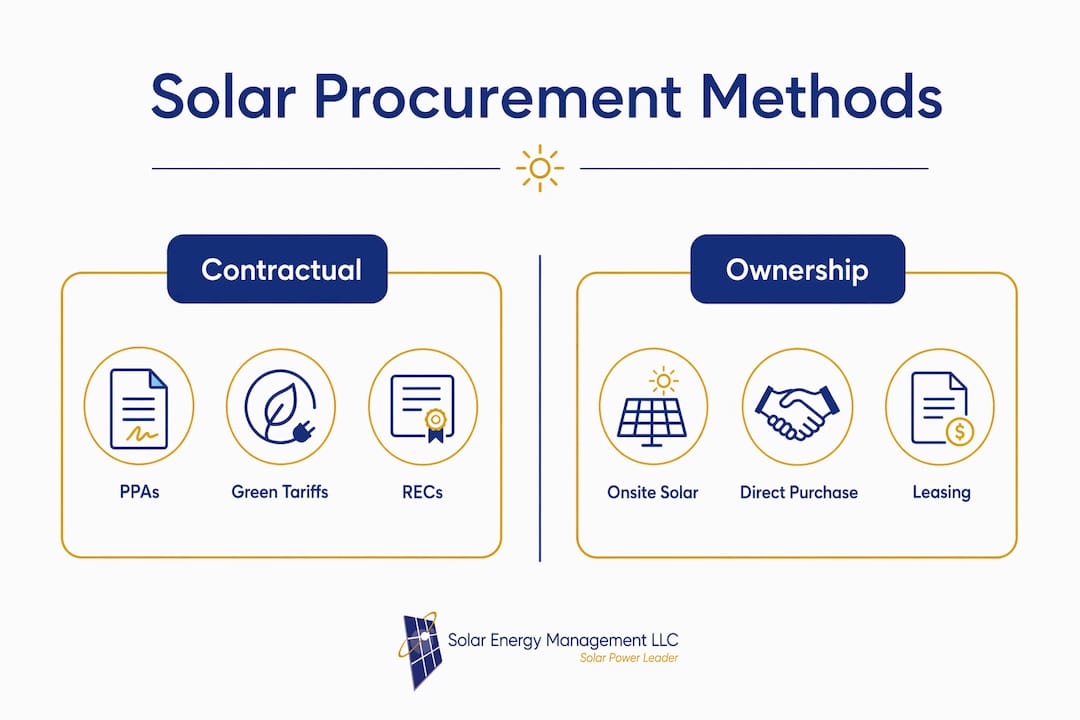
The major procurement methods available to organizations include:
- Onsite solar ownership: The organization finances, owns, and operates a solar system on its own property.
- Power Purchase Agreements (PPAs): A third-party developer owns and operates the system; the buyer purchases the electricity output at a contracted rate.
- Green Tariff Programs: Utility-offered programs that allow customers to source a portion of their electricity from renewable generation.
- Renewable Energy Certificates (RECs): Tradeable certificates representing one megawatt-hour of renewable electricity, purchased separately from physical power delivery.
- Community solar: Shared off-site solar projects where subscribers receive bill credits proportional to their share of the system’s output.
Which method fits your organization depends heavily on your local electricity market structure, whether regulated or deregulated, your available capital, and your tax position.
What are the main solar energy procurement methods?
Power Purchase Agreements
A PPA contract structure transfers system ownership and all maintenance responsibility to the developer. The buyer pays only for the electricity generated, typically at a fixed or escalating rate over a term of 15–25 years. No upfront capital is required, which makes PPAs attractive for organizations without the balance sheet capacity or tax appetite to own a system outright. The trade-off is that the developer captures the Investment Tax Credit (ITC) and depreciation benefits, not the buyer.

Pros: Zero upfront cost, immediate savings potential, no maintenance burden, predictable pricing.
Cons: Long contract terms create exit risk, buyer does not capture federal tax incentives, rate escalators can erode savings over time.
Green tariff programs
Green tariff programs are utility-administered options that let commercial customers pay a premium to source electricity from specific renewable projects, often large-scale solar or wind farms. They are most common in regulated markets where direct physical PPAs are not feasible. The buyer does not own any generation asset and faces no interconnection complexity.
Pros: Simple to execute, no capital required, available in regulated markets.
Cons: Limited price control, program availability varies by utility, renewable attribute ownership terms vary.
Onsite solar ownership
Direct ownership means the organization finances, installs, and operates the solar system itself. This path captures the full 30% Investment Tax Credit and MACRS accelerated depreciation, which together can substantially reduce net system cost. Total cost of ownership analysis, accounting for panel degradation rates of roughly 0.5–1% annually, operations and maintenance expenses, and contract escalators, provides a far more accurate financial picture than a simple cost-per-watt comparison.

Pros: Full tax benefit capture, long-term cost certainty, asset ownership.
Cons: Capital intensive, maintenance responsibility falls on the buyer, requires internal project management capacity.
Renewable Energy Certificates
RECs allow organizations to claim renewable energy usage without receiving physical solar electricity. One REC represents one megawatt-hour of renewable generation and can be purchased bundled within a power contract or separately on the open market. They serve both compliance obligations and voluntary sustainability reporting goals, making them a flexible tool for organizations that cannot install onsite generation or access a PPA.
Pros: Flexible, low cost, available in any market.
Cons: Do not reduce physical electricity costs, face scrutiny from sustainability auditors when unbundled from physical delivery.
Pro Tip: If your organization operates in a regulated utility territory, RECs bundled with a green tariff program often deliver the cleanest sustainability claim at the lowest administrative burden.
Best practices for solar energy contract development
A well-structured contract development process protects your organization from pricing risk, production shortfalls, and legal exposure. The EPA’s green power partnership recommends keeping a formal Request for Proposal (RFP) open for 4–6 weeks, with clear evaluation criteria and detailed technical and financial requirements, to attract competitive bids and give vendors enough time to price accurately.
Key internal stakeholders who must be aligned before an RFP goes out include:
- Energy procurement lead: Owns the technical specifications and vendor evaluation.
- Finance and accounting: Models total cost of ownership, tax implications, and budget impact.
- Legal counsel: Reviews contract terms, liability clauses, and termination provisions.
- Facilities management: Confirms site readiness, structural capacity, and operational constraints.
- Risk management: Assesses counterparty risk and production guarantee adequacy.
Establishing a cross-functional project team early prevents the approval delays that derail procurement timelines. Every contract should specify production guarantees, pricing escalators, term length, maintenance responsibilities, and REC ownership. Ambiguity on any of these points creates disputes years into the agreement.
Pro Tip: Require vendors to submit a detailed energy production model, not just a nameplate capacity figure. A model that accounts for local shading, panel orientation, and degradation gives you a defensible baseline for production guarantee negotiations.
Critical market context and preliminary considerations
Whether your organization operates in a regulated or deregulated electricity market determines which procurement paths are even available to you. In deregulated markets, buyers can execute physical PPAs where solar electricity is delivered directly to their account, or virtual PPAs (VPPAs) where the financial settlement is based on a reference price rather than physical delivery. Regulated markets typically restrict direct physical procurement, pushing buyers toward green tariff programs or RECs.
Timeline is the factor most organizations underestimate. Utility interconnection alone can take 8–24 weeks, and that window sits on top of permitting, engineering, and construction. Interconnection is often the critical path: some utilities require costly infrastructure upgrades depending on local grid capacity and queue position, so an early application during contract negotiation prevents expensive surprises.
Key figure: Utility interconnection timelines of 8–24 weeks are common for commercial solar projects, making early application one of the highest-leverage actions in the entire procurement process.
Federal incentives shape the ownership decision more than any other single variable. Businesses with sufficient tax liability benefit most from direct ownership, capturing the 30% ITC and MACRS depreciation. Organizations without that tax capacity are better served by a PPA, where the developer monetizes the tax benefits and passes some savings through as a lower electricity rate.
Pro Tip: File your interconnection application as soon as a site is identified, even before finalizing contract terms. Queue position is first-come, first-served at most utilities, and waiting until after contract execution can add months to your go-live date.
Real-world examples of solar procurement in the U.S.
American universities have been among the most active solar procurement buyers, frequently using competitive RFPs to secure long-term PPAs for off-site solar farms. The U.S. Department of Energy’s National Renewable Energy Laboratory has documented common pitfalls universities encounter when writing solar RFPs, including vague technical specifications and unclear REC ownership terms, both of which inflate bid prices and create post-award disputes.
Municipal governments represent another active procurement segment. Many cities have used the EPA’s RFP template framework to procure rooftop solar on public buildings, combining onsite generation with green tariff subscriptions to meet 100% renewable electricity targets. The key lesson from these projects: organizations that issued a Request for Information before the formal RFP consistently received better-structured bids because vendors understood site constraints in advance.
For commercial solar buyers in the private sector, manufacturing facilities and distribution centers with large roof areas and high daytime electricity loads have seen the strongest financial returns from onsite ownership. Their load profiles align well with solar generation hours, reducing the need to export excess power back to the grid at unfavorable net metering rates.
How federal and state incentives shape procurement decisions
The 30% federal Investment Tax Credit remains the most powerful financial lever in U.S. solar procurement. It applies to direct ownership and third-party-owned systems alike, though in a PPA structure the developer captures it rather than the buyer. For organizations evaluating ownership versus a PPA, the ITC’s value relative to their effective tax rate is often the deciding factor.
MACRS accelerated depreciation compounds the ITC benefit for direct owners, allowing the system’s cost basis to be depreciated over five years rather than the system’s full useful life. Together, these two incentives can reduce the net cost of ownership substantially, though the exact impact depends on the buyer’s tax position and the depreciation schedule applied.
State-level incentives vary considerably. Florida, for example, offers a property tax exemption on the added value solar installations bring to commercial properties, reducing the carrying cost of ownership. Some states also offer production-based incentives or additional tax credits that stack on top of the federal ITC. Reviewing solar financing options specific to your state before selecting a procurement method prevents leaving money on the table.
Net metering policies at the state level also affect the economics of onsite solar. States with full retail-rate net metering make onsite ownership more attractive; states that have moved to avoided-cost compensation reduce the value of excess generation, which shifts the financial calculus toward right-sizing the system rather than maximizing output.
How to evaluate solar energy vendors and contracts
Vendor evaluation goes beyond price per kilowatt-hour. The criteria that matter most for long-term procurement success include:
- Financial stability of the developer: A PPA is a 15–25 year relationship. A developer that cannot secure project financing or exits the market mid-contract creates serious operational risk.
- Production guarantee structure: Look for guarantees backed by liquidated damages, not just best-effort language. Understand how production shortfalls are calculated and compensated.
- Escalator rate: A fixed annual escalator of 1–2% looks manageable today but compounds significantly over a 20-year term. Model the total payment stream, not just year-one savings.
- REC ownership: Confirm in writing whether RECs are bundled with the electricity purchase or retained by the developer. Retaining RECs is what allows you to make a credible renewable energy claim.
- Buyout and transfer provisions: Understand the buyout price formula if your organization relocates, sells the property, or wants to exit the contract early.
- References from comparable projects: Request references from buyers with similar load profiles, building types, and market locations, not just the developer’s marquee clients.
For vendor selection guidance specific to your market, working with an independent consultant who has no financial stake in which developer wins the contract gives you an unbiased evaluation framework. Solar Energy Management provides exactly this kind of independent analysis, with over 20 years of experience in financial modeling and feasibility assessment for commercial clients.
If you are ready to move from evaluation to execution, Solar Energy Management’s energy solutions team can guide your organization through every stage of the procurement process, from market analysis and RFP development to contract negotiation and system commissioning.

Get a Solar Quote Now and let Solar Energy Management’s independent consultants build the financial model your procurement decision deserves.
Key Takeaways
Solar energy procurement requires matching the right contract structure to your organization’s tax position, market type, and capital availability before any RFP goes out.
| Point | Details |
|---|---|
| Market type determines options | Deregulated markets allow physical and virtual PPAs; regulated markets typically limit buyers to green tariffs and RECs. |
| PPAs run for long contract terms typically spanning multiple decades | Contract terms are long, so escalator rates and buyout provisions deserve as much scrutiny as year-one pricing. |
| Interconnection can take several weeks to a few months, making early application the highest-leverage action to avoid timeline delays. | Filing the interconnection application early is the single highest-leverage action to avoid timeline delays. |
| ITC favors direct owners | The 30% Investment Tax Credit goes to the system owner; in a PPA, the developer captures it, not the buyer. |
| RFP open period matters | The EPA recommends keeping the RFP open several weeks to attract competitive bids and allow accurate vendor pricing. |
FAQ
What is solar procurement?
Solar procurement is the process by which an organization strategically sources and contracts for solar-generated electricity, using methods such as PPAs, green tariffs, onsite ownership, or RECs to meet energy cost and sustainability goals.
How does energy procurement work for solar?
An organization identifies its energy needs and market context, issues an RFP to qualified developers or utilities, evaluates bids against financial and technical criteria, and executes a contract that defines pricing, term length, production guarantees, and REC ownership.
Why are some businesses moving away from solar panels?
Most businesses that exit solar contracts do so because of poorly structured agreements, specifically unfavorable escalator rates, inadequate production guarantees, or buyout provisions that make early termination prohibitively expensive, not because solar itself underperforms.
What is the 20% rule for solar?
The 20% rule recommends designing a solar array to generate 120% of average annual consumption. This buffer compensates for inverter losses, panel degradation, shading, weather variability, and system inefficiencies, ensuring reliable energy coverage over the system’s life.
Recommended
- Solar Energy Tax Credits for Businesses: 2026 Guide – Commercial + Residential Solar Power Florida
- Solar Energy Vendor Selection Guide for 2026 – Commercial + Residential Solar Power Florida
- Future Energy Solutions Florida: 2026 Guide – Commercial + Residential Solar Power Florida
- Commercial Solar Installation Cost in Florida: A 2026 Guide – Commercial + Residential Solar Power Florida


