
TL;DR:
- Solar consulting is essential for businesses to accurately evaluate, design, and manage solar projects, reducing financial and technical risks. It helps model utility tariffs, load profiles, and avoid costly delays caused by engineering oversights or grid constraints, ensuring optimal system performance and savings. Engaging a consultant early maximizes project success and long-term cost reductions.
Solar consulting is defined as the independent, expert-led process of evaluating, designing, and managing commercial solar investments to align them with a business’s operational and financial goals. Understanding why businesses need solar consulting starts with one fact: a vendor selling panels has a different incentive than an advisor whose only job is to protect your capital. Solar Energy Management has spent over 20 years in the Florida market watching businesses sign contracts that looked attractive on paper and underperformed for decades. The difference between a profitable solar project and a costly one almost always comes down to whether an independent consultant was involved before the ink dried.
Why businesses need solar consulting to reduce financial risk
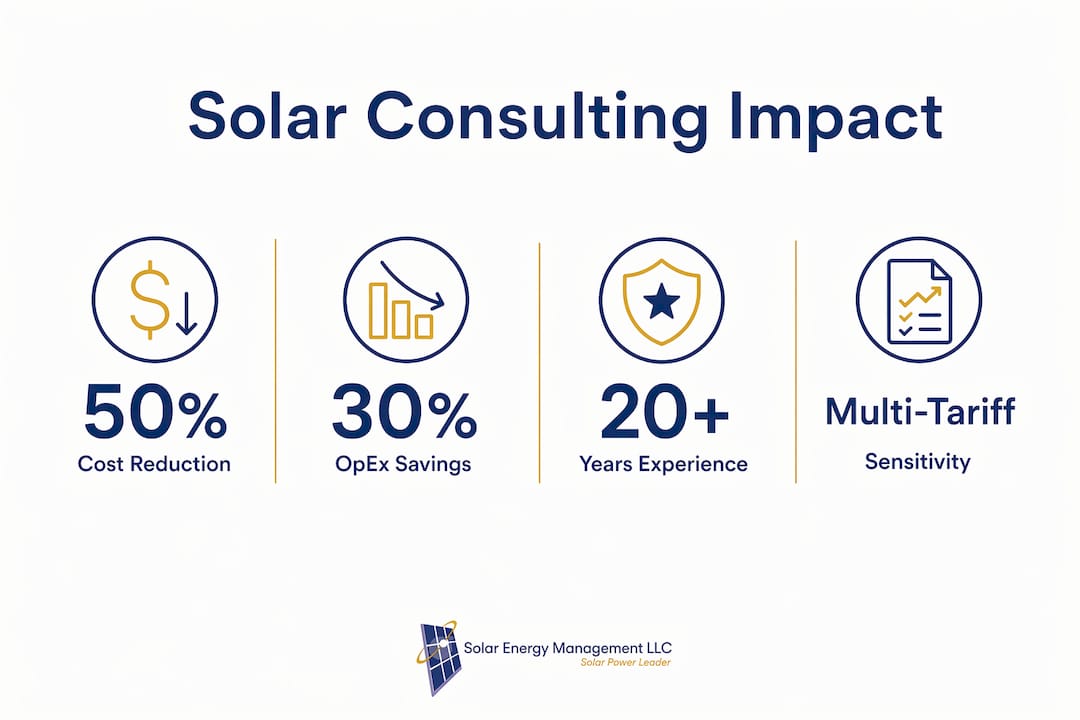
Grid electricity prices do not move in straight lines. Demand charges spike, tariff structures shift, and fuel adjustment clauses add costs that most business owners never anticipated when they budgeted for energy. Businesses using independent solar consulting can reduce their exposure to grid price fluctuations by 50% over five years. That figure reflects the combined effect of locking in generation costs, reducing peak demand charges, and designing systems that match actual load patterns rather than estimated ones.
Vendor-driven proposals rarely account for this complexity. A solar installer’s job is to sell and install equipment. An independent consultant’s job is to model your utility tariff, stress-test the financial assumptions, and tell you whether the project makes sense before you commit. Those are fundamentally different services.
The financial case becomes even clearer when you factor in the commercial 30% investment tax credit, which Solar Energy Management builds into every financial model it produces. Without accurate modeling of avoided costs and tariff impacts, businesses routinely underestimate payback periods and overestimate returns.
- Load profile analysis maps your actual consumption hour by hour, revealing when demand charges hit hardest.
- Tariff impact modeling shows exactly how your utility bill changes under different solar scenarios.
- Avoided-cost scenario modeling is essential for project viability and investor confidence.
- Sensitivity analysis tests how the project performs if electricity prices rise, fall, or restructure.
Pro Tip: Request a multi-tariff sensitivity analysis from your consultant before signing any solar contract. If the project only works under one pricing scenario, it carries more risk than the proposal suggests.
What does a solar consultant do for your business?
A solar consultant performs a structured sequence of assessments, each designed to catch problems before they become expensive. Think of it like the architectural and engineering review before a contractor breaks ground on a building. Skipping those reviews does not make the building cheaper. It makes it dangerous.
The EPA identifies early-stage feasibility studies as a critical checkpoint before committing to any renewable energy contract. A thorough feasibility assessment covers structural capacity, electrical infrastructure, consumption patterns, and grid connection constraints. Each of those factors can independently disqualify a project or require a redesign.
“A solar project must match the building, load, grid, and commercial goals. Independent consultants evaluate site-specific constraints such as load profile, roof condition, grid capacity, and business objectives to find the optimal solar system — not the largest one a vendor can sell.”
The core services a qualified consultant delivers include:
- Feasibility assessment. Structural review of the roof, electrical panel capacity, grid interconnection feasibility, and shading analysis. A solar feasibility study often disqualifies inappropriate projects early, recommending alternatives like roof replacement or behind-the-meter microgrids before capital is wasted.
- Financial modeling. Detailed projection of capital costs, incentive capture, utility bill savings, demand charge reductions, and net present value across a 20-to-25-year system life.
- System design review. Independent validation of panel selection, inverter sizing, racking design, and battery storage integration to confirm the design meets performance targets.
- Regulatory and interconnection navigation. Preparation and review of utility interconnection applications, permitting documentation, and compliance with local building codes and utility-specific engineering standards.
- Project management and installation oversight. Monitoring contractor performance against design specifications, flagging deviations, and confirming commissioning results match modeled output.
Solar consulting also extends past installation. Ongoing performance monitoring, tariff renegotiation support, and system expansion planning are services that protect your investment across its full operating life.
Why customized solar strategies outperform generic solutions

No two commercial facilities have the same energy profile. A food manufacturer running three shifts consumes power very differently than a warehouse with a single daytime operation or a school with seasonal demand peaks. Matching the solar system to the actual load pattern is the difference between a project that pays back in eight years and one that takes fifteen.
Independent consultants evaluate site-specific constraints including load profile, roof condition, grid capacity, and business objectives before recommending any system size or configuration. That process protects you from oversizing, which wastes capital, and undersizing, which leaves savings on the table.
| Business type | Key load characteristic | Consulting priority |
|---|---|---|
| Manufacturing facility | High, consistent daytime load | Maximize self-consumption; minimize demand charges |
| Warehouse or logistics | Moderate load, lighting-heavy | LED integration before solar sizing |
| School or university | Seasonal peaks, summer low usage | Storage evaluation for demand management |
| Retail or hospitality | HVAC-driven afternoon peaks | Peak shaving design with battery storage |
Grid constraints add another layer of complexity. Many commercial sites sit in areas where the utility limits how much solar power a facility can export to the grid. A consultant identifies those export limitations early and designs the system to operate within them. A vendor who ignores export caps may install a system that trips protective relays or triggers curtailment, reducing actual output below projections.
Pro Tip: Ask your consultant to pull the utility’s interconnection queue data for your substation before finalizing system size. Congested queues can delay your project by months and force costly redesigns.
Common pitfalls that solar consulting helps you avoid
Commercial solar projects fail in predictable ways. Understanding those failure modes is the fastest way to appreciate what a consultant actually prevents.
Engineering oversights often cause utility interconnection delays, which are a major source of project schedule slippage and cost overruns. A utility interconnection application that contains errors or omits required engineering documentation gets rejected. Resubmission cycles add months to project timelines and, in some cases, require redesigning the system entirely. Consultants standardize documentation and review applications before submission, cutting resubmission risk significantly.
Solar-plus-storage projects carry additional complexity. The “messy middle” of commercial solar involves inaccurate performance modeling, which consultants prevent by precisely validating avoided costs and tariff effects. Inaccurate battery sizing, for example, can eliminate the demand charge savings that justified the storage investment in the first place.
- Structural failures. Roofs that cannot support panel weight are identified in the feasibility phase, not after installation.
- Interconnection queue delays. Engineering errors in applications cause months of schedule slippage and budget overruns.
- Tariff miscalculation. Demand charges and time-of-use rates that are not modeled correctly produce payback periods far longer than projected.
- Contractor performance gaps. Without independent oversight, installations may deviate from design specifications without the business owner knowing.
- Regulatory non-compliance. Permits pulled without meeting local structural or electrical codes create liability and can require costly remediation.
Solar consulting drives a 30% reduction in operational expenses by the third year through expert design and optimization. That figure assumes the system was correctly sized and designed from the start. Projects that skip consulting rarely achieve that outcome.
Businesses that experience high energy costs from HVAC systems, for example, benefit from addressing peak demand charges through intelligent solar design before committing to a system size. Cooling loads are often the single largest driver of demand charges, and a consultant who ignores them will undersize the storage component.
Key Takeaways
Solar consulting is the most reliable way to protect a commercial solar investment from financial, technical, and regulatory risk before a contract is signed.
| Point | Details |
|---|---|
| Financial risk reduction | Independent consulting cuts grid price exposure by 50% over five years through load and tariff modeling. |
| Feasibility first | Early-stage structural, electrical, and consumption assessments prevent wasted capital on unsuitable projects. |
| Customized system design | Load profile analysis matches panel size, storage, and configuration to actual operational needs. |
| Interconnection protection | Consultant-reviewed applications reduce engineering errors that cause costly utility queue delays. |
| Operational savings | Expert design and optimization produce measurable reductions in energy costs starting in year three. |
What 20 years of solar consulting has taught us
Solar consulting has moved well past sustainability reporting. Commercial solar is now a boardroom-level performance strategy, and the businesses that treat it that way consistently outperform those that treat it as a facilities project.
The pattern we see most often at Solar Energy Management is this: a business receives a compelling vendor proposal, skips the feasibility study to save time, and signs a contract. Three years later, the system underperforms because the load profile was estimated rather than measured, the tariff structure shifted, or the roof required structural reinforcement that was never budgeted. The cost of fixing those problems almost always exceeds what the feasibility study would have cost.
The businesses that get solar right treat the consultant as a strategic partner, not a one-time service provider. They involve us before the RFP goes out, not after the installer has already designed the system. That sequence matters because a consultant’s leverage disappears once a contract is signed.
Florida’s energy market adds specific pressure. Utility rates here have historically been volatile, and the state’s grid infrastructure in many commercial zones is constrained. An energy audit for businesses is often the right starting point before any solar conversation begins, because it establishes the baseline that makes every subsequent financial model accurate.
The uncomfortable truth about commercial solar is that the technology is not the hard part. Panels work. Inverters work. The hard part is matching the system to the business, the grid, and the financial reality of the next 25 years. That is what consulting does.
— Solar Energy Management
Solar Energy Management: expert consulting for commercial energy decisions
Solar Energy Management brings over 20 years of independent consulting experience to commercial solar projects across Florida. The firm does not sell equipment. It sells clarity, protecting business owners from financial and technical risk at every stage of a solar project.

From feasibility studies and load profile analysis to financial modeling and interconnection support, Solar Energy Management delivers the full scope of services that turn a solar proposal into a sound investment. The team also covers battery storage planning, demand charge reduction, and the commercial 30% investment tax credit. Businesses ready to move from vendor proposals to independent analysis can review integrated energy solutions for businesses or contact Solar Energy Management directly for a customized assessment.
FAQ
What is solar consulting for businesses?
Solar consulting is the independent, expert-led process of evaluating a commercial facility’s energy needs, financial targets, and grid constraints before recommending or designing a solar system. It differs from vendor proposals because the consultant’s only obligation is to the business, not to equipment sales.
How does solar consulting reduce energy costs?
Consultants model load profiles, utility tariffs, and demand charges to size and design systems that maximize savings. Businesses that engage independent solar consultants can reduce grid price exposure by 50% over five years through accurate avoided-cost modeling.
Why do commercial solar projects need feasibility studies?
The EPA identifies early-stage feasibility assessments as critical before committing to any renewable energy contract. Feasibility studies catch structural, electrical, and grid constraints that would otherwise cause project failures or costly redesigns after installation.
What causes utility interconnection delays in commercial solar?
Engineering oversights in interconnection applications are the leading cause of utility queue delays and cost overruns. Independent consultants review and standardize documentation before submission, reducing the risk of rejection and resubmission cycles.
When should a business hire a solar consultant?
The right time to engage a consultant is before an RFP goes to installers, not after a vendor has already proposed a system. Early involvement gives the consultant full leverage to shape the project scope, financial model, and design specifications in the business’s favor.


